
Serbian Railways: A Comprehensive History of Rail Transport in Serbia
The evolution of rail transport in Serbia is a story of geopolitical shifts, industrial ambition, and modern restructuring. From the early days of horse-drawn carriages to the high-capacity electrified lines of the late 20th century, the railway network has served as a vital artery for both passenger travel and the movement of industrial goods across the Balkan Peninsula.
Early Foundations and Imperial Influence
Rail transport on present-day Serbian territory began in the mid-19th century, a period when the region was divided between the Austro-Hungarian and Ottoman Empires. The first line was inaugurated on August 20, 1854, connecting Lisava, Oravica, and Bazijaš. Initially, this line relied on horse-drawn traffic before transitioning to steam locomotives (engines that produce power by boiling water to create steam) in 1856. While part of this line passed through Bela Crkva in Serbia, the remainder was located in Romania.
During this era, lines in the Austro-Hungarian territories were primarily oriented toward Budapest. Meanwhile, in the Ottoman-controlled regions, the Skopje to Kosovska Mitrovica line opened in 1874. The landscape changed significantly following the Berlin Congress and the independence of the Principality of Serbia, which sparked a major expansion of the rail network during the latter half of the 19th century.
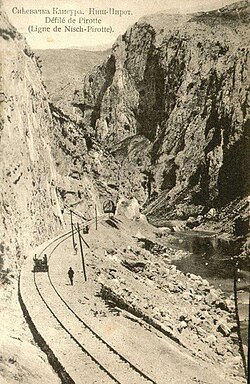
The Birth of Serbian National Railways
The formal establishment of Serbian Railways as a corporate entity dates back to 1881, when Prince Milan I declared the formation of the Serbian National Railways. The company marks August 23, 1884, as its official founding year, coinciding with the departure of the first train from Belgrade to Niš.
However, other specialized lines existed prior to this. In June 1882, the Serbian Copper & Iron Co. (a British-funded venture) launched a 12 km narrow-gauge track (600 mm) from the Majdanpek copper processing plant to Velike Livade. This line was primarily industrial but occasionally transported passengers.
Further expansion occurred in 1888 with the construction of an 80 km dual-purpose track (760 mm gauge) from the Vrška Čuka mine to the port of Radujevac on the Danube. This project was managed by the Brussels-registered Societé Anonyme "L'Industrielle Serbe," involving Belgian, French, Austro-Hungarian, and Serbian ownership.

The Yugoslav Era and Modernization
From the 1920s through the 1990s, the network operated as Yugoslav Railways, managing the rail systems for the Socialist Federal Republic of Yugoslavia. This period saw significant technological leaps, including the opening of the first electrified line between Belgrade and Šid in 1970 and the completion of the strategic Belgrade-Bar line in 1976, connecting the capital to the south Adriatic coast.
The 1990s brought severe challenges following the dissolution of Yugoslavia. The network suffered from a critical lack of infrastructure maintenance and a dramatic decline in cargo traffic. By 2000, the workforce stood at 32,832 employees, but the overall trend remained negative into the early 2000s.
Infrastructure Revitalization (2010–2015)
A turning point arrived in the early 2010s with a concerted effort to modernize rolling stock and infrastructure. In 2013, Serbian Railways entered an $840 million contract with RZD International to revitalize aging main lines. Key improvements included:
- Reconstruction of the Ruma to Golubinci section (Belgrade-Šid line) in 2014.
- Modernization of five sections on the Belgrade-Niš-Preševo line between 2015 and 2016, including Sopot-Kosmajski Kovačevac and Bujanovac-Bukarevac.
- The doubling of tracks and reconstruction of the Belgrade to Pančevo section on the Belgrade-Vršac line.
Corporate Restructuring and Current State
In March 2015, the Government of Serbia announced a strategic split of Serbian Railways into separate business entities to optimize operations. On August 10, 2015, three independent companies were founded:
- Srbijavoz: Responsible for passenger transport.
- Srbija Kargo: Responsible for cargo transport.
- Serbian Railways Infrastructure: Responsible for infrastructure management.
This restructuring led to a significant reduction in the workforce. Between 2016 and 2018, approximately 6,000 employees left with severance payments totaling 39 million euros. The total workforce across the four rail-related companies dropped from 17,635 in 2016 to roughly 11,500 in 2018, with further reductions planned to reach approximately 10,000 by 2020.
Key Facts
- First Rail Line: Inaugurated August 20, 1854 (Lisava-Oravica-Bazijaš).
- Official Company Founding: August 23, 1884 (Belgrade to Niš).
- First Electrified Line: Belgrade to Šid, opened in 1970.
- Major Modernization: $840 million contract with RZD International signed in 2013.
- Workforce Reduction: Total employees decreased from 32,832 in 2000 to a target of 10,000 by 2020.
| Period/Year | Key Event/Entity | Primary Focus |
|---|---|---|
| 1854 | First line (Lisava-Oravica-Bazijaš) | Horse-drawn, then steam transport |
| 1884 | Serbian National Railways | Official company establishment |
| 1920s-1990s | Yugoslav Railways | Federal network management |
| 2013 | RZD International Contract | Infrastructure modernization |
| 2015 | Corporate Split | Separation of Passenger, Cargo, and Infrastructure |
Frequently Asked Questions
When was the first railway line established on Serbian territory?
The first line was inaugurated on August 20, 1854, between Lisava, Oravica, and Bazijaš, initially using horse-drawn traffic.
What is the significance of the year 1884 for Serbian Railways?
August 23, 1884, is considered the official founding year of the company, marked by the first train departure from Belgrade to Niš.
Which companies were created during the 2015 restructuring?
The government established Srbijavoz (passenger transport), Srbija Kargo (cargo transport), and Serbian Railways Infrastructure (infrastructure management).
How did the workforce change between 2000 and 2020?
The workforce saw a massive decline from 32,832 employees in 2000 to a projected 10,000 by 2020, representing a reduction of nearly 70%.
What was the purpose of the 2013 RZD International contract?
The $840 million contract aimed to modernize aging infrastructure, specifically focusing on key sections of the main railway lines, such as the Belgrade-Šid and Belgrade-Niš-Preševo lines.