
Shark Bay World Heritage Site
Located in Western Australia, the Shark Bay World Heritage Site is a region of extraordinary ecological and geological significance. Negotiated and established as a World Heritage site in 1991, it was the first of its kind in the state. Its importance was further recognized on May 21, 2007, when it was added to the Australian National Heritage List under the Environment and Heritage Legislation Amendment Act (No. 1), 2003.
The site encompasses a vast area of 23,000 square kilometres, approximately 70 per cent of which consists of marine waters. This protected expanse includes the Shark Bay Marine Park, Francois Peron National Park, the Hamelin Pool Marine Nature Reserve, and the Zuytdorp Nature Reserve, along with several protected islands. While the towns of Denham and Useless Loop are within the site's boundaries, they are specifically excluded from the heritage designation.
Key Facts
- World Heritage Status: Granted in 1991; National Heritage List since 2007.
- Marine Biodiversity: Home to 12.5% of the global dugong population and over 323 fish species.
- Botanical Records: Contains the world's largest seagrass bank (Wooramel Seagrass Bank).
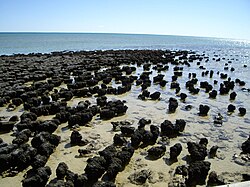
- Living Fossils: Hamelin Pool hosts the world's most diverse and abundant living stromatolites.
- Geography: Features a 1,500 km coastline and the dramatic Zuytdorp Cliffs.
Geography and Landforms
The bay spans 1,300,000 hectares with an average depth of 9 metres. Its complex geography is defined by shallow banks, numerous islands, and peninsulas. Along the coast, visitors can find 300 kilometres of limestone cliffs, including the striking Zuytdorp Cliffs. The region is uniquely positioned in a transition zone between two major botanical provinces and three major climatic regions.
The Peron Peninsula divides the bay and hosts the area's largest settlements and a National Park. To the north-west, Dirk Hartog Island serves as a historical landmark. In 1616, explorer Dirk Hartog landed at Inscription Point and left a pewter plate to mark his discovery. While the original plate is now housed in the Rijksmuseum in the Netherlands, a replica is displayed at the Shark Bay Discovery Centre in Denham.
Conservation efforts are central to the region's islands. Bernier and Dorre islands provide critical, predator-free habitats for the threatened hare-wallaby. These islands are used to release species bred at Project Eden in François Peron National Park. Additionally, the Australian Wildlife Conservancy manages Faure Island, where sea turtles nest seasonally under the study of the Department of Biodiversity, Conservation and Attractions.
Marine Life and Biodiversity
Shark Bay is a zoological powerhouse. It supports approximately 10,000 dugongs (sea cows), representing about 12.5% of the world's population. The waters are also famous for Indo-Pacific bottlenose dolphins, particularly at Monkey Mia, where they have been known for their friendliness since the 1960s. Some of these dolphins exhibit rare tool-use behavior, using sponges to protect their noses while foraging on the sandy sea floor.
The region is a vital sanctuary for 26 threatened Australian mammal species, nearly 150 reptile species, and over 230 bird species. It serves as a critical nursery for crustaceans, coelenterates (such as corals and jellyfish), and over 323 fish species, including various sharks and rays. The massive whale shark visits the bay during the full moons of April and May, while humpback and southern right whales use the area as a migratory staging post.
The Role of Seagrass and Hypersalinity
The bay hosts the largest known area of seagrass, covering over 4,000 square kilometres. This includes the Wooramel Seagrass Bank, the largest in the world, which features a 200-square-kilometre meadow of Posidonia australis formed by a single plant.
With twelve different species recorded—sometimes up to nine in one location—these seagrasses are the foundation of the local food chain. Over millennia, the accumulation of shell fragments and sediment within these meadows has raised the sea floor, making the bay shallower. This biological structure also restricts tidal flow, which, combined with a hot climate where evaporation exceeds precipitation, creates hypersaline conditions. Consequently, the water in the bay is 1.5 to 2 times saltier than the open ocean.
Stromatolites: Windows into Earth's Past
In the southern part of the bay, Hamelin Pool is home to stromatolites. These are microbialites—sedimentary structures built by cyanobacteria (blue-green algae). While fossilized stromatolites date back 3.5 billion years, the living examples in Hamelin Pool were only identified in 1956, providing a modern parallel to some of the earliest signs of life on Earth.
It is believed these structures began forming in Hamelin Pool about 1,000 years ago. There is ongoing scientific debate regarding their growth rates; they may grow up to 250 times slower than Precambrian examples, or previous estimates for ancient stromatolites may have been too high. Some researchers hypothesize that these organisms contain a unique form of chlorophyll known as chlorophyll f.
Summary of Shark Bay Features
| Feature | Detail |
|---|---|
| Total Area | 23,000 sq km (70% marine) |
| Key Species | Dugongs, Bottlenose Dolphins, Whale Sharks |
| Botanical Highlight | Wooramel Seagrass Bank (World's largest) |
| Geological Wonder | Living Stromatolites in Hamelin Pool |
| Water Condition | Hypersaline (1.5x to 2x ocean salinity) |
Visitor Information and Access
Visitors can learn more about the region at the Shark Bay World Heritage Discovery Centre in Denham, which offers interactive displays managed by the Shire of Shark Bay and the Department of Biodiversity, Conservation and Attractions.
Access to the region is available via Shark Bay Airport or by road via the World Heritage Drive, a 150-kilometre link connecting Denham to the Overlander Roadhouse on the North West Coastal Highway.
Frequently Asked Questions
What are stromatolites and why are they important?
Stromatolites are microbialites, which are sedimentary structures created by cyanobacteria. They are significant because they are among the earliest signs of life on Earth, with fossils dating back 3.5 billion years.
Why is the water in Shark Bay so salty?
The water is hypersaline because the region's hot, dry climate causes evaporation to exceed precipitation. Additionally, vast seagrass meadows restrict the tidal flow, preventing the ocean from diluting the salt concentration.
Which animals are protected on the islands of Shark Bay?
Bernier and Dorre islands are critical habitats for the threatened hare-wallaby. These islands are kept free of non-native feral animals to provide a safe haven for species bred at Project Eden.
What is unique about the dolphins at Monkey Mia?
The Indo-Pacific bottlenose dolphins at Monkey Mia are known for being particularly friendly toward humans since the 1960s. Some also exhibit tool-use behavior by using sponges to protect their noses while foraging.
What is the Wooramel Seagrass Bank?
It is the largest seagrass bank in the world, covering 1,030 square kilometres. It includes the world's largest single-plant meadow of Posidonia australis, spanning 200 square kilometres.