
Sherpa Mountaineering and the Perils of Mount Everest
In the high-altitude reaches of the Himalayas, the Sherpas are recognized as elite mountaineers and indispensable experts. While the term is often used broadly by foreigners to describe any guide or climbing supporter regardless of ethnicity, the Sherpa people possess a specialized skill set and hardiness that have made them vital to early explorers and modern expeditions alike.
Scientific speculation suggests that the remarkable climbing ability of the Sherpas may be rooted in genetic adaptations to high-altitude living. These biological advantages potentially include a unique hemoglobin-binding capacity and the production of double the amount of nitric oxide compared to those from lower altitudes.
The Danger of the Khumbu Icefall
One of the most treacherous segments of the ascent to Mount Everest is the Khumbu Icefall. An icefall is an area of turbulent ice flow, similar to a waterfall, which forms where a glacier bed narrows or steepens. Because the ice is in constant structural shift, the route through the icefall must be continuously updated.
Climbers must navigate this zone using ladders to cross crevasses—deep cracks in the ice that can reach depths of 50 meters (160 ft). Above them loom seracs, massive ice towers weighing several thousand tons that can collapse without warning. To minimize risk, passage is often attempted at night when lower temperatures make the ice more stable.
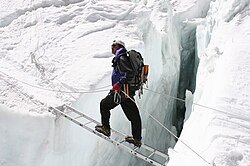
The statistics highlight the severity of this region. By 2017, 66 people had died in the Khumbu Icefall, including 29 victims of avalanches, nine due to collapsing icefall sections, and six who fell into crevasses.
Tragedies and Labor Struggles
The risks faced by Sherpas are significantly higher than those of their clients. While a foreign climber may pass through the icefall two or three times per season, Sherpas often traverse it up to 30 times. They are responsible for hauling luxury items and essential equipment to five different camps, setting everything up before the clients arrive.
On April 18, 2014, a serac collapse triggered an avalanche that killed 16 Nepalese Sherpa guides, marking the deadliest disaster in Everest's history at that time. This record was later surpassed on April 25, 2015, when an avalanche killed 22 people. Additionally, an earthquake in 2015 resulted in the deaths of 10 Sherpas at Everest base camp.
These tragedies sparked significant unrest. Following the 2014 disaster, the Nepalese government offered the families of the deceased 40,000 rupees (approximately US$400). Outraged by the lack of compensation and poor working conditions, many Sherpas went on strike, demanding better support and the cancellation of the climbing season out of respect for the dead.
Economic Impact and Human Cost
Mountaineering is a critical economic driver for Nepal, with Everest expeditions contributing $300 million to the economy in 2019. Sherpas typically earn up to $5,000 per two-to-three-month season for guiding international clients to the summit.
| Category | Detail/Statistic |
|---|---|
| Total Sherpa Deaths (1921–2018) | 118 |
| Proportion of Everest Deaths | Sherpas account for one-third |
| Typical Seasonal Earnings | Up to $5,000 |
| 2019 Economic Contribution | $300 million to Nepal |
| Khumbu Icefall Crevasse Depth | Up to 50 meters (160 ft) |
Key Facts
- Genetic Adaptation: Sherpas may have doubled nitric oxide production and unique hemoglobin-binding for high-altitude survival.
- High-Risk Zones: The Khumbu Icefall is one of the most dangerous areas due to shifting ice and massive seracs.
- Workload Disparity: Sherpas may cross the icefall 30 times a season, compared to 2-3 times for foreign clients.
- Deadliest Events: Avalanches in 2014 (16 deaths) and 2015 (22 deaths) are among the worst disasters in the mountain's history.
- Mortality: Between 1921 and 2018, 118 Sherpas died on Mount Everest.
Frequently Asked Questions
What is a serac?
A serac is a large tower or block of glacial ice. These structures are unstable and can collapse at any time, often triggering avalanches.
Why is the Khumbu Icefall so dangerous?
It is dangerous because it is an area of turbulent ice flow with ongoing structural shifts, deep crevasses, and the constant threat of collapsing seracs.
How do Sherpas differ biologically from other climbers?
It is speculated that Sherpas have genetic adaptations for high altitudes, including unique hemoglobin-binding capacity and increased nitric oxide production.
What caused the Sherpa strikes in 2014?
The strikes were caused by a lack of government compensation for deceased guides, poor working conditions, and a desire to cancel the season out of respect for those killed in a major avalanche.
How much do Sherpas earn for guiding a summit attempt?
During a typical two-to-three-month season, Sherpas can earn up to $5,000 for guiding international clients to the summit of Everest.