
Smiley Face Symbolism in Popular Culture and Commercial Applications
The smiley face is one of the most recognized symbols globally, transcending language barriers to communicate a simple message of happiness and positivity. While it may seem like a modern digital staple, the use of the smiling face in commercial and artistic contexts dates back over a century, evolving from detailed sketches to the minimalist yellow icon we recognize today.
Key Facts
- Earliest Commercial Use: First recorded in 1919 by the Buffalo Steam Roller Company.
- The Smiley Company: Founded following Franklin Loufrani's 1971 design for the newspaper France-Soir.
- Cultural Impact: Became a defining symbol of the 1980s acid house and electronic dance music (EDM) scenes.
- Commercial Success: Vittel saw an 11.8% sales increase using smiley-branded water bottles.
- Gaming Influence: Inspired iconic characters like Pac-Man and the Pokémon Ditto.
The Evolution of Advertising Campaigns
In the early to mid-20th century, smiling faces were primarily used in regional advertising in the Northeastern United States. The first known commercial application occurred in 1919, when the Buffalo Steam Roller Company in New York added stickers to receipts featuring a detailed face with eyebrows, a nose, and facial creases, similar to the "man-in-the-Moon" style.
By 1922, the Gregory Rubber Company of Ohio advertised "smiley face" balloons in The Billboard, utilizing a design with pie eyes and hair. Later, in 1953 and 1958, promotional campaigns for the films Lili and Gigi employed similar imagery. However, the symbol became a widespread advertising theme in the 1960s, particularly after the WMCA adopted a yellow and black color scheme. Today, this legacy continues with major corporations, such as Walmart, using the smiley face as a mascot.
Impact on Print, Comics, and Literature
The comics and cartoons industry was among the first to widely adopt the smiley. In 1971, Franklin Loufrani designed a smiling face for the French newspaper France-Soir to highlight "feel-good news," a move that eventually led to the creation of The Smiley Company. Shortly after, in 1972, Mad magazine featured twenty smileys on its April cover, with one notably pulling a face.
DC Comics has integrated the symbol into its narratives through characters like "Boss Smiley," a political boss with a smiley face for a head. More darkly, the Watchmen comic series uses a blood-splattered smiley badge worn by the Comedian as a central plot device.

The cultural trajectory of the symbol was further documented in 2022 by Assouline in the publication 50 Years of Good News.
Music, Film, and Subcultures
From the 1970s onward, various music genres adopted the smiley to signal specific cultural identities. The American band Dead Kennedys used smileys on their "California über alles" single cover, replacing swastikas on Nazi-style banners to create a provocative collage.
In the United Kingdom, the symbol became intertwined with psychedelic culture and later the acid house movement during the late 1980s "Second Summer of Love." This association was strengthened when the band Bomb the Bass used a smiley from Watchmen on their hit single "Beat Dis." DJ Danny Rampling is often credited with sparking this trend by using the smiley for Paul Oakenfold's birthday.
Cinema has also utilized the icon in various ways. In Forrest Gump (1994), it is implied that the main character inspired the design. The film Evolution (2001) and its spin-off Alienators: Evolution Continues feature a three-eyed smiley logo. More recently, David Guetta's 2022 music video for "Silver Screen" collaborated with street artist André Saraiva to promote the message "Take The Time To Smile."
Physical Products and Global Markets
The psychological impact of the smiley face has proven lucrative. In 2017, Vittel released special edition water bottles featuring the icon, resulting in 128 million bottles sold across Europe and an 11.8% increase in sales compared to standard packaging.
Asia has seen a significant boom in smiley-themed merchandise. In China, 15 stores opened by the end of 2024 in cities including Guangzhou, Suzhou, and Xiamen, with projections suggesting the number could reach 50 by 2027. Thailand also saw the opening of three stores in 2024.
Art, Fashion, and Gaming
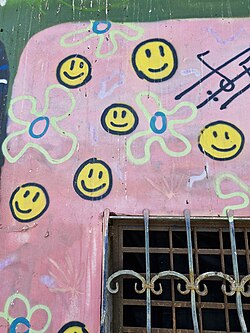
The smiley has been a tool for both high fashion and street art. Banksy, the anti-consumerist graffiti artist, incorporated the symbol into his 2004 Flying Copper portrait and his 2005 "grin reaper" piece. In the fashion world, the symbol has appeared in collections for Moschino, Pull & Bear, H&M, Zara, Fendi, and Moncler. High-end jeweler Valerie Messika even produced smiley pendants in white and yellow gold.
In the gaming industry, the yellow face is iconic. Namco's Pac-Man (1980) is perhaps the most famous example. In Battlefield: Bad Company (2008), a yellow smiley appeared on grenades, becoming a series staple. The Atari ST game MIDI Maze (also known as Faceball 2000) featured smileys as enemies that taunted players with the phrase "Have a nice day." Additionally, the Pokémon Ditto is based on the smiley face design.

Public Events and Social Science
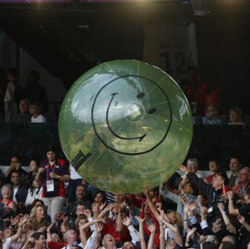
The smiley is frequently used in public installations to boost morale. During the London 2012 Olympics opening ceremony, large smiley-face balls were released into the crowd.
Other notable displays include an 82-foot-wide projection on the Brooklyn Bridge in 2020 and global projections on landmarks, such as the Seoul Tower, for the International Day of Happiness in 2022.
Beyond aesthetics, user experience researchers have found that using smileys in answer scales for cross-cultural surveys can reduce challenges related to translation and implementation.
| Sector | Key Example | Notable Impact/Detail |
|---|---|---|
| Advertising | Buffalo Steam Roller Co. | First known commercial use (1919) |
| Music | Acid House / EDM | Symbol of 1980s dance culture |
| Gaming | Pac-Man / Ditto | Yellow-faced character design |
| Fashion | Moschino / Fendi | Integration into high-end luxury lines |
| Retail | Vittel | 11.8% increase in sales via "feel-good effect" |
Frequently Asked Questions
When was the first commercial use of a smiley face?
The first known commercial use was in 1919 by the Buffalo Steam Roller Company in Buffalo, New York, which used stickers on receipts featuring a detailed smiling face and the word "thanks."
Who created the modern "smiley" term and company?
Franklin Loufrani used the word "smiley" when designing a face for the newspaper France-Soir in 1971 to highlight feel-good news, which eventually led to the formation of The Smiley Company.
How is the smiley face linked to electronic dance music?
The smiley became a symbol of 1980s dance music, particularly acid house, after being used by DJ Danny Rampling and later by the band Bomb the Bass on their "Beat Dis" single.
Which video games feature the smiley face?
Notable examples include Pac-Man, Battlefield: Bad Company (where it appears on grenades), MIDI Maze (Faceball 2000), and the Pokémon franchise via the character Ditto.
Does the smiley face have any practical use in research?
Yes, user experience researchers use smileys in survey answer scales to help overcome translation and implementation hurdles in cross-cultural studies.