
Staffan de Mistura: The UN Special Envoy's Mission in Syria
On July 10, 2014, UN Secretary-General Ban Ki-moon appointed Staffan de Mistura as the Special Envoy for Syria. His primary mandate was to seek a peaceful resolution to the devastating conflict that had already gripped the nation. De Mistura's tenure was marked by complex diplomatic maneuvers and a persistent effort to transition the conflict from military confrontation to a political process.
Diplomatic Strategies and Challenges
One of de Mistura's central strategies involved the creation of localized "freezes"—temporary halts in fighting in specific areas. The goal was to replicate these freezes across the country, combining them with political, administrative, and humanitarian initiatives to build a foundation for a broader political settlement. However, this approach was not without controversy; Mouin Rabbani, a former staff member in de Mistura's office, later criticized the strategy as a "gimmick."
The urgency of the crisis was most evident in October 2016 during the battle for Aleppo. With at least 200,000 civilians trapped in Eastern Aleppo, de Mistura offered to personally escort rebel fighters out of the city to prevent further bombing. He warned that without such an agreement, the city would be completely destroyed within two months, resulting in thousands of civilian deaths. While the Al-Nusra Front initially refused the offer, they eventually left Aleppo in December.
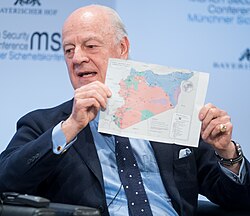
A Legacy of Mediation
By 2018, de Mistura had become the longest-serving of the three UN mediators assigned to the conflict, following Kofi Annan and Lakhdar Brahimi. After four and a half years in the role, he announced his departure for personal reasons, stepping down at the end of November 2018.
In his final briefing to the Security Council on December 20, 2018, de Mistura reflected on the progress and shortcomings of his mandate. He emphasized that while the UN's efforts were vital, they could not replace the need for influential countries to work constructively with one another.
Achievements and Unfinished Business
De Mistura identified several key outcomes from his tenure:
- Life-saving measures: Limited ceasefires and de-escalations saved lives and improved humanitarian access, though not to the extent civilians required.
- Political Dialogue: He convened the government and opposition and assisted in uniting the opposition, though the parties failed to fully recognize each other as legitimate negotiating partners.
- Frameworks for Peace: Key principles for a future settlement and a clear negotiation agenda were established, but real implementation mechanisms remained elusive.
- Inclusivity: He strongly promoted the participation of civil society and Syrian women—who make up more than half the population—despite constant challenges to these efforts.
- Constitutional Reform: Work was nearly completed on a constitutional committee to draft reforms, though the final steps remained.
He concluded by noting that while the requirements for UN-supervised elections and a neutral environment were known, the full work to realize them had not yet begun.
Key Facts
- Appointment Date: July 10, 2014, by Secretary-General Ban Ki-moon.
- Tenure: The longest-serving of three UN mediators (including Kofi Annan and Lakhdar Brahimi).
- Successor: Geir Pedersen.
- Key Intervention: Offered personal escort for rebels in Aleppo in October 2016 to protect 200,000 civilians.
- Core Strategy: Implementation of localized "freezes" to transition toward a political process.
| Category | Details |
|---|---|
| Role | UN Special Envoy for Syria |
| Duration | July 2014 – November 2018 |
| Primary Goal | Peaceful resolution of the Syrian conflict |
| Major Challenges | Lack of party recognition, limited international cooperation, and urban warfare in Aleppo |
| Key Contributions | Constitutional committee progress, promotion of women's involvement, and temporary ceasefires |
Frequently Asked Questions
Who appointed Staffan de Mistura as the Special Envoy for Syria?
He was appointed by the United Nations Secretary-General Ban Ki-moon on July 10, 2014.
What was the "freeze" strategy mentioned in his mandate?
The strategy involved establishing localized freezes in fighting that could be replicated elsewhere, combined with humanitarian and political initiatives to lay the groundwork for a new political process.
How did de Mistura attempt to help civilians in Aleppo?
In October 2016, he offered to personally escort rebel fighters out of Eastern Aleppo to stop the bombing and protect at least 200,000 civilians caught in the battle.
What did de Mistura believe was the biggest obstacle to peace?
He stated that UN work is no substitute for genuine efforts by influential countries to talk to each other and work constructively.
Who succeeded Staffan de Mistura in his role?
He was succeeded by Geir Pedersen.