
Steer Wrestling: The Art and Technique of the Bulldogger
Steer wrestling, often referred to as bulldogging, is a high-energy rodeo event that tests the strength, timing, and agility of both horse and rider. The objective is simple yet demanding: a mounted cowboy must catch a running steer, dismount his horse, and wrestle the animal to the ground as quickly as possible.
The event involves a coordinated effort between several participants. The steer is guided through narrow pathways into a chute equipped with spring-loaded doors. To ensure the steer has a fair head start, a barrier rope is fastened around its neck, with the length of the rope determined by the specific dimensions of the arena.
The Roles and the Run
Two primary riders are essential to every run. On one side of the chute is the hazer, whose responsibility is to ride parallel to the steer once it is released, ensuring the animal runs in a straight line. On the opposite side is the steer wrestler (the bulldogger), who waits behind a taut rope barrier held in place by a breakable string connected to the steer.
The action begins when the steer wrestler "calls" for the steer with a nod of his head. The chute man then trips a lever to open the doors. As the steer breaks out and is shadowed by the hazer, it eventually reaches the end of its rope. This action pops the rope off and simultaneously releases the barrier, signaling the steer wrestler to charge.
The wrestler must accelerate to catch the steer, lean over the side of his galloping horse, and grab the steer's horns. The momentum of the slowing steer pulls the wrestler off the horse and onto the dirt. By planting his heels and manipulating the steer's head and nose, the wrestler pulls the animal off balance and throws it to the ground.
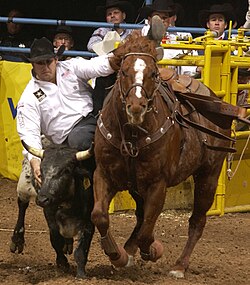
The run officially ends when all four of the steer's legs are off the ground, at which point an official waves a flag to stop the clock. The steer is then released to trot away.
Technical Execution
Mastering the wrestle requires a specific sequence of physical movements. The wrestler leans from the galloping horse, applying the weight of his upper body to the steer's neck. He typically grasps the near horn with one hand and the far horn in the crook of his other elbow.
As the horse carries his feet along the steer, the wrestler naturally falls out of the stirrups. He slides with his feet turned slightly to the left, twisting the steer's head by pushing down with the near hand and pulling up and in with the far elbow. To complete the throw, he releases the near horn, secures the steer's nose in the crook of his left elbow, and throws his weight backward to unbalance the animal.
Key Facts
- Professional Times: Typically range from 3.0 to 10 seconds.
- Steer Weight: Generally between 450 and 650 pounds.
- Wrestler Weight: Typically ranges from 180 to 300 pounds.
- Cattle Breeds: Most commonly Corriente or Longhorn cattle.
- Safety: Injury rates are higher than speed events but lower than bull or bronc riding.
Rules and Regulations
To maintain fairness and safety, steer wrestling is governed by strict rules. A critical requirement is that the bulldogger's horse must not break the rope barrier before the steer releases it; doing so results in a 10-second penalty.
If a steer stumbles or falls before the wrestler brings it down, the bulldogger must either wait for the animal to rise or assist it back up before attempting the wrestle. If the wrestler completely misses the steer during his descent from the horse, he is awarded a "no time" for the run.
| Category | Details |
|---|---|
| Common Steer Breeds | Corriente, Longhorn |
| Steer Weight Range | 450–650 lbs |
| Wrestler Weight Range | 180–300 lbs |
| Typical Event Duration | 3.0–10 seconds |
| Barrier Penalty | 10 seconds |
Frequently Asked Questions
What is the role of the hazer in steer wrestling?
The hazer rides parallel to the steer after it leaves the chute to ensure the animal continues running in a straight line, making it possible for the steer wrestler to make a clean catch.
What happens if the wrestler breaks the barrier rope early?
If the bulldogger's horse breaks the rope barrier before the steer releases it, a 10-second penalty is added to the final time.
How is the official end of a run determined?
The run ends when all four of the steer's legs are off the ground, at which point an official waves a flag to mark the time.
What happens if the steer falls on its own?
If the steer stumbles or falls before the wrestler brings it down, the wrestler must wait for the steer to get up or help it up before proceeding with the wrestle.
What are the typical weights of the animals and athletes involved?
The steers generally weigh between 450 and 650 pounds, while the steer wrestlers typically weigh between 180 and 300 pounds.