
Stilfragen and the Evolution of Artistic Ornament
The study of artistic style often fluctuates between the influence of technology and the drive of human creativity. In the seminal work Stilfragen, the evolution of ornament is analyzed not as a byproduct of technical tools, but as a continuous, coherent development driven by an internal artistic impulse. By examining the transition from prehistoric lines to the complex patterns of the Ottoman era, the text challenges the notion that art is merely a reflection of available machinery or a direct copy of nature.
Key Facts
- Artistic Drive: Ornament originates from an immanent human drive rather than technical processes like weaving.
- Geometric Origins: Early geometric patterns evolved from attempts to represent natural forms in two dimensions.
- Heraldic Symmetry: Paired animal compositions stem from a desire for symmetry, not the constraints of silk-weaving looms.
- Vegetal Evolution: Plant-based motifs, such as the lotus, often lose their original symbolic meaning to become purely decorative.
- The Arabesque: This style is a geometricized version of ancient tendril ornaments, linking antiquity to Islamic art.
The Geometric and Heraldic Styles
The foundation of ornamental history begins with the Geometric Style. Contrary to theories suggesting that these patterns were inspired by wickerwork or weaving, evidence from Stone Age European art—specifically discoveries in the Dordogne—suggests a deeper origin. The process began with the "invention of line," where early humans attempted to flatten natural forms into two dimensions. Once the outline was established, these lines were arranged using principles of rhythm and symmetry.
Following this is the Heraldic Style, characterized by paired animals arranged symmetrically around a central element. While previous scholars, such as Ernst Curtius, attributed this style to the technical requirements of silk-weaving, the analysis in Stilfragen argues that this symmetry was a conscious artistic choice that existed before the invention of mechanical weaving-looms.
The Development of Vegetal Ornament
The transition into Vegetal Ornament marks a shift toward organic forms, tracing a path from ancient Egypt through late Roman art. A key observation here is the shift from symbolism to decoration; for example, the lotus flower may have held hieratic (sacred or symbolic) meaning for Egyptians, but subsequent cultures adopted it purely for its aesthetic value.
One of the most significant revisions in this study concerns the acanthus ornament. While Vitruvius and others believed it was a direct copy of the acanthus plant, it is actually a sculptural adaptation of the palmette motif (a fan-shaped leaf design). This proves that such ornaments are products of pure artistic invention rather than a compulsion to mimic living organisms.
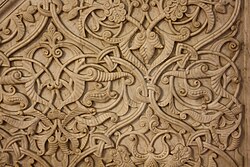
The Arabesque and Islamic Art
The evolution of the ornamental tendril culminates in the Arabesque, which spans late antique, early Byzantine, and Islamic art. The arabesque is defined as a geometricized version of earlier tendril systems. This establishes a direct genetic relationship between the ornamental tendrils of antiquity and those found in Islamic art, showing a seamless progression of style.
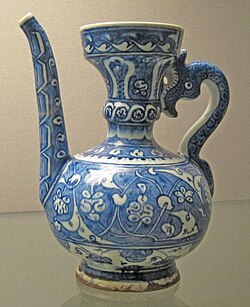
Ultimately, the history of ornament from ancient Egypt to Ottoman Turkey demonstrates that motifs develop according to artistic criteria. This continuous development suggests that ornament evolves with the same coherence found in all periods of art, independent of mimetic (imitative) concerns or technical limitations.
| Style | Primary Characteristic | Origin/Driver |
|---|---|---|
| Geometric | Rhythmic lines and symmetry | Two-dimensional representation of nature |
| Heraldic | Symmetrical paired animals | Inherent desire for symmetry |
| Vegetal | Lotus, Palmette, Acanthus | Artistic invention and adaptation |
| Arabesque | Geometricized tendrils | Evolution of ancient tendril systems |
Frequently Asked Questions
Did weaving techniques inspire early geometric art?
No. The evidence suggests that geometric ornament arose from an immanent artistic drive and the attempt to represent natural forms in two dimensions, occurring long before the invention of woven coverings.
What is the relationship between the acanthus ornament and nature?
Contrary to traditional beliefs, the acanthus ornament is not a direct copy of the acanthus plant but is instead a sculptural adaptation of the palmette motif, making it a product of artistic invention.
How did the meaning of the lotus flower change over time?
While the lotus flower originally possessed symbolic or hieratic significance in ancient Egypt, it was later adopted by other cultures as a purely decorative element.
What is the origin of the Arabesque?
The arabesque is a geometricized version of earlier tendril ornaments, creating a direct link between the artistic styles of antiquity and Islamic art.
Is the evolution of ornament driven by technology?
No, the development of these styles is presented as a continuous history driven by purely artistic criteria rather than technical constraints or the need to mimic nature.