
Stonorov: A Legacy of Modernist Architecture and Urban Planning
The trajectory of 20th-century American architecture was shaped by pivotal collaborations and a commitment to functional urban living. Among these influential figures was Stonorov, an architect whose work in Pennsylvania helped redefine the relationship between residential design and city planning.
The Formative Partnership with Louis Kahn
Stonorov's career is marked by a significant professional relationship with the renowned architect Louis Kahn. Their collaboration began in 1940, when they worked alongside George Howe on various housing developments across Pennsylvania. This initial cooperation evolved into a formal architectural office partnership that spanned from February 1942 to March 1947.
During this five-year partnership, the duo was remarkably prolific, producing fifty-four known projects and structures. Beyond physical buildings, they shared a deep interest in the theoretical side of urban development. In 1943, they co-authored Why City Planning Is Your Responsibility, followed by a 1944 primer titled You and Your Neighborhood... A Primer for Neighborhood Planning.
Influence and Later Collaborations
The office of Stonorov served as a breeding ground for future architectural talent. Between 1950 and 1954, Robert Venturi—a future Pritzker Prize winner (the highest honor in architecture) who would later work directly for Louis Kahn—worked within Stonorov's firm.
In 1957, Stonorov entered a new partnership with Frank Haws. Together, they designed the Palace Hotel in Philadelphia, completed in 1963. They also collaborated with Mansinh Rana to create the Indian Pavilion for the 1964 New York World's Fair.
Modernist Public Housing in Philadelphia
Based near Philadelphia, Stonorov focused heavily on modernist public housing—a style emphasizing simplicity, functionality, and the use of industrial materials to provide quality living spaces for the general public. His most notable achievement in this sector was the design of the Carl Mackley Houses.
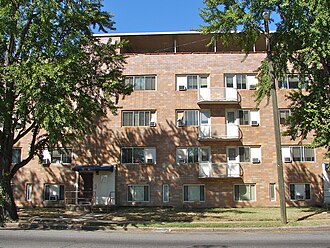
The Carl Mackley Houses are recognized for their historical and architectural significance. The development was added to the Philadelphia Register of Historic Places in 1982 and later earned a spot on the National Park Service's National Register of Historic Places in 1998. Interestingly, because Stonorov was not a registered architect in the United States at the time of construction, William Pope Barney was appointed as the chief architect to facilitate the acquisition of necessary city permits.
Key Facts
- Partnership with Louis Kahn: Lasted from February 1942 to March 1947, resulting in 54 known projects.
- Urban Planning Literature: Co-authored two influential planning guides in 1943 and 1944.
- Notable Mentorship: Robert Venturi worked in Stonorov's office from 1950 to 1954.
- Historic Landmark: The Carl Mackley Houses are listed on both the Philadelphia and National Registers of Historic Places.
- Major Works: Includes the Palace Hotel (1963) and the Indian Pavilion for the 1964 New York World's Fair.
| Period/Year | Collaborator/Project | Key Outcome |
|---|---|---|
| 1942–1947 | Louis Kahn | 54 projects and structures |
| 1943–1944 | Louis Kahn | Two urban planning publications |
| 1950–1954 | Robert Venturi | Venturi employed in Stonorov's office |
| 1957–1964 | Frank Haws | Palace Hotel and Indian Pavilion |
| 1982/1998 | Carl Mackley Houses | Added to Historic Registers |
Frequently Asked Questions
Who was Stonorov's most significant early partner?
Stonorov's most significant early partner was Louis Kahn. They worked together from 1940 and maintained a formal partnership from 1942 to 1947, producing dozens of projects.
What is the significance of the Carl Mackley Houses?
The Carl Mackley Houses are a prime example of modernist public housing. Their architectural value is recognized by their inclusion in the Philadelphia Register of Historic Places (1982) and the National Register of Historic Places (1998).
Why was William Pope Barney involved in Stonorov's projects?
William Pope Barney served as the chief architect for the purpose of obtaining city permits because Stonorov was not registered as an architect in the United States at that time.
Which famous architect worked for Stonorov in the 1950s?
Robert Venturi, who later became a Pritzker Prize winner, worked in Stonorov's offices between 1950 and 1954.
What other major projects did Stonorov design with Frank Haws?
With Frank Haws, Stonorov designed the Palace Hotel in Philadelphia (1963) and the Indian Pavilion for the 1964 New York World's Fair, the latter of which also involved Mansinh Rana.