
Straight-Four Engines: Design, Displacement, and Balance
The straight-four engine, also known as the inline-four, is one of the most common configurations in modern automotive design. Its popularity stems from a balance of efficiency, cost, and simplicity. Unlike V4 or flat-four layouts, the straight-four utilizes a single cylinder head, which significantly reduces production costs and mechanical complexity.
In a four-stroke cycle, this configuration ensures that there is always a cylinder on its power stroke, providing a more consistent delivery of energy than engines with fewer cylinders.
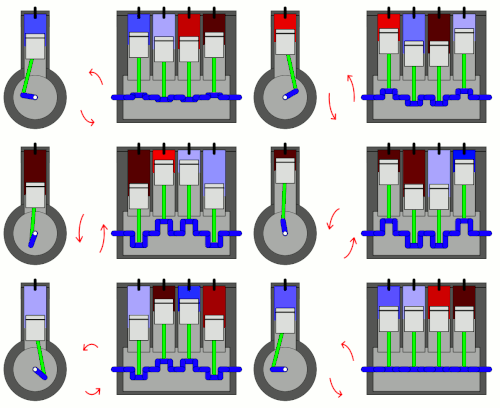
Key Facts
- Simplified Construction: Uses only one cylinder head, lowering costs compared to V or flat configurations.
- Primary Balance: Naturally achieves perfect primary balance as pistons move in opposing pairs.
- Secondary Imbalance: Prone to up-and-down vibrations at twice the crankshaft speed due to piston acceleration differences.
- Displacement Range: Varies widely from 660 cc in Japanese kei cars to over 5 L in commercial trucks.
- Vibration Control: Balance shafts, such as Mitsubishi's "Silent Shaft," are often used in larger engines to counteract secondary imbalance.
Engine Displacement and Applications
Displacement—the total volume of all cylinders in an engine—varies greatly depending on the vehicle's purpose. In modern passenger cars, petrol straight-four engines typically range between 1.3 and 2.5 liters. While most stay within this window, some exceptions exist, such as the 3.0 L engines found in the Porsche 944 and 968, or the historic 4.5 L Bentley from the late 1920s.
Diesel engines often utilize larger displacements to generate more torque. For example, Mitsubishi produced a 3.2 L turbocharged engine for the Pajero/Shogun/Montero, and Toyota developed a 3.0 L variant. In the commercial sector, European and Asian trucks with gross vehicle weight ratings between 7.5 and 18 tonnes frequently employ inline-four diesels around 5 L. Even larger displacements are reserved for stationary, marine, and locomotive engines.
At the other end of the spectrum are Japanese kei cars. These vehicles have historically adhered to strict regulations, with displacements previously capped at 550 cc and currently limited to 660 cc.
The Mechanics of Balance and Vibration
Primary and Secondary Balance
A well-configured straight-four engine possesses perfect primary balance. This occurs because the pistons move in pairs; while one pair ascends, the other descends, canceling out the primary forces.
However, these engines suffer from secondary imbalance. This is caused by the fact that connecting rods are not infinitely long, meaning pistons accelerate and decelerate faster during the top half of the crankshaft rotation than during the bottom half. Because two pistons always move together, this creates a dynamic imbalance resulting in a vertical vibration that occurs at twice the speed of the crankshaft.
The intensity of this vibration is influenced by the reciprocating mass, the peak piston velocity, and the ratio of the connecting rod length to the stroke. Consequently, small engines with light pistons or racing engines with long connecting rods experience less vibration. However, the effect increases quadratically as engine speed (RPM) rises.
Power Delivery Pulsations
While engines with five or more cylinders can maintain a power stroke at any given moment, four-cylinder engines experience gaps in power delivery. Each cylinder completes its power stroke before the next begins, leading to a pulsating delivery that generates more vibration than higher-cylinder counts.
Mitigating Vibration with Balance Shafts
To combat secondary imbalance, especially in larger displacement engines, engineers often implement a balance shaft system. Invented in 1911, this system uses two shafts with eccentric weights that rotate in opposite directions at twice the crankshaft's speed to cancel out vibrations.
Mitsubishi Motors patented a version of this in the 1970s, branding it the "Silent Shaft" for the Mitsubishi Astron engine. This technology was subsequently licensed to various other manufacturers.
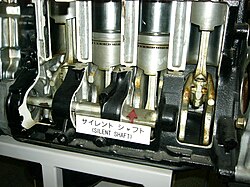
Not all large straight-fours require these shafts. Some engines, such as the 2.4 L Citroën DS, the 2.6 L Austin-Healey 100, the 2.5 L GM Iron Duke, and the 3.3 L 1927 Ford Model A, operated without them. Similarly, Soviet GAZ Volga and UAZ engines (up to 2.9 L) omitted balance shafts because they were low-revving engines, which naturally reduced the severity of the imbalance.
| Feature | Characteristic | Impact/Note |
|---|---|---|
| Cylinder Head | Single | Lower complexity and cost |
| Primary Balance | Perfect | Pistons move in opposing pairs |
| Secondary Balance | Imbalanced | Causes vibration at 2x crankshaft speed |
| Power Delivery | Pulsating | Gaps between power strokes |
| Vibration Solution | Balance Shafts | Common in larger displacement engines |
Frequently Asked Questions
Why is a straight-four engine cheaper to produce than a V4?
A straight-four engine only requires a single cylinder head, whereas a V4 engine requires two, which increases the number of parts and the complexity of the manufacturing process.
What causes the secondary imbalance in these engines?
It is caused by the acceleration and deceleration of the pistons. Because connecting rods have a finite length, pistons move faster in the top half of the crankshaft rotation than in the bottom half, creating a dynamic up-and-down vibration.
What is a "Silent Shaft"?
The Silent Shaft is a balance shaft system patented by Mitsubishi Motors in the 1970s. It uses two shafts with eccentric weights rotating at twice the crankshaft speed to neutralize secondary vibrations.
Do all large straight-four engines need balance shafts?
No. Some large engines, such as the GM Iron Duke or various Soviet GAZ engines, did not use them. In many cases, keeping the engine's operating RPM low reduces the need for such a system.
How does displacement differ between petrol and diesel straight-fours?
Modern petrol straight-fours typically range from 1.3 to 2.5 L. Diesel versions are often larger, with some SUV engines reaching 3.2 L and commercial truck engines reaching around 5 L.