
Stratford Works: A History of Railway Engineering and Innovation
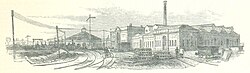
For over 150 years, Stratford Works served as a cornerstone of British railway engineering. From its humble beginnings as a maintenance hub to its peak as a massive industrial complex capable of building locomotives in record time, the site mirrored the evolution of the UK's rail network. Today, while the workshops have been replaced by the modern infrastructure of Stratford International and Westfield Stratford City, the legacy of the site remains a testament to Victorian ambition and industrial resilience.
The site's journey began in 1840, initiated by the Northern and Eastern Railway. The earliest facility was a roundhouse known as the Polygon, designed by the legendary Robert Stephenson. By 1847, the Eastern Counties Railway expanded the site to accommodate its growing needs, creating a hub so significant that the surrounding area was known for years as "Hudson Town," named after the "Railway King" George Hudson.
Key Facts
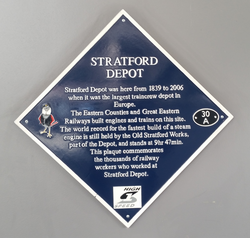
- Record-Breaking Speed: In 1891, a Class Y14 tender engine was built in just 9 hours and 47 minutes.
- Massive Workforce: Employment grew from 1,000 men in 1850 to approximately 6,500 by 1912.
- Diverse Production: Beyond locomotives, the works produced everything from steam breakdown cranes to an elephant van.
- War Effort: During WWII, the site pivoted to manufacture artillery parts, aircraft components, and tank parts.
- Longevity: The final portion of the works, the Engine Repair Shed, remained operational until March 31, 1991.
The Great Eastern Railway Era (1862–1922)
The takeover by the Great Eastern Railway (GER) in 1862 marked a period of immense growth. The works expanded northward and westward, incorporating new locomotive sheds at a site often called High Meads. Between 1870 and 1900, the facility produced roughly 960 locomotives.
The GER era was characterized by specialized departments. While locomotive building flourished, the works also managed carriage painting—sometimes outsourcing to Felixstowe Beach station to handle the volume—and moved wagon maintenance to the Temple Mills Wagon Works in 1896. One of the most notable technical achievements of this era was the Macallan blastpipe, patented in 1888 by George Macallan and Charles Adams, which was fitted to approximately 700 GER locomotives.
Industrial Capacity and Specialization
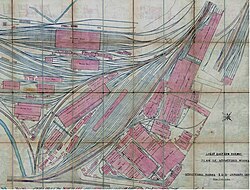
By 1912, the works had become a city within a city. In that year alone, 39 new locomotives and 82 carriages were constructed. The facility's versatility was highlighted by the production of non-passenger vehicles, including horse boxes and a specialized elephant van.
The Impact of World War I
During the Great War, Stratford Works shifted its focus to support the military. This included the manufacture of munitions and the construction of a hospital train. To handle the predicted increase in rail traffic, a new Engine Repair Shed was opened in 1915 on the western side of the site. The works even performed unusual tasks, such as building numbered henhouses for the GER farm in Suffolk and repairing Belgian locomotives evacuated during the German invasion.
Facilities and Infrastructure in 1921
At the time of the 1921 grouping, the works were divided into highly specialized "shops." The original site housed the heavy engineering components, while carriage works were split between two main areas, CD1 and CD2.
| Department/Shop | Primary Function | Key Detail |
|---|---|---|
| Erecting and Fitting Shop | Locomotive assembly | Could accommodate up to 50 engines |
| Boiler Shop | Boiler construction | Six bays; damaged during 1941 bombings |
| New Iron Foundry | Castings production | Capacity of 85 tons of castings per week |
| Engine Paint Shop | Final finishing | Locomotives painted after successful trial trips |
| Carriage Body Shop (CD1) | Carriage construction | 50,000 square feet of workspace |
| Engine Repairing Shop | Light repairs | Opened 1915; last part of works to close (1991) |
Power and Lighting
The works operated its own generating station, providing three-phase 50 Hz alternating current. Additionally, an oil gas works established in 1877 using the Pintsch principle supplied gas for carriage lighting. This gas was distributed via a fleet of 41 tank wagons to outlying stations until the plant finally closed in 1960.
Transition to LNER and British Railways (1923–1991)
In 1923, the works passed to the London and North Eastern Railway (LNER). While locomotive construction ceased shortly after—with the N7 0-6-2T being the final model built—the site remained vital for maintenance. During World War II, the works suffered damage from the London Blitz and a V2 rocket, yet continued to produce critical military hardware and prepare US Army Class S160 locomotives for service.
Following the nationalization of railways in 1948, the site transitioned to British Railways. The original steam-era site ceased operations in 1963, and the 1915 shed was converted into a diesel locomotive repair shop. In its final decade, the works were often used to "cannibalize" older diesel classes for spare parts to keep the remaining fleet operational.
Frequently Asked Questions
What was the fastest locomotive ever built at Stratford Works?
While not the fastest in terms of speed, the Class Y14 tender engine holds the record for the fastest construction time, being completed in 9 hours and 47 minutes in 1891.
What happened to the site after the works closed?
The site was repurposed for the Stratford London International Freight Terminal in the 1970s and later became the location for the Stratford International station and the Westfield Stratford City shopping centre.
Did the works produce anything other than trains?
Yes. The works produced steam breakdown cranes, munitions, artillery parts, aircraft components, and even henhouses for a GER farm during World War I.
Who were the key leaders of the works?
Notable figures include the early resident engineer John Braithwaite and several Locomotive Superintendents, most notably James Holden (1885–1907) and Alfred John Hill, who became the Chief Mechanical Engineer in 1915.
When did the very last part of the works close?
The Engine Repairing Shop, which had opened in 1915, was the final section to remain operational, closing its doors on March 31, 1991.