
Swedish Riksdag Elections: System and Results
The Riksdag, Sweden's unicameral parliament, is the central legislative body of the nation. Every four years, the Swedish people participate in general elections to determine the composition of this body, ensuring that the government reflects the current will of the electorate through a sophisticated system of proportional representation.
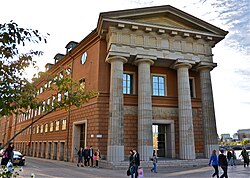
The offices of the parliament are housed in several buildings, including the former Royal Mint on Mynttorget Square.
Key Facts
- Total Seats: 349 members are elected to the Riksdag.
- Election Cycle: General elections are held every four years.
- Voting Age: Swedish citizens must be 18 years old by election day.
- Entry Threshold: Parties generally need 4% of the national vote or 12% in a single constituency to enter parliament.
- System Type: Proportional representation using both fixed and adjustment seats.
Eligibility and Candidacy
To be eligible to vote in the general elections, an individual must be a Swedish citizen, be at least 18 years old no later than the day of the election, and have been registered as a resident at some point. Those wishing to stand for election must meet these same voting eligibility requirements and be nominated by a political party.
Sweden minimizes the need for by-elections by electing substitutes for each deputy simultaneously during the general election. In the event of a snap election, the newly elected members do not start a fresh four-year term but instead serve the remainder of the existing term.
The Electoral System
Sweden employs a proportional electoral system, meaning the distribution of seats closely mirrors the percentage of votes each party receives. The 349 seats are divided into two categories:
Fixed Constituency Seats
There are 310 fixed constituency seats distributed across 29 multi-member constituencies. These are allocated based on the number of eligible voters within each specific region.
Adjustment Seats
To ensure the final national result is truly proportional, 39 adjustment seats are used. These seats correct any deviations from the national distribution that occur during the allocation of the fixed constituency seats.
The Threshold Requirement
To prevent extreme fragmentation, a party must meet a specific threshold to participate in the seat distribution. A party must receive at least 4% of the total national vote to enter the Riksdag. However, a party can still gain representation if it secures 12% or more of the votes within a single constituency, allowing it to participate in the distribution of fixed seats for that area.
2022 Election Results
The 2022 elections saw a high level of engagement, with a registered voter turnout of 84.21% (according to the Election Authority). The results highlighted a close competition between two primary political blocs.
| Party | Votes | Percentage (%) | Seats | Change (+/-) |
|---|---|---|---|---|
| Swedish Social Democratic Party | 1,964,474 | 30.33 | 107 | +7 |
| Sweden Democrats | 1,330,325 | 20.54 | 73 | +11 |
| Moderate Party | 1,237,428 | 19.10 | 68 | -2 |
| Left Party | 437,050 | 6.75 | 24 | -4 |
| Centre Party | 434,945 | 6.71 | 24 | -7 |
| Christian Democrats | 345,712 | 5.34 | 19 | -3 |
| Green Party | 329,242 | 5.08 | 18 | +2 |
| Liberals | 298,542 | 4.61 | 16 | -4 |
The election was characterized by a tight race between two blocs: Kristersson's Bloc (Moderate Party, Sweden Democrats, Christian Democrats, and Liberals), which secured 176 seats (49.59% of votes), and Andersson's Bloc (Social Democrats, Green Party, Left Party, and Centre Party), which secured 173 seats (48.87% of votes).
Frequently Asked Questions
Who is eligible to vote in the Swedish general election?
Any Swedish citizen who is at least 18 years old by election day and has been registered as a resident at some point is eligible to vote.
What is the minimum vote percentage required for a party to enter the Riksdag?
A party must generally receive at least 4% of the national vote. Alternatively, it can enter if it receives 12% or more of the votes within a single constituency.
How are the 349 seats in the Riksdag distributed?
310 seats are fixed constituency seats allocated across 29 constituencies, while 39 adjustment seats are used to ensure the final distribution is proportional to the national vote.
Why are by-elections rare in Sweden?
By-elections are uncommon because substitutes for each deputy are elected at the same time as the general election, ensuring a replacement is already available if a seat becomes vacant.
What happens during a snap election?
In the event of a snap election, the newly elected members do not start a new four-year term; instead, they serve only the remainder of the original four-year term.