
Swine Flu Affair: The 1976 Mass Immunization Crisis
In 1976, the United States embarked on an ambitious public health campaign to vaccinate its population against a perceived looming pandemic. What began as a localized outbreak at a military base quickly escalated into a national emergency, involving high-level political decisions, legal battles over corporate liability, and a sudden halt due to unexpected medical complications. This event, known as the Swine Flu Affair, remains a pivotal case study in decision-making during public health crises.
The Spark at Fort Dix
The crisis began in January 1976 at Fort Dix, New Jersey, where soldiers began reporting respiratory illnesses. The situation turned grave in February when Private David Lewis collapsed and died after participating in a five-mile forced march.
Testing by the New Jersey Department of Health revealed that while most soldiers had the common A Victoria flu strain, two samples were atypical. These were sent to the Centers for Disease Control (CDC) in Atlanta, Georgia, which identified the strain as swine influenza A. Crucially, the CDC found evidence that this strain was related to the 1918 flu pandemic, a catastrophic event that caused between 50 and 100 million deaths worldwide.
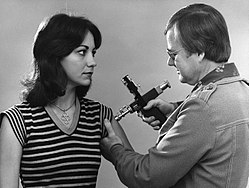
From Detection to National Mobilization
Following the verification of the findings, CDC Director David Sencer issued a memo on February 13 calling for mass immunization. By February 19, CDC Assistant Director Bruce Dull publicly linked the Fort Dix strain to the 1918 outbreak during a press conference, heightening public concern.
President Gerald Ford was briefed on the situation on March 15. After consulting a "blue ribbon" panel of experts, including renowned scientists Jonas Salk and Albert Sabin, Ford announced a televised campaign to immunize the American public. To fund this effort, the House Appropriations Committee approved a special bill on April 5, allocating $135 million to the program.
The Battle Over Indemnity
As the government pushed for rapid vaccine production, a significant legal hurdle emerged: indemnity, or legal protection against liability for damages. Pharmaceutical companies, including Merck & Co. (Sharp & Dohme), Merrell, Wyeth, and Parke-Davis, refused to sell doses unless the government guaranteed their profits and protected them from product liability lawsuits.
The insurance industry exacerbated the problem. In April 1976, the Federal Insurance Company notified Merck that it would exclude indemnity for the vaccine. T. Lawrence Jones of the American Insurance Association informed the government that the industry would not cover the vaccine without federal protection. By June, the Ford administration submitted a proposal to Congress to provide the necessary indemnity to secure the cooperation of manufacturers.
Vaccine Rollout and Emerging Doubts
Despite the political momentum, cracks began to appear in the program's foundation. In July, Bruce Dull admitted at a conference that there were no actual parallels between the current situation and the 1918 pandemic. Simultaneously, J. Anthony Morris, a researcher at the FDA's Bureau of Biologics (BoB), was dismissed for insubordination after raising concerns about the safety of the vaccine, which was produced using fertilized hen's eggs.
By late July, global investigations revealed no other cases of the swine flu strain outside the initial outbreak. However, the program proceeded. After safety testing by the FDA, Merck began shipping vaccines on September 22, and nationwide inoculations commenced shortly after, starting with a health fair in Indianapolis, Indiana.
The Suspension and Aftermath
The program faced its first major scare in October when three people died of heart attacks at a Pittsburgh clinic. While an investigation proved these deaths were unrelated to the vaccine, public anxiety grew. Even Albert Sabin, who supported the vaccine's creation, criticized the government's "scare tactics" in a New York Times editorial, suggesting a "wait-and-see" strategy instead.
The turning point came in December 1976, when cases of Guillain-Barré syndrome (GBS)—a rare neurological disorder where the immune system attacks the nerves—were reported across 10 states. CDC official William Foege estimated that the incidence of GBS was four times higher in vaccinated individuals than in the unvaccinated. On December 16, Director Sencer suspended the program.
The program was never reinstated. Following the transition of power to President Jimmy Carter and the appointment of Joseph A. Califano Jr. as Secretary of Health, Education, and Welfare, the initiative was abandoned.
Key Facts
- Origin: Started with a respiratory outbreak at Fort Dix, New Jersey, in January 1976.
- Funding: The U.S. government allocated $135 million for the immunization program.
- Liability: Vaccine manufacturers required government indemnity before agreeing to supply doses.
- Safety Issue: The program was suspended due to an increased risk of Guillain-Barré syndrome (GBS).
- Scale: Approximately 45 million people were vaccinated before the program ended.
- GBS Impact: 362 cases of GBS occurred within six weeks of vaccination.
| Date | Event | Significance |
|---|---|---|
| Jan-Feb 1976 | Fort Dix Outbreak | Identification of swine influenza A strain. |
| March 15, 1976 | Presidential Announcement | Gerald Ford supports mass immunization. |
| April 5, 1976 | Funding Approved | $135 million allocated for the program. |
| Sept 1976 | National Rollout | Vaccinations begin nationwide. |
| Dec 16, 1976 | Program Suspension | Halted due to GBS reports. |
Frequently Asked Questions
What caused the 1976 swine flu vaccination program to be suspended?
The program was suspended on December 16, 1976, after reports of Guillain-Barré syndrome (GBS) emerged in multiple states. Investigations indicated that vaccinated individuals had a four times higher risk of developing GBS than those who were not vaccinated.
Why did the government have to provide indemnity to vaccine manufacturers?
Pharmaceutical companies and their insurers refused to provide the vaccine unless the government assumed the legal liability for potential injuries. They feared product liability lawsuits and demanded guaranteed profits and indemnity to participate.
Was the 1976 swine flu strain as dangerous as the 1918 pandemic?
While initial fears were based on the strain's relationship to the 1918 flu, later evidence and statements from CDC officials, including Bruce Dull, indicated there were no actual parallels between the two situations.
How many people were vaccinated before the program ended?
Approximately 45 million people received the swine flu vaccination before the program was suspended.
What was the overall conclusion regarding the benefit of the vaccination?
A summarizing study concluded that despite the increased risk of GBS, vaccination overall provides a public health benefit by reducing mortality and preventing thousands of deaths from annual seasonal outbreaks.