
Syria's Economic Sectors: Agriculture, Energy, and Industry
Syria's economy is a complex tapestry of traditional agriculture, strategic mineral extraction, and a service sector that has historically driven a significant portion of the national GDP. While the country has faced immense challenges due to civil war and international sanctions, its economic foundation rests on a mix of state-led initiatives and evolving private sector participation.
Key Facts
- Agriculture: Historically a priority for food self-sufficiency, employing 17% of the labor force as of 2009.
- Minerals: A global leader in phosphate rock, ranking ninth worldwide in 2009.
- Energy: Oil is a critical revenue pillar, accounting for 25.1% of state revenue in 2010.
- Services: The largest economic contributor, representing 60.4% of GDP in 2017.
- Currency: The Syrian pound (SYP) has seen significant devaluation since 2011.
Agriculture and Land Use
Agriculture is central to Syria's development goals, aimed at achieving food self-sufficiency and reducing rural migration. Through capital investment and massive irrigation projects in the north and northeast, Syria transitioned from a net importer to an exporter of fruits, vegetables, and cotton prior to the civil war. As of 2009, the sector generated approximately 21% of the GDP, with grains and fruits contributing over 40% and livestock accounting for 16%.
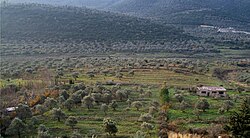
Land ownership is primarily private, with about 28% of the country's 196,000 km² being cultivated. The government designates certain irrigated lands as strategic, meaning the state controls the pricing and marketing of crops like wheat, barley, and sugar beets to support farmers. While wheat is the most common arable crop, cotton serves as the primary cash crop, though its production has declined due to water shortages and outdated irrigation.
Environmental challenges have significantly impacted yields. A severe drought in 2008 threatened the livelihoods of 1 million workers and forced Syria to become a net importer of wheat for the first time in two decades. By 2015, key exports included spice seeds ($83.2 million) and apples and pears ($53.2 million).
Energy and Mineral Resources
Mining and Phosphates
Syria possesses vast mineral wealth, most notably phosphates, with reserves estimated at 1,700 million tons. By 2009, Syria produced about 1.9% of the world's phosphate rock. Other domestic minerals include gypsum, cement, marble, and silica, which are generally used for internal consumption rather than export.
Oil and Natural Gas
Although a relatively small global producer (0.5% of global production in 2010), oil is a cornerstone of the Syrian economy. In 2010, oil sales were projected to generate $3.2 billion, representing over a quarter of state revenue. In 2008, the sector accounted for 22% of the GDP and 20% of total exports.
Electricity Generation
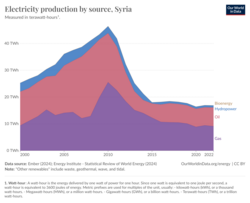
The energy landscape is in transition. While 2022 data indicated a reliance on oil and fossil gas, 2024 reports suggest a shift toward hydro power. However, the grid suffers from extensive war damage, leading to frequent power cuts and a reliance on polluting diesel generators. The Ministry of Electricity has set a target capacity of 12 GW by 2030, with significant potential for solar energy expansion.
Industry and Manufacturing
The industrial sector—comprising mining, petroleum, construction, and manufacturing—accounted for 27.3% of the GDP in 2010. Key products include textiles, food processing, tobacco, and car assembly. While state-dominated until the 1990s, reforms have allowed more private participation, though growth is often hindered by cumbersome regulations and a lack of investment funds.
Construction and real estate have remained attractive for domestic investment because land prices are not state-controlled. This sector saw a revival following Investment Law No. 10 of 1991, which opened specific areas to foreign investment.
Services and Finance
The services sector is the largest part of the economy, employing 67% of the labor force and contributing 60.4% of the GDP in 2017.
Banking and Monetary Policy
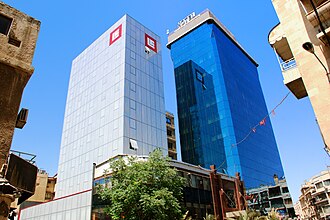
The Central Bank of Syria, established in 1959, manages foreign exchange and prioritizes public sector lending. The financial system includes six specialized state-owned banks focusing on different sectors (e.g., Agricultural Co-Operative Bank, Industrial Bank). Since 2001, the government has legalized private banks, and the Damascus Securities Exchange opened in 2009.
The economy has been heavily impacted by international sanctions from the US, EU, Arab League, and Turkey. This has led to significant capital flight and a plummeting exchange rate. The Syrian pound (SYP) fell from £S 47 per US$1 before the war to £S 1,256 by June 2020, with black market rates reaching approximately £S 4,000 per US$1 in March 2021.
Social Infrastructure
Education
Education is a constitutional right in Syria, with primary education being free and compulsory. The system is structured into three levels:
- Primary Education: Grades 1-6 (divided into First and Second Rings).
- Pre-Secondary Education: Grades 7-9.
- Upper Secondary Education: Grades 10-12.
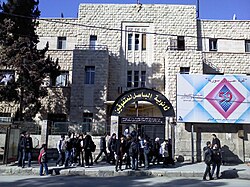
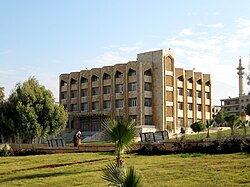
As of 2007, 98% of schools were state-run. The system served 8 million students, including 2.3 million in tertiary education.
Healthcare
The healthcare system has declined sharply due to the civil war. The conflict has resulted in the destruction of hospitals, shortages of medical supplies, and a lack of spare parts for equipment. These issues, compounded by economic collapse and sanctions, have left 60% of the population food insecure.
Transport and Telecommunications
Syria maintains a developed transport network, including 2,052 km of rail and 782 km of highways, with Damascus International Airport serving as the primary air hub. Telecommunications are managed by the Ministry of Communications and Information Technology, with fixed-line services provided by the state-owned Syrian Telecom (STE).
| Sector/Indicator | Key Statistic | Reference Period |
|---|---|---|
| Services GDP Share | 60.4% | 2017 |
| Industrial GDP Share | 27.3% | 2010 |
| Agriculture Labor Force | 17% | 2009 |
| Oil State Revenue Share | 25.1% | 2010 |
| Phosphate Global Rank | 9th | 2009 |
Frequently Asked Questions
What is the most important cash crop in Syria?
Cotton is the most important cash crop and was the largest single export before the oil sector developed, although production has declined due to water shortages.
How does the Syrian government support "strategic" crops?
The government uses state marketing boards to buy strategic products like wheat and barley at fixed prices, which are often higher than world market prices to support farmers.
What is the role of the Central Bank of Syria?
The Central Bank controls all foreign exchange and trade transactions and prioritizes lending to the public sector.
What are the main challenges facing the Syrian electricity grid?
The grid suffers from extensive war damage and a generation capacity that cannot meet demand, resulting in frequent power cuts and reliance on diesel generators.
Is education free in Syria?
Yes, primary education is free and compulsory. Secondary education is free but not compulsory, and higher education is available for a symbolic fee.