
Tau and the Early Christian Symbolism of the Cross
The intersection of language, mathematics, and faith often produces powerful symbols. In the early centuries of Christianity, the Greek letter tau (Τ) evolved from a simple character and numeral into a profound representation of the crucifixion. By examining early theological writings and ancient papyri, we can trace how the shape of the tau became inextricably linked to the instrument of Jesus' death.
The Numerical and Allegorical Origins
In the Greek numeral system, the letter tau represented the number 300. Early Christian writers used this numerical value to find hidden meanings in the Old Testament. The Epistle of Barnabas, written in the late first or early second century, provides an allegorical interpretation of Genesis 14:14, which mentions the number 318 (written in Greek as τιη’).
The author of the Epistle suggests that the numerals ιη’ (18) represent the initials of Ἰησοῦς (Iēsus), while the τ’ (300) serves as a prefiguration of the cross. This interpretation was echoed by Clement of Alexandria (c. 150 – c. 215), who referred to the shape of the character for 300 as "the Lord’s sign."
Tau as a Visual Model for Execution
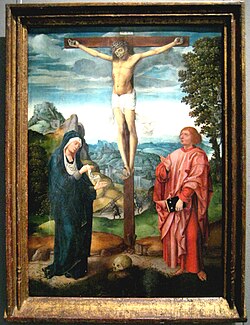
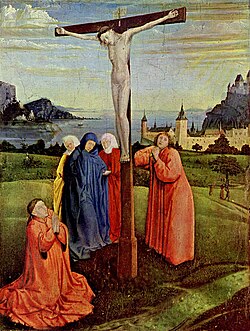
Beyond numerical allegory, the physical shape of the letter was seen as a direct mirror of the execution cross. Tertullian (c. 155 – c. 240) explicitly noted that both the Greek tau and the Latin T share the same species or shape as the cross.
This association was so strong that it appeared even in non-Christian literature. In the Trial of the Court of the Vowels by Lucian (125 – after 180), the letter Sigma accuses Tau of providing tyrants with the model for the wooden instrument used for crucifixion. Lucian notes that the word stauros (σταυρός)—the Greek term for the structure of crucifixion—derives its name from the letter Tau.
The Staurogram: Merging Text and Art
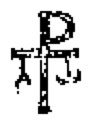
One of the most significant archaeological findings regarding early Christian symbolism is the staurogram. This is a cross-like combination of the letters tau (Τ) and rho (Ρ). Found in papyri as early as AD 200 (Papyrus 66 and Papyrus 75), and later in Papyrus 45 (dated 250), the staurogram appears in contexts relating to the crucifixion of Jesus.
Scholars such as Larry Hurtado, Robin Jensen, Kurt Aland, and Erika Dinkler suggest that the staurogram was a primitive depiction of Jesus on the cross. In this visual shorthand, the tau represents the cross itself, while the loop of the rho represents the head of Christ. David L. Balch and Dieter T. Roth have further identified this symbol in Papyrus 46, 80, and 91, arguing that the staurogram represents an early artistic emphasis on Christus crucifixus (the crucified Christ) within the textual tradition.
Biblical Precedents and Ritual Practice
The connection between a cross-shaped mark and salvation extends to the Hebrew Bible. In Ezekiel 9:4, an angel is instructed to set a mark (tav) on the foreheads of those to be saved. Because the Phoenician and early Hebrew letter tav was cross-shaped, Tertullian and Origen (184/185 – 253/254) viewed this as a prediction of the early Christian custom of tracing the sign of the cross on one's own forehead.
Key Facts
- Numerical Value: In Greek, Tau (Τ) represents the number 300.
- Staurogram: A combination of Tau and Rho used in early papyri to visually depict the crucifixion.
- Etymology: The word stauros (cross) is linked by ancient writers to the shape of the letter Tau.
- Early Evidence: Papyrus 66 and 75 (c. AD 200) contain some of the earliest examples of the staurogram.
- Tav Connection: The cross-shaped Hebrew letter tav in Ezekiel 9:4 was seen as a precursor to the sign of the cross.
| Source/Author | Period | Key Association |
|---|---|---|
| Epistle of Barnabas | Late 1st/Early 2nd Century | Tau (300) as a prefiguration of the cross |
| Lucian | 125 – after 180 | Tau as the model for the stauros (gibbet) |
| Tertullian | c. 155 – c. 240 | Visual identity between Tau/T and the execution cross |
| Early Papyri (66, 75, 45) | AD 200 – 250 | Use of the staurogram (Tau + Rho) |
Frequently Asked Questions
What is a staurogram?
A staurogram is a ligature—a combination of two letters—consisting of the Greek letters tau (Τ) and rho (Ρ). Early Christians used it as a visual representation of the crucifixion, where the tau forms the cross and the rho forms the head of Jesus.
How did the number 318 relate to the cross?
Early writers like the author of the Epistle of Barnabas and Clement of Alexandria interpreted the number 318 (τιη’) allegorically. They viewed the letters ιη’ (18) as the initials of Jesus and the τ’ (300) as a symbol for the cross.
Did non-Christians recognize the link between Tau and the cross?
Yes. The writer Lucian described the letter Tau as the model that tyrants used to create the wooden instruments of crucifixion, noting that the word stauros derived its name from the letter.
What is the significance of the letter Tav in this context?
The early Hebrew letter tav was cross-shaped. Early theologians like Origen and Tertullian linked the mark of the tav mentioned in Ezekiel 9:4 to the Christian practice of making the sign of the cross on the forehead.
Which ancient documents contain the staurogram?
The staurogram has been identified in several early Christian papyri, including Papyrus 66, 75, 45, 46, 80, and 91.