
Telephone Tapping and Communication Surveillance Methods
Telephone tapping, the act of monitoring or recording phone conversations, has evolved from manual circuit manipulation to sophisticated digital interception. Whether conducted for official law enforcement purposes or unofficial monitoring, the methods used depend heavily on the underlying technology of the communication network.
Key Facts
- CALEA requires U.S. telecommunications carriers to cooperate with law enforcement for communication interception.
- Digital switching allows for remote, undetectable tapping by copying digitized bits to a second line.
- Pen registers track call metadata (numbers and duration) rather than the actual audio content.
- IMSI-catchers perform man-in-the-middle attacks by mimicking legitimate mobile base stations.
- Modern surveillance equipment often operates in the 30–300 GHz range for high-frequency transmission.
Official Surveillance Methods
In the United States, the Communications Assistance for Law Enforcement Act (CALEA) mandates that telecommunications carriers provide access to tapping lines for law enforcement. The technical execution of these taps has shifted significantly over time.
From Mechanical to Digital Tapping
In the era of mechanical telephone exchanges, technicians had to manually link circuits to route audio signals. Today, most exchanges use digital technology, making tapping simpler and remotely executable via computer. This central office switch technology, utilizing the Advanced Intelligent Network (AIN), was patented in 1995 by Wayne Howe and Dale Malik of BellSouth.
When a tap is implemented at a digital switch, the computer simply copies the digitized bits of the conversation to a second line. Because this happens at the switch level, it is virtually impossible for the user to detect. In some instances, law enforcement may even access a mobile phone's internal microphone while the device is idle, provided the battery is functional.
Metadata and Pen Registers
Not all surveillance involves listening to audio. Phone companies automatically collect data on calling and called numbers, timestamps, and call durations for billing. Security services can access this metadata, often with fewer legal restrictions than a full audio tap. A pen register tap refers specifically to the recording of this call information without capturing the conversation's content.
Unofficial Monitoring and Recording
Conversations can be monitored unofficially by one of the participants or by a third party. The legality of these actions varies by jurisdiction.
Participant-Led Recording
A person involved in a call may record it using tape, solid-state devices, or computer software. These recordings can be triggered manually, via VOX (voice-operated exchange) which detects sound, or automatically when the phone is off the hook.
Third-Party Interception Techniques
- Inductive Coil Taps: A pickup coil placed near the handset or base picks up the stray field of the telephone's hybrid.
- In-line Taps: A physical adapter placed between the phone and the wall socket.
- In-ear Microphones: A microphone worn by the user that captures audio from the handset, often providing better volume balance between speakers.
- Speakerphone Recording: Using a standard microphone to record audio from a speakerphone.
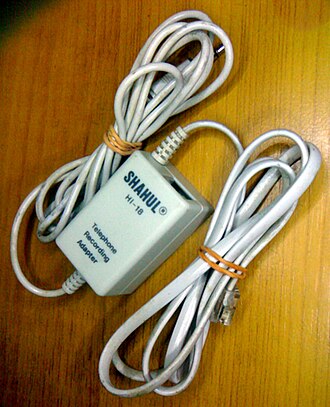
Covert Hardware and Transmission
Third parties may use a beige box for direct electrical connection to the line or an induction coil hidden under the phone base. Tapped signals can be recorded on-site or transmitted via radio. While older systems used 772 kHz, state-of-the-art equipment now operates in the 30–300 GHz range. Some transmitters are powered directly from the phone line and only activate during calls, with receivers capable of picking up signals from up to ten kilometers away under ideal conditions.
Mobile and Wireless Surveillance
Mobile phones present unique surveillance vulnerabilities due to their reliance on radio transmissions and location data.
Location Tracking
Mobile surveillance focuses heavily on communications data, including the identification of the base station used, which reveals the user's approximate geographical location. Higher precision can be achieved by combining data from multiple surrounding cells and measuring the timing advance (a GSM standard correction for the speed of light), though this typically requires specific enablement by the carrier.
IMSI-Catchers and Encryption
Early analog mobile phones (1978–1990) were easily monitored with radio scanners. Modern digital phones are harder to intercept but remain vulnerable to IMSI-catchers. These devices pretend to be legitimate base stations, forcing the phone to connect to them in a man-in-the-middle attack. This is possible because phones authenticate to the network, but the network does not authenticate to the phone. The only effective defense is end-to-end call encryption.
Internet and VoIP Interception
The rise of the internet and Voice over IP (VoIP) has expanded the scope of surveillance. In 2004, the FCC clarified that broadband and VoIP providers are considered "telecommunications carriers" under CALEA and must provide law enforcement access.
Internet Wiretapping and Webtapping
Illegal internet tapping often occurs via Wi-Fi by cracking WEP or WPA keys using tools like Aircrack-ng or Kismet, followed by ARP spoofing to view packets via Wireshark or Ettercap. Additionally, webtapping involves logging the IP addresses of users accessing specific websites, a practice permitted in the U.S. under the Patriot Act.
| Method | Target | Primary Technology | Detectability |
|---|---|---|---|
| Digital Switch Tap | Landline/VoIP | AIN / Digital Copying | Nearly Impossible |
| Pen Register | Call Metadata | Billing Records | Undetectable |
| IMSI-Catcher | Mobile Phone | Fake Base Station | Difficult |
| Inductive Coil | Physical Handset | Electromagnetic Field | Possible (Physical) |
| Webtapping | Web Traffic | IP Logging | Undetectable |
Frequently Asked Questions
What is the difference between a full tap and a pen register?
A full tap records the actual audio content of a conversation, whereas a pen register only collects metadata, such as the numbers dialed, the time of the call, and the duration.
How does an IMSI-catcher work?
An IMSI-catcher mimics a legitimate cellular base station. Because mobile phones do not require the network to authenticate itself, the phone connects to the catcher, allowing the operator to intercept communications.
Can digital phone taps be detected?
Taps implemented at the digital switch level are generally impossible to detect because the switching computer simply copies the data bits to another line without altering the original signal.
Is recording a phone call legal in Canada?
In Canada, individuals are legally allowed to record a conversation as long as they are a participant in that conversation.
What is the role of CALEA in the United States?
The Communications Assistance for Law Enforcement Act (CALEA) requires telecommunications carriers, including broadband and VoIP providers, to ensure their networks are designed to allow law enforcement to intercept communications.