
Téléscaphe: The Forgotten Underwater Cable Car of Marseille
In the mid-1960s, a daring engineering project sought to bring the mysteries of the ocean floor to the general public. This ambitious venture, known as the Téléscaphe—a portmanteau combining téléphérique (cable car) and bathyscaphe (a deep-sea submersible)—created a unique underwater transit system that allowed non-divers to experience the seabed.
Conceived by ski lift engineer Denis Creissels and alpine skier James Couttet, the project applied the principles of mountain transport to the marine environment. With the backing of the City of Marseille and the École nationale des ponts et chaussées, construction began in 1966 to create a tourist attraction that would make the depths of the Mediterranean accessible to all.
Key Facts
- Location: Passage de Croisettes, Les Goudes, Marseille, France.
- Operational Period: June 1967 to 1968.
- Capacity: Four 6-seater submarines carrying roughly 60 passengers per hour.
- Route: A 500-metre stretch between Callelongue and Cap Croisette.
- Depth: The system operated at a depth of 10 metres (33 ft).
- Cost: The total project cost exceeded 2 million francs.
Engineering and Operation
The Téléscaphe functioned as an underwater cable way. The system utilized four bell-shaped submarines, each weighing approximately 3 tons. These vessels were not self-propelled but were instead pulled along a cable system, mirroring the mechanics of a ski lift.
To ensure a high-quality experience, the submarines were equipped with lights, allowing the attraction to operate during the night. Safety was a primary concern, with professional frogmen (divers) monitoring the operation to ensure the safety of the passengers.
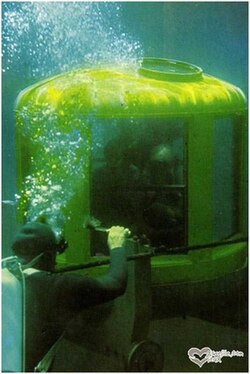
Each journey lasted 10 minutes and cost 12 francs. To commemorate the experience, passengers were issued a baptême de plongée, or "diving baptism" certificate, marking their first descent into the underwater world.
Global Recognition and Decline
The Téléscaphe gained immediate international attention. Its maiden voyage was broadcast on Our World, which holds the distinction of being the first live multinational multi-satellite television production.
Despite its novelty and a respectable turnout of over 31,000 visitors, the project was short-lived. The Téléscaphe operated for only one season before closing in 1967. The failure was attributed to a combination of high maintenance costs and a lack of sustained financial and political support.
The project's reputation was further marred by a safety incident in which one of the submarines tipped onto its side, forcing the three occupants to swim to safety. Following the closure, the system was dismantled, though some of the shoreline bull wheels—the large pulleys used to drive the cable—remain visible today.
| Feature | Detail |
|---|---|
| System Length | 500 metres (1,600 ft) |
| Operating Depth | 10 metres (33 ft) |
| Submarine Capacity | 6 people per vessel |
| Travel Time | 10 minutes |
| Total Visitors | 31,000+ |
| Ticket Price | 12 francs |
Frequently Asked Questions
What was the Téléscaphe?
The Téléscaphe was an underwater cable car system located in Marseille, France, designed to take the general public to the seabed in bell-shaped submarines.
Who designed the system?
The system was designed by Denis Creissels, a ski lift engineer, and James Couttet, an alpine skier.
Why did the Téléscaphe close so quickly?
It closed after one season due to high operational and maintenance costs, a lack of funding and support, and a safety incident where a submarine overturned.
How did passengers get around underwater?
Passengers traveled in one of four 3-ton, six-seater submarines that were pulled along a cable between Callelongue and Cap Croisette.
Are there any remains of the Téléscaphe today?
While the submarines and cables were dismantled, some of the shoreline bull wheels still remain in place at the site.