
Tenor Saxophone: History, Design, and Influence in Music
The tenor saxophone is a medium-sized member of the saxophone family, renowned for its versatile voice that can shift from a husky, deep resonance to a bright, piercing tone. Invented in the 1840s, it has evolved from a military band staple into one of the most iconic solo instruments in jazz and contemporary music.
Pitched in the key of B&flat, the tenor is a transposing instrument. This means it sounds an octave and a major second lower than the pitch written in the treble clef. While the alto saxophone is its most common counterpart, the tenor is distinguished by its larger size and the characteristic curve, or crook, in its neck.
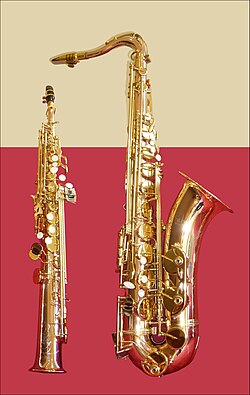
Key Facts
- Inventor: Adolphe Sax, developed in the 1840s.
- Classification: Single-reed aerophone (Hornbostel–Sachs 422.212-71).
- Key: B&flat.
- Range: Typically A&flat2 to E5 (concert), including a high F&sharp key on most modern models.
- Primary Use: Prominent in jazz, military bands, classical music, and R&B.
The Origins of the Saxophone
The tenor saxophone was part of a family of fourteen instruments designed in 1846 by Adolphe Sax, a Belgian-born instrument maker. Sax sought to create a tonal bridge between the woodwinds (like the flute and clarinet) and the brass instruments (like the ophicleide) used in military bands.
Sax's patent, granted on June 28, 1846, divided the instruments into two groups of seven, ranging from soprano to contrabass. The tenor saxophone, pitched in B&flat, was the fourth member of the family designed to integrate seamlessly with existing military band instrumentation.

Anatomy and Technical Design
The instrument consists of a conical tube made of thin brass, ending in a flared bell. Sound is produced via a single-reed mouthpiece—a wedge-shaped tube where a thin piece of giant cane (Arundo donax) is clamped by a ligature. When the player blows air, the reed vibrates, creating acoustic resonances.
The Mechanism and Bore
The body features between 20 and 23 tone holes, sealed by pads controlled by keys. To reach higher registers, the instrument utilizes speaker holes that disrupt lower harmonics, allowing the player to overblow. These are managed by an octave key operated by the left thumb.
Physical Configuration
Due to its length, the tenor saxophone features a characteristic "U-bend" above the third-lowest tone hole. It also incorporates a slight S-bend in the neck to position the mouthpiece comfortably for the player. This differs from the alto saxophone, which has a straighter neck.
Mouthpiece and Timbre
The mouthpiece is the primary determinant of the instrument's timbre (sound quality). Materials such as plastic, ebonite, bronze, brass, and stainless steel are used. Generally, classical mouthpieces produce a warmer, rounder tone, while jazz mouthpieces are designed for a brighter, edgier sound.
Musical Applications and Legacy
While it began in French and Belgian military bands, the tenor saxophone found its greatest fame in the United States. Following the American Civil War, many military instruments entered the public domain, fueling the rise of gospel and jazz.
The Jazz Revolution
The tenor saxophone was transformed from an ensemble support instrument into a powerhouse solo voice by Coleman Hawkins in the 1930s. This paved the way for a lineage of influential players, including:
- The Pioneers: Lester Young, Ben Webster, and Johnny Griffin.
- The Innovators: John Coltrane, Sonny Rollins, and Dexter Gordon.
- Modern Masters: Michael Brecker and Chris Potter.
Classical and Other Genres
In classical music, the tenor is used in concert bands and saxophone quartets. Notable composers have included it in orchestral works, such as Sergei Prokofiev (Romeo and Juliet), Maurice Ravel (Boléro), and Igor Stravinsky (Ebony Concerto). Beyond jazz and classical, it is a staple in rhythm and blues, rock and roll, and various African and Latin American musical traditions.
| Feature | Specification |
|---|---|
| Key/Pitch | B&flat (Transposing) |
| Reed Type | Single Reed (Arundo donax) |
| Material | Brass tube, various mouthpiece materials |
| Common Range | A&flat2 to E5 (Concert) |
| Distinguishing Feature | S-bend neck (crook) and U-bend body |
Frequently Asked Questions
What is the difference between a tenor and an alto saxophone?
The tenor saxophone is larger and pitched in B&flat, sounding an octave and a major second lower than written. The alto is smaller, pitched in E&flat, and lacks the characteristic S-bend crook in the neck found on the tenor.
Who invented the tenor saxophone?
The tenor saxophone was invented by Adolphe Sax, a Belgian instrument maker, as part of a larger family of saxophones patented in 1846.
Can a tenor saxophone reed be used on other instruments?
Yes, the tenor saxophone reed is similar in size to the reed used for the bass clarinet, and the two can often be substituted.
Why does the tenor saxophone have a curved neck?
The curve, or crook, is necessary because of the instrument's length; it allows the mouthpiece to be positioned comfortably in the player's mouth.
What determines the sound of a tenor saxophone?
While the brass body provides the resonance, the timbre is primarily determined by the dimensions and material of the mouthpiece and the stiffness of the reed.