
Texas Sharpshooter Fallacy: How Random Patterns Mimic Meaning
Imagine a shooter who fires several bullets at a blank wall and then draws a target around the tightest cluster of holes to make it look like they hit a bullseye. This is the essence of the Texas Sharpshooter fallacy: a cognitive bias where a person focuses on a specific cluster of data to find a pattern, ignoring the vast amount of random data that doesn't fit that pattern.
In scientific research and data analysis, this occurs when a researcher identifies a statistically significant result after the data has already been collected, rather than testing a pre-defined hypothesis. By "drawing the target" after the fact, random noise is mistaken for a meaningful discovery.
Key Facts
- The fallacy involves identifying patterns in data after the fact to create a false sense of meaning.
- It is closely linked to the multiple comparisons problem, where testing many variables increases the chance of a false positive.
- Commonly occurs in epidemiology, pharmaceutical development, and retrospective predictions.
- Results generated by this fallacy typically disappear when the study is replicated.
The Fallacy in Epidemiology
Epidemiology—the study of how often diseases occur in different groups of people—is particularly susceptible to this effect. A notable example occurred in 1993 when Swedish researchers investigated whether living within 300 metres of high-voltage power lines was linked to negative health outcomes over a 25-year period.
The researchers analyzed the prevalence of over 800 different medical conditions. They discovered that childhood leukemia was four times more common in people living near power lines, leading to calls for government action. However, the conclusion was flawed because of the sheer volume of conditions tested. When you analyze 800 different variables, the probability that at least one will show a statistically significant correlation by pure chance is very high. This is known as the multiple comparisons problem. Subsequent studies failed to replicate the association between power lines and childhood leukemia.
Pharmaceutical Drug Development
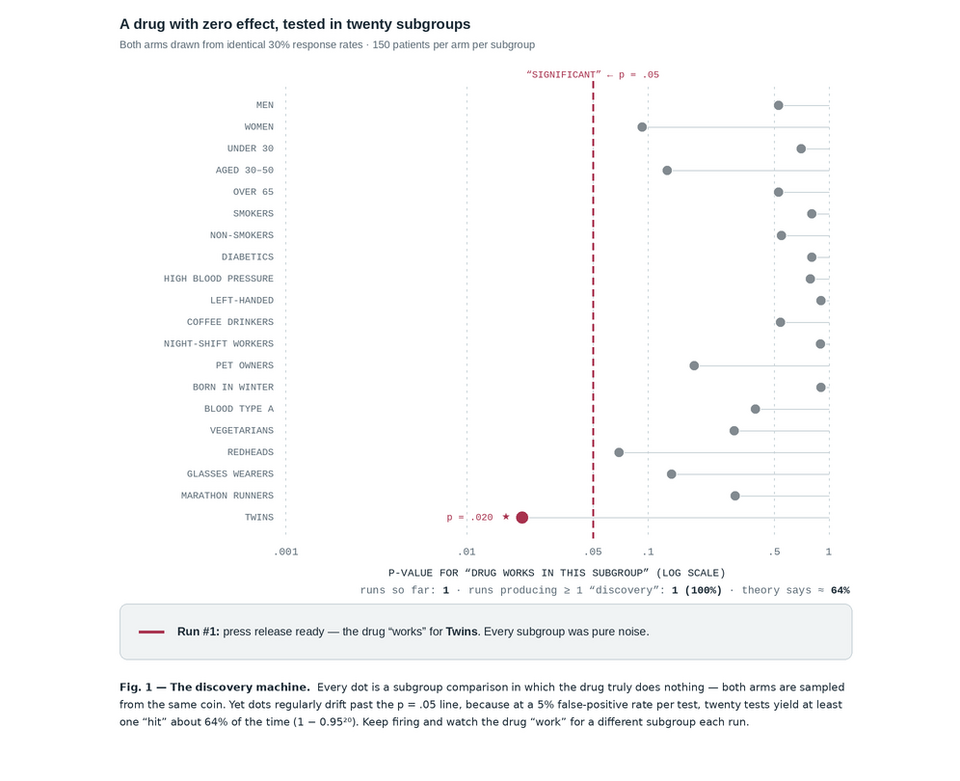
The Texas Sharpshooter effect is also a recurring issue in drug discovery and the publication of efficacy data. A drug may be entirely ineffective across a general population, yet appear successful if a researcher runs enough subgroup analyses.
For instance, a drug might show a strong positive response in a specific subgroup, such as twins, simply because false positives happened to cluster there. If the researcher did not start with the hypothesis that the drug would work specifically for twins, they are essentially drawing a target around a random cluster of data points. Because this effect is based on random noise rather than a biological mechanism, the result vanishes when the test is replicated in a new trial.
Retrospective Predictions
Beyond science, this fallacy appears in the interpretation of historical texts, most notably the quatrains of Nostradamus. These verses are often liberally translated from Middle French, stripping away their original historical context.
After a modern-day event occurs, people search through these vague verses to find a passage that seems to match the event. By applying the meaning after the event has already happened, they create the illusion that Nostradamus predicted the future, when they are actually just drawing a target around a random set of words.
Summary of the Texas Sharpshooter Fallacy
| Field | The "Random Noise" | The "Target" (False Conclusion) | The Reality |
|---|---|---|---|
| Epidemiology | 800+ medical conditions analyzed | Power lines cause childhood leukemia | Chance correlation due to multiple comparisons |
| Pharmaceuticals | Various patient subgroups | Drug is effective for a specific subgroup (e.g., twins) | False positive clustering in random data |
| Predictions | Vague, translated quatrains | Nostradamus predicted a modern event | Post-hoc interpretation of ambiguous text |
Frequently Asked Questions
What is the difference between a real discovery and the Texas Sharpshooter fallacy?
A real discovery begins with a hypothesis (the target) and then collects data to see if it hits. The Texas Sharpshooter fallacy collects the data first and then creates a hypothesis to fit the results (drawing the target around the hits).
What is the multiple comparisons problem?
The multiple comparisons problem occurs when a researcher tests many different variables at once. The more tests performed, the higher the likelihood that one will appear statistically significant purely by chance, even if no real relationship exists.
Why do these results disappear during replication?
Because the original "finding" was based on random noise (a fluke in the data), it is highly unlikely that the same random fluke will happen again in a second, independent group of data.
How can researchers avoid this fallacy?
Researchers can avoid this by pre-registering their hypotheses before analyzing data and using statistical corrections to account for the number of comparisons being made.