
Thale: A History of Industrial Innovation and Natural Beauty
Nestled in the scenic landscapes of Saxony-Anhalt, Thale is a town defined by a unique duality: a rich spiritual and natural heritage paired with a legacy of pioneering industrial achievement. From its early origins as a settlement linked to medieval monastic life to its era as a global leader in enamel production, Thale has evolved through centuries of political shift and economic transformation.
Early Foundations and Medieval Influence
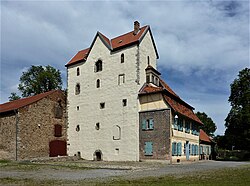
The settlement of Thale likely emerged at the start of the 10th century. Its early history is closely tied to the Wendhusen Abbey, a chapter of canonesses (a community of clergy who lived according to a specific rule) founded around 825 AD. Established by an Eastphalian comital family and modeled after Herford Abbey, it stood as one of the first monasteries in the medieval Duchy of Saxony.
In 936, Queen Dowager Matilda, the widow of King Henry the Fowler, attempted to relocate the convent. Although this effort failed, the abbey subsequently came under the guardianship of the Quedlinburg chapter. The adjacent village, referred to in a 1231 deed as Dat Dorp to dem Dale, eventually adopted the Latinised de valle in 1288 and became known as von Thale by 1303.
During the late Middle Ages, the estates were managed by the Saxon Counts of Regenstein, who served as vassals to the prince-bishops of Halberstadt. However, this period of stability was interrupted in 1525 during the German Peasants' War, when the monastery premises were stormed and devastated.
The Rise of the Iron and Enamel Industries
Thale's industrial identity began to take shape in 1445 with the establishment of an ironworks. Despite being destroyed during the Thirty Years' War and again in 1670, the industry persisted. In 1686, following the incorporation of secularised Halberstadt territories by Brandenburg-Prussia, a small hammer mill was founded. This facility grew into a significant ironworks, leveraging local wood supplies and nearby ore deposits until 1714.
The 18th and 19th centuries marked a period of rapid technological advancement. In 1740, a new business opened, which was briefly owned by King Frederick the Great. By 1831, Thale achieved a national milestone by manufacturing the first wrought-iron wagon axle in German lands. This was followed in 1835 by the founding of Europe's oldest sheet steel enamel works.
The arrival of the railway in 1862, connecting Thale to Berlin, catalyzed explosive growth. The workforce in the iron industry surged from 350 workers in 1872 to 4,400 by 1905. Thale's enamel production eventually gained international fame, accounting for 10% of the world's total output at its peak. Later, the town's industrial capacity shifted toward military production, manufacturing steel helmets from 1916 and holding a monopoly on their production from 1934 through World War II.
Tourism and Cultural Appeal
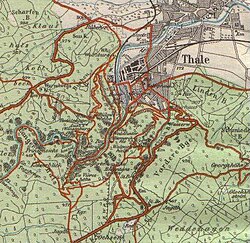
Parallel to its industrial growth, Thale became a destination for health and leisure. The opening of the radon-rich waters of the Hubertus Spring in 1836 sparked a tourism boom. The breathtaking Bode Gorge and the town's status as a summer resort for Berliners attracted prominent literary figures, including Theodor Fontane and Heinrich Heine, the latter of whom documented his experiences in Die Harzreise.
This popularity further justified the expansion of the railway network, with a line from Wegeleben arriving in 1862 and a branch line from Blankenburg (Harz) added in 1909. The resort's growth culminated in 1922 when it was officially granted town rights. More recently, Thale hosted the Saxony-Anhalt Day from June 12 to 14, 2009, under the motto Thale sagenhaft ("Legendary Thale"), drawing approximately 200,000 visitors.
Key Facts
- Industrial Milestone: Produced the first wrought-iron wagon axle in German lands (1831).
- Global Leadership: Once produced 10% of the world's enamel.
- Monastic Roots: Linked to Wendhusen Abbey, founded circa 825 AD.
- Natural Attraction: Home to the Hubertus Spring and the Bode Gorge.
- Political History: Visited by Karl Liebknecht, Rosa Luxemburg, and Clara Zetkin in 1910.
Administrative Expansion and Population
Over the last two decades, Thale has significantly expanded its borders by incorporating several surrounding municipalities. This process began with Warnstedt in 2003 and continued through 2011, drastically increasing the town's total area.
| Former Municipality | Date of Incorporation |
|---|---|
| Warnstedt | 21 December 2003 |
| Neinstedt | 1 January 2009 |
| Weddersleben | 1 January 2009 |
| Altenbrak | 1 July 2009 |
| Treseburg | 1 July 2009 |
| Friedrichsbrunn | 23 November 2009 |
| Stecklenberg | 23 November 2009 |
| Westerhausen | 1 September 2010 |
| Allrode | 1 January 2011 |
The town's population has fluctuated in tandem with its industrial fortunes. After a steady climb from 1,406 residents in 1825 to a peak of 18,082 in 1946, the population has seen a gradual decline in recent decades, recording 13,631 residents by 2003.
Frequently Asked Questions
What was Thale's primary industrial contribution to the world?
Thale was a global leader in enamel production, at one point producing 10% of the world's total output. It also manufactured the first wrought-iron wagon axle in German lands in 1831.
Which famous figures visited Thale?
The town attracted literary figures such as Heinrich Heine and Theodor Fontane. Additionally, political figures Karl Liebknecht, Rosa Luxemburg, and Clara Zetkin spoke to the town's workers in 1910.
What is the significance of Wendhusen Abbey?
Founded around 825 AD, Wendhusen Abbey was one of the first monasteries in the medieval Duchy of Saxony and served as a chapter of canonesses, deeply influencing the early development of the Thale settlement.
Why did tourism grow in Thale during the 19th century?
Tourism blossomed due to the discovery and opening of the radon-rich waters of the Hubertus Spring in 1836, as well as the natural beauty of the Bode Gorge.
How has the town's size changed recently?
Thale expanded significantly between 2003 and 2011 by incorporating nine other municipalities, growing its area from 38.13 km² to 137.62 km².