
The Cincinnati Post: A Legacy of Reform and Journalism
Founded in the late 19th century, The Cincinnati Post stood for over a century as a pillar of investigative journalism and a fierce advocate for civic reform. From its humble beginnings as a penny paper to its role as a crusader against political corruption, the publication shaped the political landscape of Ohio and Northern Kentucky.
Early Years and Rapid Growth
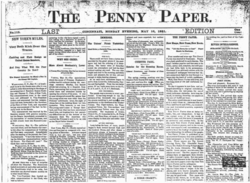
The publication began on January 3, 1881, as The Penny Paper, operating out of a small second-floor office at Vine and Longworth streets. Founded by brothers Walter E. and Frank Wellman, the paper initially struggled financially. By March, the Wellmans accepted investment from James E. and Edward Willis (E. W.) Scripps, who provided the funds necessary to purchase a press and move to a larger facility on Home Street.
The paper's early identity was closely tied to the religious community, often serving as a voice for the "religious element" of Cincinnati. This alignment helped the paper's circulation quadruple during the 1882 camp meetings of the "Boy Preacher" Rev. Thomas Harrison.
Evolution of the Brand
The publication underwent several name changes as it grew in influence and ownership shifted. On February 11, 1883, it became The Penny Post. By October 11, 1883, it was renamed The Evening Post, though it maintained its one-penny price point until 1918. Finally, on September 2, 1890, it adopted the name The Cincinnati Post.
Expansion into Kentucky began in 1890 with a dedicated edition covering Covington, Newport, Bellevue, Dayton, and Ludlow. This venture, later renamed The Kentucky Post, became so successful that it drove its primary local rival, The Commonwealth, out of business.
A Crusader for Reform
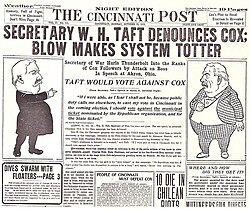
For nearly five decades, the Post was defined by its fight against bossism—the control of a city's political process by a single powerful "boss." Aligning with the local Democratic Party, the paper launched aggressive campaigns against figures like Thomas C. Campbell, a notorious jury fixer, and later George B. Cox.
The paper's commitment to the truth often came at a high cost. Editors and managers required bodyguards due to threats from the Cox machine, and the paper frequently suffered advertising boycotts after exposing collusion and graft. Despite these financial hits, the Post remained profitable because its investigative exposés were immensely popular with the public.
Political Influence and the Municipal Charter
The Post's influence peaked in 1924 when it became the only Cincinnati daily to endorse a new municipal charter. This charter introduced a council-manager system and proportional representation, effectively ending the era of political machines in the city. This shift in governance notably led to the demise of the Cincinnati Subway, which was viewed as a product of the old boss system.
Consolidation and the Media Empire
In 1935, the parent company, Scripps-Howard Newspapers, expanded into broadcasting by purchasing AM station WFBE, renaming it WCPO ("The Voice of the Cincinnati Post"). This was followed by the launch of WCPO-TV in 1949.
The mid-20th century saw a period of intense consolidation. In 1956, Scripps-Howard acquired a controlling interest in The Cincinnati Enquirer, and in 1958, it purchased The Times-Star. For a period, the paper was known as The Cincinnati Post and Times-Star before reverting to its original name in 1974.
![The Post published from the Times-Star Building from 1958 to 1984.[61] American Financial, the Enquirer's corporate parent, purchased the building in 1975.[62]](/images/dd/68/dd68b0e767706dff5abe097e641e130315fe5ba2814ebb191764ac700a8e81f7.jpg)
The Joint Operating Agreement (JOA)
By the late 1970s, the Post faced severe financial instability. In 1977, it entered into a Joint Operating Agreement (JOA) with The Cincinnati Enquirer. Under this legal arrangement, the Enquirer handled all business operations—including printing, distribution, and advertising—while the Post maintained its own editorial voice.
While the JOA was intended to preserve a second editorial voice in a "no-growth market," it resulted in the elimination of 500 jobs and the cessation of the Post's Sunday publication. In 2000, both papers transitioned to a narrower format, similar to the Berliner style, to reduce newsprint costs and improve readability.
Decline and Final Edition
The 1980s and 90s saw a steady decline in readership. By 2003, the Post's daily circulation had plummeted to roughly 23% of the Enquirer's. The paper attempted to pivot its focus toward the Kentucky market, but the trend continued downward.
On July 17, 2007, the E. W. Scripps Company confirmed that both The Cincinnati Post and The Kentucky Post would cease publication. The final print edition was published on December 31, 2007, featuring the headline "-30-"—a traditional newsroom code for the end of a story.
| Period/Date | Key Milestone | Outcome/Impact |
|---|---|---|
| 1881 | Founded as The Penny Paper | Started as a low-cost daily for the religious community. |
| 1890 | Renamed The Cincinnati Post | Established a permanent brand and expanded into Kentucky. |
| 1924-1925 | Endorsed Municipal Charter | Helped dismantle political machines in Cincinnati. |
| 1958 | Merged with Times-Star | Consolidated afternoon market share. |
| 1979 | JOA with The Enquirer | Shared business operations to avoid financial collapse. |
| 2007 | Ceased Publication | Ended 126 years of print journalism. |
Key Facts
- Founding: Started January 3, 1881, as The Penny Paper.
- Ownership: Became part of the first modern newspaper chain, the Scripps-McRae League, in 1895.
- Reform: Played a pivotal role in ending "bossism" and political machines in Cincinnati.
- Reach: At its peak in 1961, combined circulation reached 275,000.
- Broadcasting: Launched WCPO-AM and WCPO-TV as extensions of the paper's news reach.
- Closure: Published its final edition on December 31, 2007.
Frequently Asked Questions
Why was the paper originally called The Penny Paper?
It was named for its price point, as the founders hoped to emulate the success of the Cleveland Penny Press by providing affordable news to the general public.
What was the "bossism" the Post fought against?
Bossism refers to the political system where a single "boss" or machine (such as those led by Thomas C. Campbell and George B. Cox) controlled local government through graft, corruption, and jury-fixing.
What is a Joint Operating Agreement (JOA)?
A JOA is a legal arrangement where two competing newspapers merge their business operations (printing, advertising, and distribution) while keeping their newsrooms and editorial voices separate.
Why did The Cincinnati Post eventually close?
The closure was caused by a combination of factors, including the expiration of the JOA, a 75% decrease in readership, and a significant drop in advertising revenue.
What happened to the Kentucky Post?
The Kentucky Post was originally a supplement to the Cincinnati paper but eventually became a dominant force in 12 Kentucky counties. It ceased publication simultaneously with the Cincinnati Post in 2007.