
The Sun: The Newspaper That Revolutionized American Journalism
Founded in New York City on September 3, 1833, The Sun was more than just a morning newspaper; it was a catalyst for a media revolution. Edited by Benjamin Day and launched with the inclusive slogan "It Shines for All," the publication fundamentally changed who had access to information and how that information was gathered and sold.
At a time when most newspapers cost five cents and catered to the elite, The Sun was sold for a single penny (approximately 33¢ in 2025). This affordability, combined with a portable format and a focus on illustrations, made it an immediate hit with working-class readers. This shift gave birth to the penny press, a genre of journalism that democratized news across the United States.
Key Facts
- Founded: September 3, 1833, by Benjamin Day.
- Innovation: Pioneered the "penny press" model, making news affordable for low-income readers.
- Distribution: First to employ newspaper hawkers (newsboys) to sell copies on the street.
- Revenue Model: Shifted the industry toward advertising-supported revenue rather than relying solely on subscriptions.
- Journalistic Firsts: Introduced professional reporters to collect stories and pioneered crime and human-interest reporting.
Pioneering the Craft of Reporting
Before The Sun, newspapers primarily published political essays, book reviews, or theater critiques, often relying on reader submissions or unauthorized copies of other papers. Benjamin Day revolutionized this by hiring dedicated reporters to actively seek out and collect stories, establishing the foundation for modern storytelling and reporting.
The Sun shifted the editorial focus toward the masses, prioritizing police reports and human-interest stories. It was the first newspaper to report on crimes and personal tragedies, such as suicides, deaths, and divorces. By focusing on the lives of ordinary people rather than just the landed and mercantile elites, The Sun and its rival, the New York Herald, often championed the working class.
Notable coverage included high-profile murder cases, such as those of Helen Jewett, Mary Rogers, and John C. Colt. These stories provided New Yorkers with a raw look at how their city functioned, highlighting corruption, abuses of state power, and violations of justice.
Business Innovations and Growth
Beyond editorial content, The Sun transformed the economics of the press. It demonstrated that a newspaper could be profitable by relying on advertisements rather than expensive subscription fees. This allowed the paper to be sold directly on the street, creating the iconic image of the shouting newsboy.
Ownership transitioned in 1834 when Benjamin Day's brother-in-law, Moses Yale Beach, joined the venture. Beach eventually became the sole proprietor and led the paper to become the largest in New York for two decades, though it faced stiff competition from the New-York Tribune and the New York Herald.
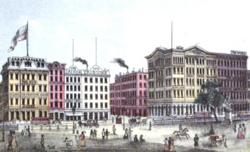
![The offices of The Sun, 1893[11]](/images/5f/60/5f6043097b8f265c1c90a566dac2defef5e7b72c707e6fb76da5db04905ae7fa.jpg)
Logistics and Communication
To maintain its edge, The Sun utilized every available communication technology of the era. From its early offices at Printing House Square (now Park Row), the paper used a rooftop pigeon house to receive news from New York Harbor. As technology evolved, the staff employed horses, steamships, trains, the telegraph, the Pony Express, and Royal Mail Ships to gather information.
Later Years and Political Impact
Following the retirement of Moses Yale Beach, the paper was eventually sold in 1868 to Charles A. Dana, who had served as the Assistant Secretary of War under Abraham Lincoln. Under Dana, The Sun became a powerhouse of investigative journalism, exposing major political scandals:
- The Crédit Mobilier Scandal (1872): Implicated corrupt Congressmen and Vice President Schuyler Colfax in a scheme involving the Union Pacific Railroad.
- The Star Route Scandal (1881): Exposed corruption within the US Postal Service involving high-profile politicians and businessmen.
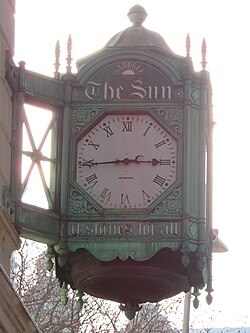
In the early 20th century, media mogul Frank Munsey acquired the paper in 1916, experimenting with various mergers and publishing formats. By 1919, The Sun moved to 280 Broadway, a site previously occupied by America's first department store. This location was renamed "The Sun Building" in 1928 and featured a prominent clock at the corner of Broadway and Chambers Street.
The Final Chapters
By the 1940s, The Sun had shifted toward a conservative editorial stance, opposing labor unions and the New Deal. Despite this, it maintained journalistic excellence, winning a Pulitzer Prize in 1949 for its exposé on labor racketeering.
The independent run of The Sun ended on January 4, 1950, when it merged with the New York World-Telegram. This entity later merged with the New York Herald Tribune to become the World Journal Tribune, which folded in 1967 following disputes with staff unions.
Summary of The Sun's Legacy
| Era/Period | Key Figure | Major Contribution/Event |
|---|---|---|
| 1833–1830s | Benjamin Day | Launched the penny press and street hawking. |
| Mid-19th Century | Moses Yale Beach | Expanded growth and industry innovations. |
| 1868–Late 1800s | Charles A. Dana | Exposed Crédit Mobilier and Star Route scandals. |
| 1916–1925 | Frank Munsey | Merged editions and moved to the "Sun Building." |
| 1940s–1950 | William Dewart | Won 1949 Pulitzer Prize; merged in 1950. |
Frequently Asked Questions
What was the "penny press"?
The penny press refers to a genre of newspapers, pioneered by The Sun, that were sold for one cent. This made news accessible to low-income, working-class readers who previously could not afford the standard five-cent publications.
How did The Sun change how news was gathered?
Benjamin Day was the first to hire professional reporters to go out and collect stories. Previously, newspapers relied on reader submissions, political essays, or copying stories from other publications.
What were some of the major scandals exposed by The Sun?
The Sun was instrumental in exposing the Crédit Mobilier Scandal of 1872, involving the Union Pacific Railroad, and the Star Route Scandal of 1881, involving the US Postal Service.
How did The Sun make money if it only cost a penny?
The Sun proved that a newspaper could be financially sustainable by relying on advertising revenue rather than high subscription fees, a model that remains central to print media today.
When did The Sun cease to exist as an independent paper?
The Sun merged with the New York World-Telegram on January 4, 1950, to form the New York World-Telegram and Sun.