
Theodor Johan Christian Ambders Brorsen: A Life of Astronomy and Eccentricity
The life of Theodor Johan Christian Ambders Brorsen was a journey of intellectual pursuit, shifting passions, and personal solitude. Born into a period of transition in South Jutland, Brorsen evolved from a law student into a dedicated astronomer, eventually spending his final years as a naturalist and eccentric figure in his hometown of Nordborg.
Early Life and Academic Pursuits
Born in Nordborg on the island of Als, Brorsen was the son of Captain Christian August Brorsen and Annette Margrethe Gerhardine Schumacher. His middle names were a tribute to his maternal great-grandfather, Johan Christian Ambders, a counsel in Nordborg. Following his parents' amicable divorce in 1822, he was raised by his mother, whose financial stability provided him with an extensive education.
Brorsen's academic path began at the Moravian school in Christiansfeld from 1826 to 1829, followed by the Latin school in Flensburg between 1830 and 1839. Initially following his mother's wishes, he studied law across several prestigious cities, including Kiel, Berlin, and Heidelberg. However, by 1844, Brorsen decided to follow his true inclinations and pivoted his studies toward astronomy in Kiel.
Professional Career in Astronomy
Brorsen's professional journey in astronomy took him through several notable observatories. He worked at the Kiel astronomical observatory in 1846 and the Altona Observatory in 1847. While he was offered a position at the "Rundetaarn" (Round Tower) observatory in Copenhagen, he declined the offer in favor of a role at the private observatory of Baron John Parish (also known as Freiherr von Senftenberg) in Žamberk, located in the present-day Czech Republic.
Despite his dedication, Brorsen faced professional setbacks. In 1854, he applied for the directorship of the Altona Observatory but was not selected. Following the death of Baron Parish in 1858, the Senftenberg observatory was dismantled and its instruments sold. Even though Brorsen offered to continue his research for free, the facility was closed. Undeterred, he remained in Senftenberg for another 12 years, conducting observations using his own personal instruments.
Return to Nordborg and Later Interests
In 1870, Brorsen returned to Nordborg. At the time, the region had become Prussian following the Second War of Schleswig in 1864, and later became part of Germany in 1871. In 1874, he settled into the house at Løjtertoft 11, where he was supported by his unmarried half-sister, Amalie Petrine Brorsen.
During his final years, Brorsen largely stepped away from astronomy. He redirected his scientific curiosity toward meteorology—including the study of the Northern Lights—and botany, with a specific passion for orchid breeding.
Personal Life and Eccentricities
Brorsen was known as an introverted individual who struggled with relationship anxieties. He remained unmarried after breaking off two engagements at the last moment: first to Louise Lassen of Sønderborg, and later to Miss Bernkopf of Žamberk.
In the last 25 years of his life, Brorsen developed several idiosyncratic habits. He neglected his appearance, allowing his hair to grow long and cutting holes into his boots where they felt too tight. He also maintained a strict daily routine of bathing in the lake known as Oldenor; during the winter months, he would hoe a hole through the ice to continue this practice.
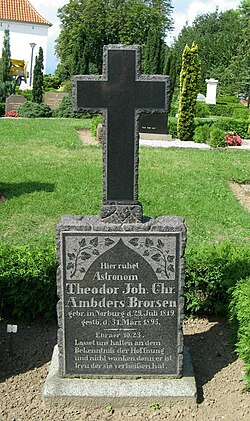
Brorsen passed away at the age of 75 and was buried on April 5, 1895, in the Nordborg cemetery.
Key Facts
- Birthplace: Nordborg, island of Als, South Jutland.
- Education: Studied law in Kiel, Berlin, and Heidelberg before switching to astronomy in Kiel (1844).
- Career Highlights: Worked at observatories in Kiel, Altona, and the private observatory of Baron John Parish in Žamberk.
- Later Interests: Shifted focus to meteorology, Northern Lights observations, and orchid breeding.
- Death: Died at age 75; buried April 5, 1895.
| Period | Location/Activity | Primary Focus |
|---|---|---|
| 1826–1839 | Christiansfeld & Flensburg | Early Education |
| 1839–1842 | Kiel, Berlin, Heidelberg | Law Studies |
| 1844–1858 | Kiel, Altona, Žamberk | Professional Astronomy |
| 1858–1870 | Žamberk (Senftenberg) | Independent Astronomy |
| 1870–1895 | Nordborg | Meteorology & Botany |
Frequently Asked Questions
Why did Brorsen change his field of study from law to astronomy?
Although he studied law in several cities to satisfy his mother's requests, Brorsen eventually decided to follow his own personal inclinations and began studying astronomy in Kiel in 1844.
Where was the observatory where Brorsen worked for Baron John Parish?
The observatory was located in Žamberk, which was known as Senftenberg at the time, in the present-day Czech Republic.
What scientific interests did Brorsen pursue after returning to Nordborg?
In his later years, he focused on meteorology, the observation of the Northern Lights, and botany, specifically the breeding of orchids.
What were some of Brorsen's most notable eccentricities?
Brorsen was known for neglecting his clothing, cutting holes in his boots for comfort, and bathing in the Oldenor lake daily, even in winter by cutting a hole in the ice.
Why did Theodor Brorsen never marry?
Due to an introverted nature and relationship anxieties, Brorsen broke off two separate engagements at the last moment and remained unmarried throughout his life.