
Tianwen Space Missions: China's Journey to Mars, Venus, and Beyond
China has rapidly expanded its footprint in deep space through the Tianwen (Heavenly Quest) program. From the historic first steps on the Martian surface to ambitious plans for the outer solar system, the China National Space Administration (CNSA) is executing a multi-decade roadmap to study planets, asteroids, and comets.
Tianwen-1: The Martian Milestone
Launched on July 23, 2020, from Wenchang, Tianwen-1 was China's first independent Mars exploration mission. It was designed with an ambitious goal: to achieve orbiting, landing, and roving capabilities simultaneously using a single spacecraft stack. This stack included an orbiter, a lander, a rover, and several deployable and remote cameras.
After a 202-day interplanetary journey, the spacecraft entered Martian orbit on February 10, 2021. During the transit, a deployable camera released in September 2020 provided critical imagery confirming the spacecraft's status. Following several orbital maneuvers to survey potential landing sites, the lander and the Zhurong rover separated from the orbiter on May 14, 2021.
The descent through the Martian atmosphere lasted approximately nine minutes, culminating in a successful soft landing in Utopia Planitia. This achievement made China the second country in history, after the United States, to operate a fully functional spacecraft on the surface of Mars.
On May 22, 2021, Zhurong deployed from its platform to begin its exploration. The rover's Mars Climatic Station (MCS) successfully recorded Martian sounds, becoming only the second instrument to do so after the Perseverance rover's microphones. On June 1, 2021, a remote selfie camera captured images confirming the successful landing of both the rover and lander.
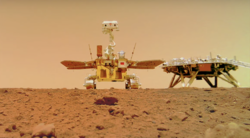
The orbiter continued its mission, releasing another deployable camera on December 31, 2021, to image the orbiter and the Utopia Planitia region. Additionally, a specialized selfie stick payload was deployed on January 30, 2022, to capture images of the orbiter's key components and the Chinese flag in honor of the Chinese New Year.
Upcoming and Planned Deep Space Missions
Tianwen-2: Asteroid and Comet Exploration
Scheduled for launch on May 28, 2025, from Xichang, Tianwen-2 will mark China's first asteroid exploration mission. The spacecraft—comprising an orbiter, a return module, and various cameras—is designed to orbit a main-belt comet and return samples from a near-Earth asteroid.
Tianwen-3: Mars Sample Return
The CNSA has announced plans for a complex Mars sample-return mission known as Tianwen-3. Currently planned for a 2028 launch and a 2031 return to Earth, the mission will utilize two spacecraft: one to land and collect samples from the surface, and a second to transport those samples via a return capsule back to Earth.
Venus Exploration Evolution
Initial plans featured the VOICE (Venus Volcano Imaging and Climate Explorer) orbiter, intended for a 2026 launch. VOICE was designed to use a Microwave Radiometric Sounder (MRS), Polarimetric Synthetic Aperture Radar (PolSAR), and an Ultraviolet-Visible-Near Infrared Multispectral Imager (UVN-MSI) to produce one-meter resolution surface images and search for biosignatures in the clouds.
However, according to the National Space Science Medium- and Long-Term Development Plan (2024-2050), VOICE was replaced by a Venus atmosphere sample return mission. A 2024 roadmap from China's Deep Space Exploration Lab envisions a spaceplane-type craft for this purpose, with a projected launch in 2033.
Jupiter and Uranus Exploration
China is planning a mission to the Jovian system, potentially targeting the moon Callisto. Whether designated as the "Jupiter Callisto Orbiter" or "Jupiter System Observer," the mission is expected to launch in 2029 and arrive in 2035, utilizing one Venus flyby and two Earth flybys for gravity assistance. The mission will also include a probe to conduct a flyby of Uranus after 2040.
Key Facts
- Tianwen-1: First Chinese mission to orbit, land, and rove on Mars.
- Zhurong Rover: Landed in Utopia Planitia on May 14, 2021.
- Tianwen-2: Planned for 2025 to return samples from a near-Earth asteroid.
- Tianwen-3: Planned 2028 launch for a Mars sample-return mission.
- Venus Mission: Shifted from the VOICE orbiter to a spaceplane-type atmosphere sample return planned for 2033.
- Jupiter Mission: Planned 2029 launch with a potential Uranus flyby after 2040.
| Mission | Target | Primary Goal | Status/Date |
|---|---|---|---|
| Tianwen-1 | Mars | Orbit, Land, and Rove | Completed (2020-2021) |
| Tianwen-2 | Asteroid/Comet | Sample Return | Planned (2025) |
| Tianwen-3 | Mars | Sample Return | Planned (2028) |
| Venus Mission | Venus | Atmosphere Sample Return | Planned (2033) |
| Jupiter Mission | Jupiter/Uranus | System Observation | Planned (2029) |
Frequently Asked Questions
Where did the Zhurong rover land on Mars?
The Zhurong rover made a successful soft landing in the Utopia Planitia region of Mars on May 14, 2021.
What is the purpose of the Tianwen-2 mission?
Tianwen-2 is designed to orbit a main-belt comet and return samples from a near-Earth asteroid to Earth.
How will the Tianwen-3 Mars sample return work?
The mission will use two spacecraft: one to collect samples from the Martian surface and send them into orbit, and a second to carry those samples back to Earth in a return capsule.
What happened to the VOICE mission to Venus?
The VOICE orbiter mission was not selected for development under the 2024-2050 National Space Science Plan and was replaced by a planned Venus atmosphere sample return mission using a spaceplane-type craft.
When is China planning to explore Jupiter?
The mission to the Jupiter system is planned for launch in 2029, with an expected arrival in 2035 and a subsequent flyby of Uranus after 2040.