
Topkapı Scroll: A Masterclass in Timurid Architectural Geometry
The Topkapı Scroll serves as a sophisticated visual archive of the geometric brilliance found in the Timurid dynasty. Spanning the 10th to the 16th century, this document acts as a guidebook for the intricate architectural ornaments that once adorned the walls and domes of the era's most magnificent structures.
Containing 114 geometric patterns rendered in ink and dye, the scroll captures the essence of complex architectural elements. These include muqarnas (honeycomb-like vaulted cells), girih (interlacing geometric star-and-polygon patterns), mosaic panels, and vibrant colorful tiles. Despite its detail, the scroll remains a mystery in some respects: it contains no date, no signature, and provides no instructions on how the patterns were actually constructed.
Key Facts
- Content: 114 geometric patterns drawn in ink and dye.
- Era: Reflects designs from the 10th to 16th century Timurid dynasty.
- Calligraphy: Features square or geometric Kufic script.
- Architectural Links: Patterns correlate with structures such as the mosque gate in Varzaneh.
- Geometry: Includes star figures with 9, 11, 13, and 16 points.
The Art of Geometric Kufic and Banna'i
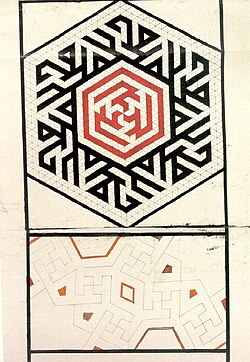
A defining characteristic of the Topkapı Scroll is its use of geometric Kufic, a stylized form of Arabic calligraphy. This rectangular script first appeared during the Ilkhanate state and was likely inspired by the form of Chinese characters.
The scroll illustrates the application of this script in banna'i, a technique where glazed tiles are alternated with plain bricks to create geometric patterns across a wall's surface. The accuracy of these drawings is evidenced by a specific pattern in the scroll that almost exactly matches the ornamentation found on the gate of a mosque in Varzaneh.
Some designs blend spiritual tradition with mathematical precision. For instance, one hexagonal pattern repeats the name of Muhammad (Muḥammad ibn ʿAbd Allāh) six times along the outer sides, while the name of Ali (Alī ibn Abī Ṭālib) is repeated three times in rotational symmetry within the inner hexagon.
Mathematical Complexity and Scale
The scroll showcases a high level of geometric sophistication, featuring star figures with nine, eleven, thirteen, and sixteen points. In the tradition of Islamic art, these complex stars were typically developed by folding specific patterns along the sides of a square.
Another notable feature is the use of overlapped patterns of varying scales. This mirrors a common technique in Islamic architecture where a building's ornamentation reveals deeper, more detailed patterns as a viewer moves closer, while maintaining a cohesive look from a distance.
Because the Topkapı Scroll presents these designs in two dimensions, historians and architects still debate exactly how these flat patterns were translated into the three-dimensional ornaments seen on physical buildings.
| Feature | Details |
|---|---|
| Total Patterns | 114 |
| Dynastic Influence | Timurid (10th–16th Century) |
| Script Style | Square/Geometric Kufic |
| Star Point Variations | 9, 11, 13, and 16 points |
| Key Techniques | Banna'i, Girih, Muqarnas |
Frequently Asked Questions
What is the Topkapı Scroll?
It is a guidebook consisting of 114 geometric patterns in ink and dye, documenting architectural ornaments from the Timurid dynasty between the 10th and 16th centuries.
What is geometric Kufic?
Geometric Kufic is a rectangular form of Arabic calligraphy that first appeared in the Ilkhanate state, possibly inspired by Chinese characters.
How were the star patterns in the scroll created?
The nine, eleven, thirteen, and sixteen-pointed stars were developed by folding certain patterns along the sides of a square, a common practice in Islamic art.
What is the banna'i technique mentioned in the scroll?
Banna'i is an architectural method where plain bricks and colored tiles are alternated to create geometric patterns and calligraphy on wall surfaces.
Does the scroll explain how to build these patterns?
No, the scroll does not mention the construction methods for the patterns, nor does it include a date or a signature.