
Trompe-l'œil Across Art and Media
Trompe-l'œil, a French term meaning "deceive the eye," is an artistic technique used to create the optical illusion that depicted objects exist in three dimensions. While often associated with classical painting, this method of visual deception spans a vast array of disciplines, from the grandeur of Italian palaces to the digital landscapes of modern video games.
Key Facts
- Forced perspective is a form of trompe-l'œil used in theater to create the illusion of depth.
- Matte painting is a cinematic variant where scenes are painted on glass panels.
- Frescography is a modern method of producing illusion paintings developed by Rainer Maria Latzke.
- Lüftlmalerei refers to the illusion architecture common on facades in the Alpine region.
- The technique is used in fashion, cinema, street art, and interactive gaming to manipulate the viewer's perception of space.
Trompe-l'œil in Architecture and Stage Design
One of the most effective applications of trompe-l'œil is forced perspective, a technique that manipulates visual cues to make a space appear deeper than it actually is. This has been a staple of stage-theater set design for centuries. A landmark example is the Teatro Olimpico in Vicenza, where Vincenzo Scamozzi designed seven "streets" in 1585 that appear to recede far into the distance.
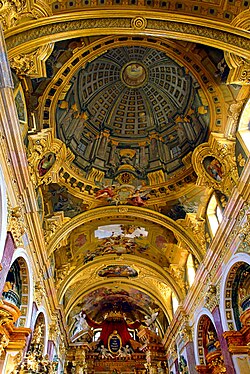
In permanent architecture, the technique has been used both for aesthetic grandeur and cost-saving measures. The Palazzo Salis of Tirano, Italy, utilized trompe-l'œil to mimic expensive masonry, balconies, staircases, and draperies, creating an atmosphere of opulence without the cost of real materials. Similarly, in the Alpine region, illusion architecture and Lüftlmalerei (traditional facade painting) are common features of local buildings.
Modern urban environments also embrace these illusions. In Chicago's Near North Side, artist Richard Haas transformed a 16-story 1929 apartment hotel in 1981 with murals honoring Chicago school architecture, including a depiction of the Chicago Board of Trade Building designed to look like a reflection of the actual building located two miles south.
Cinema, Animation, and Digital Media
The film industry has long relied on trompe-l'œil to expand its visual horizons. Matte painting—where elements of a scene are painted on glass panels placed before the camera—is a direct variant of this technique. In live-action cinema, the 1952 film Singin' in the Rain features a famous sequence where Donald O'Connor runs up a wall; the scene transitions from a real wall to a large trompe-l'œil mural of a hallway. Director Roy Andersson has also employed similar visual tricks in his feature films.
In animation, the technique is often used for comedic effect. Looney Tunes frequently uses "fictional" trompe-l'œil, such as Wile E. Coyote painting a tunnel on a rock wall that the Road Runner appears to drive through. This specific sight gag was later referenced in Who Framed Roger Rabbit. From a more philosophical perspective, Japanese animator Isao Takahata viewed trompe-l'œil as essential for making fantasy worlds feel as if they "existed right there," thereby increasing the audience's belief in the characters.
Contemporary digital media continues this trend. The music video for OK Go's "The Writing's on the Wall" utilizes trompe-l'œil and other optical illusions in a single-shot take. Furthermore, video games like The Witness and Superliminal have integrated these illusions directly into their gameplay mechanics.
Fashion and Contemporary Art
Trompe-l'œil has also made a significant mark on the world of fashion. Designer Elsa Schiaparelli was a pioneer in this area, creating the Bowknot Sweater, which is widely regarded as one of the first uses of the technique in clothing. Her collaboration with Salvador Dalí on the Tears Dress combined appliqué tears on the veil with trompe-l'œil tears painted on the dress itself.
In the realm of contemporary fine art, street painting (or pavement art) uses chalk on sidewalks to create startling 3D effects. Because these works are temporary and wash away, they are preserved primarily through photography. Notable practitioners include Julian Beever, Edgar Mueller, Leon Keer, and Kurt Wenner.
Interior design has also seen a renaissance of "illusion painting" since 1980. English artist Graham Rust and German muralist Rainer Maria Latzke are key figures in this movement; Latzke specifically invented frescography in the 1990s to modernize the production of illusion paintings.
| Field | Specific Technique/Example | Primary Purpose |
|---|---|---|
| Theater | Forced Perspective | Creating depth on a shallow stage |
| Cinema | Matte Painting | Adding painted environments to film |
| Fashion | Schiaparelli's Bowknot Sweater | Visual deception in garment design |
| Architecture | Lüftlmalerei | Decorative facade illusions |
| Street Art | Pavement Art | Temporary 3D chalk illusions |
| Gaming | Gameplay Mechanics | Interactive spatial puzzles |
Frequently Asked Questions
What is the difference between trompe-l'œil and forced perspective?
Trompe-l'œil is the broad artistic technique of "deceiving the eye" to create a 3D illusion. Forced perspective is a specific application of this technique, often used in theater and architecture, to make an object or space appear farther away, closer, larger, or smaller than it actually is.
How is matte painting related to trompe-l'œil?
Matte painting is a cinematic variant of trompe-l'œil. Instead of painting a wall or ceiling, artists paint realistic environments on glass panels that are positioned in front of the camera to blend with live-action footage.
What is frescography?
Frescography is a modern method of producing illusion paintings invented in the 1990s by the German muralist Rainer Maria Latzke.
Where can I see large-scale trompe-l'œil as a tourist attraction?
Many Asian countries host attractions like the Trickeye Museum and the Hong Kong 3D Museum, where visitors can photograph themselves within illusory scenes. Similar Trick Art Museums have also opened in Europe.
Who are some famous contemporary street painters?
Prominent artists who use chalk to create 3D pavement art include Julian Beever, Edgar Mueller, Leon Keer, and Kurt Wenner.