
Truss Bridges of Europe and North America: A History of Timber Engineering
Covered bridges are iconic structures defined by their longitudinal timber-trusses—the structural backbone that supports the bridge's weight. While often associated with rural landscapes, these bridges represent a significant evolution in engineering, transitioning from early intuitive designs to precise mathematical analyses. From the ancient spans of Switzerland to the vast networks of the United States and Canada, these structures served as vital links for transport and commerce.
Key Facts
- The Kapellbrücke in Switzerland is the world's oldest surviving truss bridge, dating back to the 1300s.
- The Hartland Bridge in New Brunswick, Canada, is the longest covered bridge in the world.
- Approximately 14,000 covered bridges were constructed in the United States, primarily between 1825 and 1875.
- Squire Whipple revolutionized bridge building in 1847 by publishing the first correct analysis of load distribution in trusses.
- The transition to wrought and cast iron in the mid-19th century rendered timber covers unnecessary.
European Origins and Evolution
Europe provided the early blueprints for the timber truss bridges later seen in North America. Switzerland, in particular, was a pioneer, developing modern-style timber truss bridges in the mid-1700s. The country is home to several notable examples, including the Neubrügg, the Spreuer Bridge, and the historic Kapellbrücke.
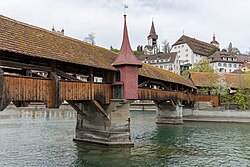
Germany also maintains a rich heritage with 70 surviving historic wooden covered bridges. One of the most significant is the Holzbrücke Bad Säckingen, which connects Bad Säckingen, Germany, to Stein, Switzerland. Originally built before 1272, this bridge has been destroyed and rebuilt numerous times over the centuries.
While most European truss bridges utilized timber, some regions employed other materials. In Italy, the Ponte Coperto in Pavia is a stone and brick arch bridge. After the original 1354 structure was damaged by Allied bombing in 1945 and partially collapsed in 1947, a new version was constructed beginning in 1949.
North American Development
Between the late 1700s and late 1800s, Canada and the U.S. built numerous timber covered bridges inspired by German and Swiss designs. Most of these were single-lane structures designed to cross streams. While most had a single span, a few two-lane versions were created by adding a third, central truss.
Engineering and Truss Designs
Early builders relied on a rough understanding of dynamics, but several distinct designs emerged to improve stability. The Burr Truss, patented in 1817, became highly popular by combining an arch to bear the load with trusses to maintain rigidity. Other common designs included the King, Queen, Lattice, and Howe trusses.
A turning point occurred in 1847 when American engineer Squire Whipple published the first accurate analysis of how loads are carried through truss components. This scientific approach allowed engineers to build stronger bridges using fewer materials.
The Legacy of Covered Bridges in the United States
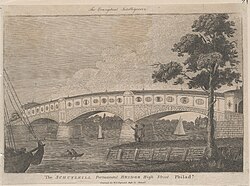
The United States saw a massive boom in construction between 1825 and 1875. The first documented example was the Permanent Bridge in Philadelphia, completed in 1805 to span the Schuylkill River.
Early examples from the 1820s include the Hassenplug Bridge (Pennsylvania) and Hyde Hall Bridge (New York), both from 1825, as well as the Roberts Covered Bridge (Ohio) and Haverhill–Bath Covered Bridge (New Hampshire) from 1829. While a mile-long bridge was built in Lancaster County, Pennsylvania, in 1814, it was lost to flooding and ice in 1832. Today, the Medora Bridge in Indiana and the Cornish–Windsor Bridge (spanning the Connecticut River between New Hampshire and Vermont) are among the longest remaining.
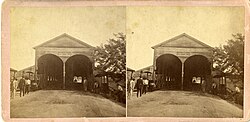
While most remaining bridges are in the east, Oregon has a unique collection of about fifty. These remained popular due to the state's abundant lumber and waterways, as well as a cultural resemblance to the covered wagons of the territorial era. By 2021, the World Guide to Covered Bridges listed 840 bridges in the U.S., including the Felton Covered Bridge in California, which stands as the tallest at 35 feet.
Covered Bridges in Canada
Canada's covered bridge population has declined significantly, dropping from roughly 400 in 1969 to under 200 by 2015. The distribution varies greatly by province:
- Quebec: Once home to an estimated 1,000 bridges in 1900, Quebec saw a construction peak in the 1930s. Many were built as pont rouges (red bridges) using the Town québécois design—a variant of the 1820 Ithiel Town lattice truss. Today, 82 remain, including the Félix-Gabriel-Marchand Bridge.
- New Brunswick: This province also built bridges into the 1950s, peaking at 400. It currently hosts 58 bridges, including the world's longest, the Hartland Bridge.
- Ontario: Only two remain: the West Montrose Covered Bridge and a short bridge in Latchford.
Summary of Regional Bridge Characteristics
| Region | Notable Feature/Bridge | Key Design/Material | Status/Quantity |
|---|---|---|---|
| Switzerland | Kapellbrücke | Timber Truss | Oldest surviving truss bridge |
| United States | Permanent Bridge | Burr, Howe, Lattice Trusses | ~840 listed (2021) |
| Quebec, Canada | Félix-Gabriel-Marchand | Town québécois (Lattice) | 82 remaining |
| New Brunswick | Hartland Bridge | Howe, Town, Burr Trusses | World's longest |
Frequently Asked Questions
Why were these bridges covered?
The covers were designed to protect the timber trusses from the elements, preventing rot and extending the lifespan of the wooden structure.
What is a Burr Truss?
Patented in 1817, the Burr Truss is a design that uses an arch to support the primary load while the surrounding trusses provide the necessary rigidity to the bridge.
Why did the construction of covered bridges decline?
The introduction of cheaper wrought and cast iron in the mid-19th century allowed for metal trusses that did not require covers. Additionally, timber bridges were often too narrow or low to accommodate modern, heavy traffic.
Who provided the first scientific analysis of truss loads?
American engineer Squire Whipple published the first correct analysis of load distribution in 1847, which enabled the construction of stronger bridges using fewer materials.
Which is the longest covered bridge in the world?
The Hartland Bridge, located in New Brunswick, Canada, is recognized as the longest covered bridge in the world.