
Tudor Rose: The Heraldic Symbol of English Unity
The Tudor rose is one of the most recognizable symbols of English heritage. While often associated with the bloody conflicts of the 15th century, the rose is more than just a floral emblem; it is a masterclass in political branding. Created to signify the end of civil war and the unification of two warring dynasties, the Tudor rose remains a prominent feature of British royal and national identity today.
The Origins of the Tudor Rose
The story of the Tudor rose begins with the Battle of Bosworth Field in 1485. In this decisive conflict, Henry VII of the House of Lancaster defeated Richard III of the House of York, effectively ending the period now known as the Wars of the Roses. To solidify his claim to the throne and heal the divide between the two factions, Henry VII married Elizabeth of York in January 1486.
Contrary to popular belief, the juxtaposition of the red rose (Lancaster) and the white rose (York) was largely a creation of Henry VII himself. Historian Thomas Penn notes that the "Lancastrian" red rose barely existed as a formal emblem before Henry VII; previous kings of that house often used gold roses or the antelope badge. For nearly twenty-five years, the white rose of Edward IV was the only royal rose in prominence. By merging the two, Henry VII positioned himself as a "peacemaker king," using the new symbol to legitimize his reign.
The resulting Tudor rose is typically depicted as a double rose—a white rose superimposed on a red one. In heraldry, it is described as "proper," meaning it is shown in its natural colors, despite the fact that such a flower does not exist in nature. It can also appear "quartered" (divided into four sections) or "per pale" (divided vertically into red and white halves).
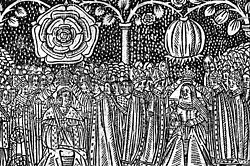
Historical Evolution and Usage
While Henry VII used the Tudor rose strategically, he remained reserved in its application, often continuing to use the Lancastrian rose alone. His son, Henry VIII, who descended from both houses, adopted the symbol more frequently to emphasize his dual lineage.
Royal Monuments and Propaganda
The symbol was used extensively to assert royal legitimacy. When Prince Arthur died in 1502, his tomb in Worcester Cathedral featured both roses to highlight his descent from Lancaster and York. Similarly, Henry VII decorated his chapel at Westminster Abbey with the Tudor rose and the Beaufort portcullis as a form of political propaganda.
Henry VIII further integrated the symbol into the state's imagery, including the repainting of the legendary "Round Table" at Winchester Castle, which featured a Tudor rose at its center.
Variations of the Badge
Over time, the Tudor rose appeared in several heraldic variations:
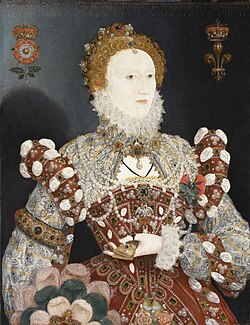
- Slipped and Crowned: Shown as a cutting with a stem and leaves beneath a crown. This version is seen in the "Pelican Portrait" of Elizabeth I and became the official royal floral emblem of England via an Order in Council in 1800.
- Dimidiated: This involves cutting the rose in half and combining it with another emblem. For example, Henry VIII and Catherine of Aragon used a badge combining the Tudor rose with the Spanish pomegranate. Later, James I combined the rose with the Scottish thistle.
Contemporary Significance
Today, the crowned and slipped Tudor rose serves as the official plant badge of England, standing alongside the thistle of Scotland, the leek of Wales, and the shamrock of Ireland.
National and Military Use
The emblem is woven into the fabric of British institutional identity. It appears on the uniforms of the Yeomen of the Guard and the Yeomen Warders at the Tower of London. It is also featured in the Royal Coat of Arms of the United Kingdom, the badge of the Supreme Court of the United Kingdom, and the cap badge of the British Army's Intelligence Corps.
In the Royal Navy, the flagship aircraft carrier HMS Queen Elizabeth uses a Tudor rose divided per pale, a design inherited from the early 20th-century battleship of the same name.
Global and Civic Influence
The influence of the Tudor rose extends beyond the UK. It appears on the coat of arms of Canada and is used in the flags and seals of various North American cities, including Queens, New York, and Annapolis, Maryland. In the United States, cities such as York and Lancaster in both South Carolina and Pennsylvania use stylized red and white roses in their emblems.
Within England, the rose is used by the city of Oxford, the Royal Town of Sutton Coldfield, and the tourist board VisitEngland. Even in sports, the crest of the England national football team features ten Tudor roses.
Key Facts
- Origin: Created by Henry VII after the Battle of Bosworth Field (1485) to symbolize the union of the Houses of Lancaster and York.
- Design: Usually a double rose (white on red), described heraldically as "proper."
- Official Status: Became the royal floral emblem of England by an Order in Council on November 5, 1800.
- Variations: Can be "slipped and crowned" (with stem and crown) or "dimidiated" (half-combined with another symbol).
- Modern Use: Featured on the UK's Royal Coat of Arms, the 20-pence coin (1982-2008), and the England national football team crest.
| Country | Floral Badge |
|---|---|
| England | Tudor Rose |
| Scotland | Thistle |
| Wales | Leek |
| Ireland | Shamrock (or Flax in Northern Ireland) |
Frequently Asked Questions
What do the colors of the Tudor rose represent?
The red represents the House of Lancaster and the white represents the House of York. By combining them, the Tudor rose symbolizes the peace and unity achieved after the Wars of the Roses.
Was the red rose always the symbol of Lancaster?
Not necessarily. Historians note that Lancastrian kings used roses sporadically, and they were often gold. The strong association with the red rose was largely popularized by Henry VII to create a clear visual contrast with the white rose of York.
What does "slipped and crowned" mean in heraldry?
A "slipped" rose is depicted as a cutting with its stem and leaves attached, rather than just the flower head. "Crowned" means the emblem is placed beneath a royal crown.
Where can the Tudor rose be seen today?
It is visible on the Royal Coat of Arms of the UK, the uniforms of the Yeomen Warders, the England national football team crest, and the seals of several cities in the UK and the United States.
How is the Tudor rose used in the Royal Navy?
The current flagship aircraft carrier, HMS Queen Elizabeth, uses a Tudor rose divided vertically (per pale), a heraldic tradition passed down from the original HMS Queen Elizabeth battleship of the early 1900s.