
Ultimate Frisbee Strategy: Mastering Offensive and Defensive Tactics
In the fast-paced world of Ultimate Frisbee, success is determined by more than just athletic ability; it requires a deep understanding of spatial management and tactical coordination. At its core, offensive play is about creating open lanes for the disc to travel, while defense focuses on restricting those lanes and forcing errors. Whether you are a beginner or an experienced player, mastering these strategies is essential for progressing the disc efficiently and scoring goals.
Offensive Foundations: Handlers and Cutters
Most organized teams divide players into two primary roles based on their strengths: handlers and cutters. Handlers are the primary distributors, positioned around the disc to move it forward and provide reset options. Cutters are the receivers positioned downfield, tasked with sprinting into open space to catch the disc and advance toward the end zone.
When facing a zone defense, cutters often adopt specialized roles. Poppers make short cuts within 15 yards of the handlers, while rails (or deep deeps) handle longer movements downfield. Depending on the team's strategy, a zone offense may utilize three or four cutters instead of the standard two or three.
Common Offensive Formations
Vertical Stack
The vertical stack is one of the most widely used strategies. Offensive players line up in a column between the disc and the target end zone, typically in the center of the field. This creates two wide lanes along the sidelines for cutters to make sudden sprints, often using a "fake" move to deceive their defender.
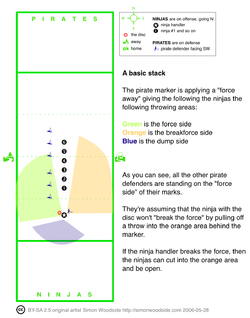
Variations of this system include:
- Side Stack: The stack moves to one sideline, leaving a large open space for a single isolated player (an "ISO" play).
- Split Stack: Players are divided into two separate stacks on either sideline.
- Cascades: Starting from a side stack, players cut in sequence from the top or bottom of the line.
In these systems, one player often acts as the dump, providing a safe reset option behind the thrower.
Horizontal Stack (Ho-Stack)
The horizontal stack features three handlers across the width of the field and four cutters spaced evenly downfield. This formation allows cutters more creativity, as they can attack space both toward and away from the disc. To reset the stall count and shift the defense, handlers will "swing" the disc side-to-side. Cutters typically move in a "diamond" or "peppermill" pattern, cutting toward the disc at an angle and away from it in a straight line.
Specialized Offenses: Feature, Hexagon, and Isolation
The Feature (also known as German or Isolation) is a horizontal stack variation where three cutters stay deep while one "feature" player stays close to the handlers. This maximizes give-and-go opportunities and is particularly effective if the feature player has a speed advantage over their defender.
The Hexagon Offence, created by Felix Shardlow, utilizes equilateral triangles to form a hexagon with one player in the center. This dynamic shape rapidly changes angles of attack to exploit holes in the defense and maintain a fluid flow toward the goal.
Defensive Principles and the Pull
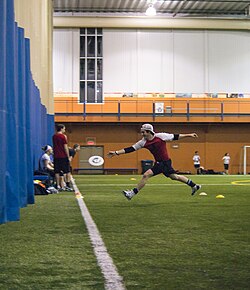
Every point begins with the pull, the initial throw that starts play. A strategic pull aims for maximum hang time and distance, landing as deep in the opponent's end zone as possible to force the offense to cover more ground. Most players use an inside-out backhand to achieve this.
The Force (The Mark)
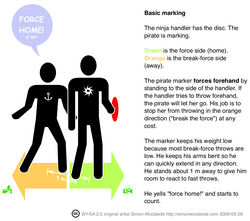
The force (or mark) is the fundamental defensive act of restricting the thrower's options. The marker positions themselves to make throwing to the "break side" difficult, forcing the disc toward the "force side" (or open side). This allows downfield defenders to concentrate their coverage on the force side.
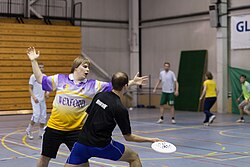
Common force types include:
- Home/Away: Forcing toward the team's bags or away from them.
- Sideline/Middle: Forcing toward the nearest sideline or the center of the field.
- Straight Up: Standing directly in front of the thrower to stop long passes.
- Triangle Mark: An advanced technique using shuffling and drop-stepping to take away specific throwing angles.
Defensive Strategies
Match-to-Match Defense
Also known as man-on-man, this is the simplest strategy where each defender is assigned a specific offensive player (their "mark"). Success depends on individual matchups; if every defender shuts down their mark, the offense is likely to turn over the disc.
Poaching
Poaching occurs when a defender temporarily leaves their assigned mark to cover a dangerous area, such as deep space or a throwing lane. This is often used to prevent a fast score if a cutter accidentally becomes open deep.
Zone Defense
In a zone, defenders cover specific areas of the field rather than individual players. This is highly effective in poor weather or for neutralizing deep threats. Zone defenses typically consist of a cup or wall near the disc and "mids" or "deeps" further upfield.
The Cup: A three-person semi-circle that forces the handler to throw into the defense. Except for the marker, cup players must stay 3 meters away from the thrower unless an offensive player "crashes the cup" by moving within that 3-meter radius.
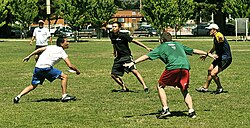
The Wall: Often a "1-3-3" formation featuring a "rabbit" (a fast marker) and a horizontal line of three defenders who block short in-cuts.
Hybrid and Advanced Defenses
- Junk/Clam: A "bait and switch" strategy that looks like man defense but shifts into zonal coverage of cutting lanes.
- Bracket: Used against vertical stacks, this employs a "deep" defender behind the stack and an "under" defender between the stack and the handler.
- Hasami: A Japanese hybrid defense (meaning "scissors") that divides the field into sections (under/away and left/right) using pairs of defenders.
- Flexagon: A combinatory approach where defenders communicate constantly to sandwich opponents and switch marks dynamically.
Key Facts
- Handlers distribute the disc; cutters receive it downfield.
- Vertical Stacks create sideline lanes; Horizontal Stacks offer more width and creativity.
- The Force limits the thrower to one side of the field to simplify downfield coverage.
- Zone Defense is preferred in bad weather to force risky, high-volume passing.
- The Cup is a three-person zone formation that requires a 3-meter distance from the thrower.
| Strategy Type | Name | Primary Goal | Key Characteristic |
|---|---|---|---|
| Offense | Vertical Stack | Create sideline lanes | Players line up in a center column |
| Offense | Horizontal Stack | Maximize field width | Cutters spread across the field |
| Defense | Match-to-Match | Individual shutdown | One-to-one player assignments |
| Defense | Zone (Cup) | Force risky throws | Semi-circular formation around thrower |
| Defense | Junk/Clam | Deceive the offense | Mixes man and zone elements |
Frequently Asked Questions
What is the difference between a handler and a cutter?
Handlers are the primary throwers who manage the disc and distribute it, while cutters are the receivers who sprint into open space to move the disc downfield or score in the end zone.
How does a "force" work in defense?
A force is when the marker positions themselves to block one side of the field (the break side), compelling the thrower to pass toward the other side (the force side), where the rest of the defense is positioned to intercept.
What happens if a player "crashes the cup"?
In a cup defense, defenders must stay 3 meters away from the thrower. If an offensive player moves within 3 meters of the thrower (crashing), the defenders in the cup are then allowed to move within 3 meters as well.
What is a "dump" in a vertical stack?
A dump is a player who positions themselves behind the thrower to provide a safe, short passing option (a reset) if the primary downfield cuts are covered.
When should a team use a zone defense instead of man-to-man?
Zone defense is typically used in poor weather conditions to pressure the offense into making mistakes, or to neutralize an opponent with a very strong deep-throwing game.