
Unissued Circulation Coins: The World's Rarest Numismatic Treasures
In the world of currency, the state maintains strict control over mints to prevent the distribution of counterfeit money. However, the history of coinage is occasionally interrupted by anomalies—coins that appear in the hands of collectors despite being absent from official mint records or marked for destruction. These unissued coins are among the most coveted prizes in numismatics, the scientific study and collection of currency, because they represent mysteries that defy official documentation.
Key Facts
- Unissued coins are specimens that were either never officially recorded or were ordered to be destroyed.
- The 1933 Double Eagle holds one of the highest auction records for a coin at over $18 million.
- Some unissued coins survived only through the intervention of royalty or theft from mints.
- Professional grading services like PCGS and NGC are used to certify the authenticity of these rare specimens.
The Mystery of the 1913 Liberty Head Nickel
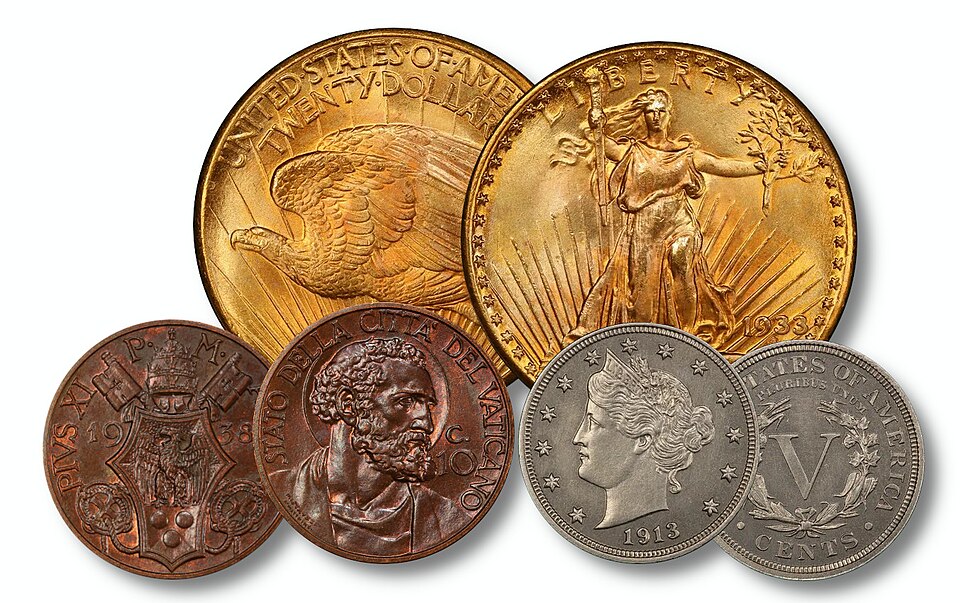
The United States Mint records indicate that no Liberty Head nickels were produced in 1913. Despite this official stance, a previously unknown specimen surfaced in December 1919 during a meeting of the Chicago Coin Club. The exact circumstances of how these coins were created remain a mystery to this day.
Only five examples of this coin are known to exist. The rarity and intrigue surrounding the 1913 Liberty Head nickel drove its value to historic heights; the finest known specimen was sold at the ANA U.S. Stacks Bowers Auction in August 2018 for $4,560,000.
The Vatican City 10 Centesimi of 1938
The 10 centesimi coin from 1938 is officially classified as unissued and does not appear in the records of the Mint of Rome. The reason for its absence was the death of Pope Pius XI; consequently, circulation coins bearing the Pope's name from that year were not released to the public.
The survival of this rarity is attributed to Victor Emmanuel III, the King of Italy, a passionate collector who saved the coins from destruction. To date, eight specimens have been certified by professional grading services such as PCGS and NGC. The finest known example, graded MS65, has never been offered for sale.
The 1933 Double Eagle: A Forbidden Treasure
The 1933 double eagle is perhaps the most famous example of a coin that should not exist. While official records show no issuance, it is alleged that 445,500 specimens were minted over three weeks in March 1933. None were officially circulated, and the government ordered all but two to be melted down.
While only two were intended to survive, several coins were stolen from the mint without officials realizing it. Today, only 14 specimens are known, and only one is held in private ownership. This specific coin, graded MS65, fetched a staggering $18,872,250 at a Sotheby's auction on June 8, 2021.
Summary of Rare Unissued Coins
| Coin Name | Country/Entity | Known Quantity | Notable Value/Status |
|---|---|---|---|
| 1913 Liberty Head Nickel | United States | 5 | $4,560,000 (2018 Auction) |
| 1938 10 Centesimi | Vatican City | 8 (Certified) | Finest (MS65) never sold |
| 1933 Double Eagle | United States | 14 | $18,872,250 (2021 Auction) |
Frequently Asked Questions
What makes a coin "unissued"?
A coin is considered unissued if it does not appear in the official mint records of the issuing authority or if the records indicate that the entire mintage was destroyed and never released for circulation.
Why are unissued coins so valuable to collectors?
Their value stems from extreme rarity and the unique historical stories associated with their survival, such as theft from a mint or preservation by a royal collector.
How are these rare coins verified?
They are typically verified and graded by professional third-party grading services, such as the Professional Coin Grading Service (PCGS) and the Numismatic Guaranty Company (NGC).
Why was the 1938 Vatican 10 centesimi not issued?
The coins were not issued due to the death of Pope Pius XI, as the coins bore his name.
How many 1933 Double Eagles are privately owned?
Out of the 14 known specimens, only one is currently held in private ownership.