
University of Tulsa: A Comprehensive History from Frontier Origins to Modern Era
The University of Tulsa (TU) stands today as a pillar of higher education in Oklahoma, but its roots stretch back to the late 19th century in the Indian Territory. From its beginnings as a specialized school for young women to its evolution into a comprehensive research university, the institution's journey reflects the growth and ambition of the region itself.
Frontier Origins and Henry Kendall College
The story begins in 1882 in Muskogee, Indian Territory, with the founding of the Presbyterian School for Indian Girls, also known as the "Minerva Home." This institution was established to provide primary education to young women of the Creek Nation.
By 1894, the school expanded and was renamed Henry Kendall College, honoring Henry Kendall, the secretary of the Presbyterian Board of Home Missions. The college's early years were marked by significant milestones, including the granting of Oklahoma's first post-secondary degree in June 1898. Under the leadership of co-founder and president William Robert King, the college moved to a larger campus on land donated by Creek Nation Chief Pleasant Porter.
The institution also played a political role during this era; students, faculty, and administrators were deeply involved in the effort to establish the State of Sequoyah, contributing to the design of its seal and the drafting of its proposed constitution.
The Relocation to Tulsa
Despite its early achievements, the college struggled with small class sizes. By the end of the 1906–07 academic year, only 27 collegiate graduates had emerged. Seeking a more sustainable future, the administration looked toward the growing town of Tulsa.
The Tulsa Commercial Club—the precursor to the Tulsa Chamber of Commerce—secured the college's move in 1907 with an aggressive bid. This package included $100,000, 20 acres of real estate, and guaranteed street car and utility services. The college officially opened in Tulsa in September 1907, just two months before Oklahoma achieved statehood.
Initial classes were held at the First Presbyterian Church until the completion of Kendall Hall in 1908. While the original campus buildings were eventually demolished—the last in 1972—the bell from the Kendall Building tower was preserved and now resides in Bayless Plaza.
The Birth of the University of Tulsa
The early 20th century brought new opportunities and competition. In 1918, oilman Robert M. McFarlin provided funding for the Methodist Church to establish McFarlin College. Recognizing that Tulsa could not support two separate competing institutions, Henry Kendall College merged with the proposed McFarlin College in 1920 to form the University of Tulsa.
The legacy of the original institution persists today through the Kendall College of Arts and Sciences, while the McFarlin name is honored through the university's library.
Growth, Crisis, and Recovery in the 20th Century
The university expanded its academic scope in 1928 by opening the School of Petroleum Engineering. However, the Great Depression nearly ended the institution. By 1935, TU faced a $250,000 debt, plummeting enrollment of 300 students, and low faculty morale.
The university was rescued by oil tycoon Waite Phillips, who appointed former investment banker Clarence Isaiah ("Cy") Pontius as president to stabilize the finances. Pontius's tenure sparked a period of significant growth:
- n
- 1935: The College of Business Administration opened (renamed the Collins College of Business in 2008).
- 1943: The Tulsa Law School became part of the university.
- 1948: William G. Skelly funded the creation of KWGS (now Public Radio Tulsa).
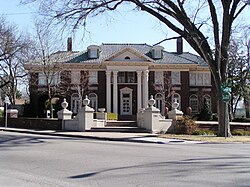
The university also had a unique relationship with the Skelly Mansion. Donated by William G. Skelly's widow, the home was sold in 1959, repurchased in 2012 to serve as the president's residence, and sold again in 2021.
Later in the century, Ben Graf Henneke became the first alumnus to serve as president. He modernized the university by introducing doctoral programs, expanding research facilities for petroleum engineering, and launching publications such as Petroleum Abstracts. He was succeeded by Eugene L. Swearingen, who further expanded the campus footprint and increased the university's endowment.
Modern Evolution in the 21st Century
Under the presidency of anthropologist Steadman Upham (2004–2016), the university underwent a physical and academic transformation. This era saw 13 major construction projects, including the Roxana Rozsa and Robert Eugene Lorton Performance Center. TU also launched the Oxley College of Health Sciences (renamed the Oxley College of Health & Natural Sciences in 2023) and assumed management of the Gilcrease Museum.
The university also became a temporary home for The Bob Dylan Archive in 2016 through a partnership with the George Kaiser Family Foundation.
Recent leadership transitions have included Gerard Clancy (2016–2020), who oversaw a controversial academic restructuring, and Brad R. Carson (2021–2025). Stacy Leeds assumed the presidency on July 1, 2026.
Key Facts
- n
- Founded: 1882 as the Presbyterian School for Indian Girls.
- First Degree: The first post-secondary degree in Oklahoma was granted in June 1898.
- Relocation: Moved from Muskogee to Tulsa in 1907.
- Formation: Created in 1920 via the merger of Henry Kendall College and McFarlin College.
- Financial Rescue: Saved from closure during the Great Depression by the leadership of Cy Pontius and support from Waite Phillips.
- Notable Assets: Home to the Kendall College of Arts and Sciences and the McFarlin Library.
| Year | Event | Significance |
|---|---|---|
| 1882 | Founding of Presbyterian School for Indian Girls | Original root of the institution in Muskogee. |
| 1894 | Renamed Henry Kendall College | Transition to a collegiate structure. |
| 1907 | Relocation to Tulsa | Established higher education in the city of Tulsa. |
| 1920 | Merger with McFarlin College | Official creation of the University of Tulsa. |
| 1928 | School of Petroleum Engineering opens | Expansion into specialized technical education. |
| 1935 | Appointment of Cy Pontius | Financial rescue during the Great Depression. |
| 2016 | Management of Gilcrease Museum | Expansion into cultural and museum management. |
Frequently Asked Questions
What was the original name of the University of Tulsa?
The institution began as the Presbyterian School for Indian Girls in 1882, later becoming Henry Kendall College in 1894 before merging to become the University of Tulsa in 1920.
Why did the college move from Muskogee to Tulsa?
The college struggled with small class sizes in Muskogee. The Tulsa Commercial Club offered a generous incentive package, including $100,000 and 20 acres of land, to relocate the school to Tulsa in 1907.
How did the university survive the Great Depression?
By 1935, the university was near closure due to a $250,000 debt. Oil tycoon Waite Phillips helped rescue the school by appointing Cy Pontius, a former investment banker, as president to focus specifically on financial recovery.
What is the significance of the name "Kendall" at TU today?
The name persists through the Kendall College of Arts and Sciences, honoring the university's predecessor, Henry Kendall College.
Which famous archive was temporarily housed at the university?
In 2016, the university partnered with the George Kaiser Family Foundation to temporarily house The Bob Dylan Archive.