
UNTSO: The History and Evolution of UN Truce Supervision in the Middle East
The United Nations Truce Supervision Organization (UNTSO) serves as one of the most enduring peacekeeping presences in the world. Established in the wake of the 1948 Arab-Israeli War, UNTSO was designed to act as a neutral intermediary, containing isolated incidents and preventing them from escalating into full-scale regional conflicts. Over decades of shifting borders and repeated wars, its functions have evolved to meet the changing geopolitical landscape of the Middle East.
Establishment and the 1948 Conflict
The origins of UNTSO trace back to November 1947, when the UN General Assembly endorsed a partition plan for the British Mandate of Palestine, proposing the creation of separate Arab and Jewish states with Jerusalem under international trusteeship. This plan faced significant opposition from Palestinian Arabs and neighboring Arab states. Following the proclamation of the State of Israel on May 14, 1948, and the subsequent invasion by Arab states, the UN moved quickly to secure a truce.
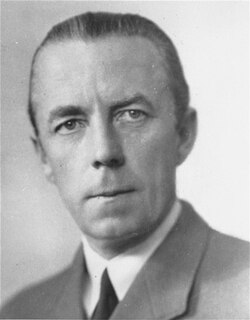
On May 14, 1948, the General Assembly adopted Resolution 186 (S-2), appointing Count Folke Bernadotte as the UN Mediator. Shortly after, the Security Council passed Resolution 49, calling for an end to hostile military actions.
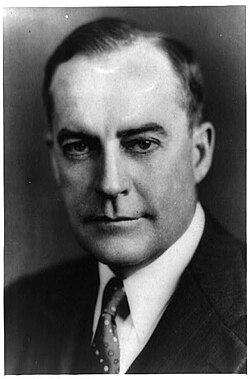
The environment was volatile; on May 22, 1948, Thomas C. Wasson, a US Consul and member of the UN Truce Commission, was assassinated in Jerusalem. By May 29, Resolution 50 established that the truce would be supervised by the Mediator and a group of military observers.
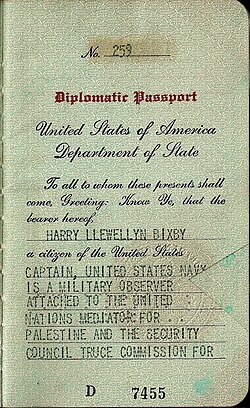
The first group of observers, drawn from Belgium, France, and the United States, arrived in June 1948. This initial formation faced immediate danger; on July 6, French Observer Commandant Rene de Labarriere became the first casualty while investigating a truce violation. Despite early setbacks and the failure of a first one-month truce, a second, indefinite truce was called on July 15, 1948, under Resolution 54.
As the mission expanded to cover a larger area, the UN Secretariat formally created the United Nations Truce Supervision Organization (UNTSO). Initially, the organization was led by a military Chief-of-Staff under the direction of the civilian Mediator.
The General Armistice Agreements (1949–1956)
By August 11, 1949, the Mediator's role concluded, and supervision of the ceasefire passed entirely to the UNTSO Chief of Staff. The organization became the primary overseer of the General Armistice Agreements (GAAs) signed between Israel and its neighbors: Egypt, Jordan, Lebanon, and Syria.
While the GAAs were intended as temporary military non-aggression pacts, they lacked provisions for establishing normal diplomatic relations. This led to a culture of constant claims and counter-claims. Friction was common, particularly regarding water rights and village boundaries. In some cases, such as the Egyptian front, Israel pushed south to Umm Rashrash (Eilat) after the agreement was signed, complicating the establishment of "truce lines." Over time, Israel withdrew from several Mixed Armistice Commissions (MACs) due to frustration with the process.
From the Suez Crisis to the Six-Day War
Tensions peaked in 1956 when Egypt nationalized the Suez Canal, leading to an invasion by British, French, and Israeli forces. In the aftermath, the UN worked to ensure the withdrawal of Israeli forces from the Gaza Strip and Sharm al Shaikh by March 1957.
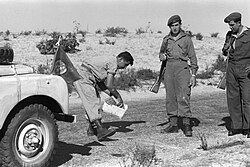
Throughout the late 1950s and early 1960s, UNTSO continued to manage disputes, including military parades in Jerusalem and land-use conflicts in the Hula Lake demilitarized zone (DMZ) between Israel and Syria. Despite various Security Council resolutions calling for compliance with the GAAs, military confrontations persisted, particularly around Lake Tiberias.
The Era of Major Wars: 1967 to 1973
The Six-Day War of 1967 fundamentally altered the region. Because Israel abrogated the original Armistice Agreements, the MAC system became defunct. UNTSO adapted by establishing Observation Posts (OPs)—15 along the Suez and 16 in the Golan Heights—to monitor the new ceasefire lines.
The Yom Kippur War of 1973 further disrupted these positions, resulting in the abandonment of eight OPs. Following this conflict, UNTSO personnel were restructured into "Observer Groups." In the Sinai, they were attached to the Second United Nations Emergency Force (UNEF II) until 1979, after which they returned to a standalone UNTSO structure with a headquarters in Cairo (later moved to Ismailia in 1993).
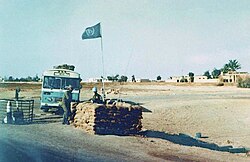
On the Syrian border, UNTSO worked alongside the United Nations Disengagement Observer Force (UNDOF) through the Damascus and Golan Observer Groups.
The Lebanon Conflict and Modern Challenges
The outbreak of the Lebanese Civil War and the 1978 Israeli invasion of Southern Lebanon led to the creation of the United Nations Interim Force in Lebanon (UNIFIL). UNTSO reorganized to form the Observer Group Lebanon (OGL) to support this mission.
The mission has faced significant risks. In September 1982, four unarmed observers (one Finn, one Irishman, and two Americans) were killed by a landmine near Beirut. More recently, on July 25, 2006, an Israeli air strike on a UN OP at Khiam killed four unarmed peacekeepers from Austria, China, Finland, and Canada.
Key Facts
- Established: May 1948, following the Arab-Israeli War.
- Primary Role: Acting as a neutral go-between to prevent isolated incidents from escalating into major conflicts.
- Host Countries: Egypt, Israel, Jordan, Lebanon, and the Syrian Arab Republic.
- Core Mechanism: Use of unarmed military observers and Observation Posts (OPs).
- Evolution: Transitioned from supervising General Armistice Agreements (GAAs) to supporting specialized forces like UNEF, UNDOF, and UNIFIL.
| Period | Primary Focus | Key Mechanism/Entity |
|---|---|---|
| 1948–1949 | Initial Truces | UN Mediator & First Military Observers |
| 1949–1967 | Armistice Supervision | General Armistice Agreements (GAAs) & MACs |
| 1967–1973 | Post-Six Day War | Observation Posts (OPs) |
| 1973–Present | Regional Stability | Observer Groups (Sinai, Golan, Lebanon) |
Frequently Asked Questions
What is the primary purpose of UNTSO?
UNTSO serves as a neutral intermediary in the Middle East, using unarmed military observers to monitor ceasefires and prevent local incidents from escalating into larger wars.
Which countries does UNTSO operate within?
UNTSO maintains relations and operations across five host states: Egypt, Israel, Jordan, Lebanon, and the Syrian Arab Republic.
What were the General Armistice Agreements (GAAs)?
The GAAs were military non-aggression agreements signed in 1949 between Israel and its neighbors. They were intended as transitional measures to end bloodshed rather than permanent peace treaties.
How did UNTSO change after the 1967 Six-Day War?
After the war, the Mixed Armistice Commissions (MACs) became defunct. UNTSO shifted its strategy to establishing fixed Observation Posts (OPs) along the Suez and in the Golan Heights.
Does UNTSO work alone in the region?
No. While UNTSO is a foundational organization, its observers often assist other specialized UN missions, such as UNIFIL in Lebanon and UNDOF in the Golan Heights.