
Ursa: The Story of Bristol's Iconic Anti-Gentrification Sculpture
In the heart of Bristol, a towering figure once stood as a sentinel for the independent spirit of the city. Ursa, a striking public sculpture, became more than just a piece of art; she was a symbol of resistance, community identity, and the creative pulse of the Stokes Croft area.
Conception and Fabrication (2012–2013)
Created by artist Gillman, Ursa was conceived as a statement against gentrification—the process of urban redevelopment that often displaces lower-income residents and alters the character of a neighborhood. The sculpture was designed to embody the independent spirit of both Bristol and the nearby Stokes Croft district.
The construction process was a labor of love and community effort. Built from reclaimed construction hoardings, the frame required ten months of assembly. The final structure featured a distinctive aesthetic of alternating black-and-white painted boards. To support the massive work, volunteers manually removed four tonnes of earth to create a sturdy plinth. On May 10, 2013, the statue was winched into position and officially unveiled by then-mayor George Ferguson.
A Landmark and Community Symbol (2013–2018)
Perched on her elevated plinth overlooking the A38, Ursa quickly transitioned from a new installation to a recognizable city landmark. Her influence extended into the local economy and culture, appearing on tourist postcards, merchandise, and even the £B5 Bristol Pound (a local currency designed to keep wealth within the city).
Beyond her visual appeal, Ursa served as a vital focal point for civic engagement. The People's Republic of Stokes Croft (PRSC) and local political groups, including the Bristol Green Party, utilized the space around the statue for markets, artistic performances, and protest art.
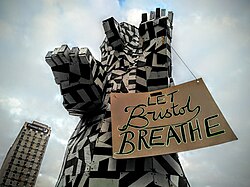
The sculpture's popularity was formally recognized in 2018 when an online poll conducted by the Naked Guide to Bristol ranked Ursa as one of the city's four favorite public sculptures. Throughout her tenure, the structural integrity of the work was maintained through annual inspections provided free of charge by a structural engineer.
The Removal of Ursa (2018–2019)
The statue's presence came to an end in October 2018 when the Bristol City Council terminated the PRSC's license to occupy the Bearpit area. The council issued legal notices demanding the removal of all non-council structures, including Ursa.
The decision sparked significant public backlash. A petition to save the sculpture garnered over 4,000 signatures and forced a council debate. Despite this, Deputy Mayor Asher Craig maintained that all unauthorized items had to be removed. Craig later reported receiving death threats as a result of her stance on the removal.
On September 26, 2019, Gillman and PRSC volunteers dismantled the sculpture. Upon disassembly, they discovered that the reclaimed materials had become badly rotted. The remains were transported to the artist's studio yard for potential future restoration. Today, the site where Ursa once stood is marked by floral decorations.
Key Facts
- Artist: Gillman.
- Materials: Reclaimed construction hoardings painted black and white.
- Installation Date: May 10, 2013.
- Purpose: A symbol of Bristol's independent spirit and an anti-gentrification statement.
- Community Impact: Featured on the £B5 Bristol Pound and ranked as one of Bristol's top four favorite sculptures in 2018.
- Removal Date: September 26, 2019.
| Phase | Timeline | Key Event/Status |
|---|---|---|
| Fabrication | 2012–2013 | 10-month build using reclaimed materials. |
| Prominence | 2013–2018 | Became a cultural icon and site for protests/markets. |
| Conflict | 2018–2019 | Council license termination and public petition. |
| Dismantling | Sept 2019 | Removed due to legal notices and material rot. |
Frequently Asked Questions
What did the Ursa sculpture represent?
Ursa was designed to symbolize the independent spirit of Bristol and Stokes Croft, serving specifically as a statement against gentrification.
How was the statue constructed?
The sculpture was built over ten months using reclaimed construction hoardings, which were painted in alternating black and white boards.
Why was Ursa removed from the Bearpit?
Bristol City Council terminated the license for the People's Republic of Stokes Croft to occupy the area and required the removal of all non-council structures.
Was there any public effort to save the statue?
Yes, a petition with more than 4,000 signatures was created, which led to a formal debate within the city council.
What happened to the sculpture after it was taken down?
Because the materials were found to be badly rotted, the remains were moved to the artist's studio yard for possible restoration.