
USS Yorktown: A Legacy of Naval Aviation and Global Service
The USS Yorktown stands as a testament to the evolution of American naval power, transitioning from a frontline strike force in the Pacific during World War II to a specialized antisubmarine warfare platform during the Cold War. Throughout its decades of service, the vessel played a pivotal role in some of the 20th century's most significant maritime conflicts, adapting its design and mission to meet the changing demands of global security.
From its commissioning in 1943 to its eventual designation as a National Historic Landmark, the Yorktown's journey reflects the broader history of the United States Navy's shift toward jet aviation and specialized carrier roles.
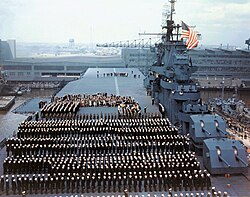
Key Facts
- Commissioned: April 15, 1943.
- WWII Role: Conducted major strikes in the Gilbert, Marshall, and Mariana Islands.
- Cold War Role: Reclassified as an ASW (Antisubmarine Warfare) carrier (CVS-10).
- Vietnam Service: Provided critical ASW and Search and Rescue (SAR) support on Yankee Station.
- Status: Declared a National Historic Landmark in 1986.
World War II: The Pacific Campaign
After completing shakedown training near Trinidad and post-shakedown availability in Norfolk, the Yorktown entered the Pacific theater in July 1943. Its early combat operations focused on suppressing Japanese installations, beginning with strikes on Marcus Island in August and Wake Island in October.
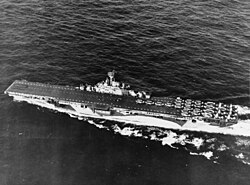
The Push Through the Central Pacific
In November 1943, the Yorktown joined Task Force 38, the Fast Carrier Task Force, for the occupation of the Gilbert Islands. The ship launched raids to suppress enemy airpower during the amphibious assaults on Tarawa, Abemama, and Makin. This momentum continued into early 1944 with successful strikes on Truk Atoll and Saipan.
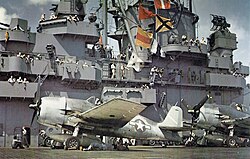
The carrier's versatility was further demonstrated in April 1944, when it supported General Douglas MacArthur's assault on the Hollandia area (now Jayapura) in northern New Guinea, attacking installations in the Wakde-Sarmi region.
The Battle of the Philippine Sea and Beyond
During the Battle of the Philippine Sea in June 1944, Yorktown aircraft were instrumental in denying Japanese land-based planes the ability to interfere with the assault on Guam. The carrier's air group claimed 37 enemy planes destroyed and delivered 21 tons of bombs during the first day of the battle.
Following an overhaul in late 1944, the Yorktown supported the Leyte invasion in the Philippines. During this period, the ship survived the infamous typhoon of December 1944, which sank three destroyers: the Spence, Hull, and Monaghan. Yorktown actively participated in the rescue of survivors from these vessels.
The Final Push Toward Japan
In the closing months of the war, the Yorktown conducted "softening-up" strikes on Okinawa and raids over Kyūshū. On March 29, 1945, the ship narrowly avoided disaster when a Japanese "Judy" suicide plane crashed approximately 60 feet from the portside after being hit by anti-aircraft fire.
Post-War Evolution and Reactivation
Following the war, the Yorktown was mothballed before being reactivated in 1952. It was placed in full commission as an attack carrier (CVA) in February 1953, serving in the Far East and conducting training operations in the Sea of Japan shortly after the Korean War armistice.
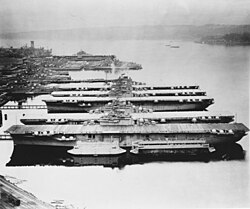
Modernization and the Angled Deck
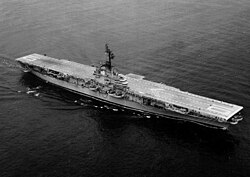
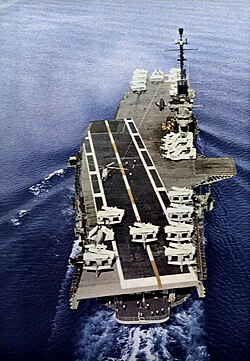
To keep pace with the advent of jet aircraft, the Yorktown underwent extensive modifications in 1955, most notably the installation of an angled flight deck. This modification significantly increased the ship's capability to launch and recover faster, heavier jet aircraft.
Transition to Antisubmarine Warfare (ASW)
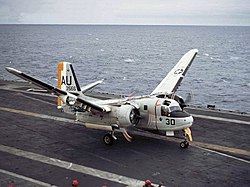
On September 1, 1957, the ship's home port moved to Long Beach, California, and it was reclassified as an antisubmarine warfare carrier with the designation CVS-10. In this new role, the Yorktown focused on detecting and neutralizing submarine threats, a critical mission during the Cold War.
The Vietnam War and Final Deployments
The Yorktown's final active years were dominated by the Vietnam War. Between 1964 and 1968, the carrier deployed multiple times to the South China Sea. Operating from Yankee Station, the Yorktown provided essential ASW and sea-air rescue (SAR) services for the fast carriers conducting air strikes against targets in Vietnam.
One of its final major assignments was "Operation Formation Star" in early 1968, where it provided support in the Sea of Japan following the North Korean capture of the USS Pueblo.
Preservation and Legacy
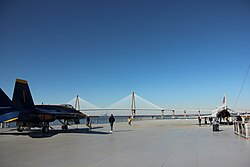
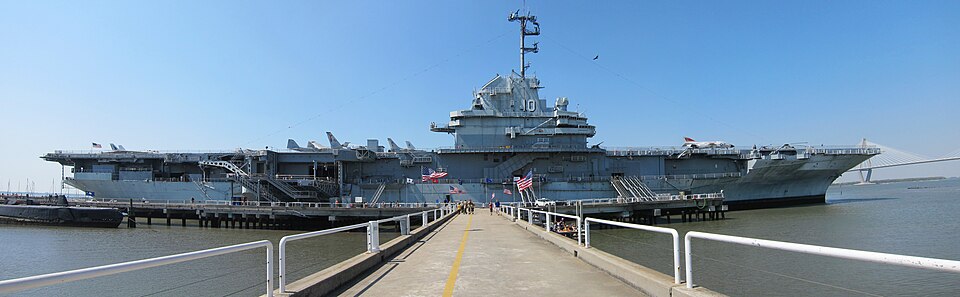
After its decommissioning, the Yorktown transitioned from a weapon of war to a vessel of education. It became a National Historic Landmark in 1986 and eventually served as a unique venue for community services, including housing a public radio station (WSCI-FM) in its primary flight control (pri-fly) until 1998.
| Era | Primary Designation | Key Operations/Roles |
|---|---|---|
| World War II | Aircraft Carrier | Gilbert, Marshall, and Mariana Islands; Philippine Sea; Okinawa |
| Early Cold War | Attack Carrier (CVA) | Far East training; Jet aircraft modernization |
| Late Cold War | ASW Carrier (CVS-10) | Vietnam War (Yankee Station); Operation Formation Star |
| Post-Service | Museum Ship | National Historic Landmark (1986) |
Frequently Asked Questions
What was the Yorktown's role during the Battle of the Philippine Sea?
The Yorktown launched strikes against Japanese air bases on Guam to neutralize land-based aircraft and intercepted carrier-based raids, claiming 37 enemy planes destroyed on the first day of the battle.
How did the ship's design change in 1955?
The ship received an angled flight deck, a critical modification that allowed it to operate modern jet aircraft more effectively than the original straight-deck design.
What does the designation CVS-10 mean?
CVS-10 indicates that the ship was reclassified as an Antisubmarine Warfare (ASW) aircraft carrier, shifting its primary mission from general attack to submarine detection and neutralization.
What was "Yankee Station"?
Yankee Station was a designated area in the Gulf of Tonkin where the USS Yorktown and other carriers operated to provide air strikes, ASW, and search and rescue support during the Vietnam War.
Did the Yorktown survive any kamikaze attacks?
Yes, on March 29, 1945, a Japanese "Judy" suicide plane attempted to dive into the ship but was hit by anti-aircraft fire, crashing approximately 60 feet from the portside.