
Vágar Villages: A Journey Through the Settlements of the Faroe Islands
The island of Vágar is home to a diverse collection of settlements, ranging from bustling hubs of activity to quiet, remote hamlets. These villages reflect the rich cultural tapestry of the Faroe Islands, blending ancient Norse heritage with the strategic military history of the 20th century.
Key Facts
- Largest Settlements: Sørvágur and Miðvágur are the most populous villages.
- Historic Landmarks: Kálvalíð is potentially the oldest house in the Faroe Islands.
- Cultural Heritage: Sandavágur was the seat of the law speaker until 1816.
- Modern Infrastructure: Gásadalur is now accessible via the Gásadalstunnilin mountain tunnel.
- Traditional Practices: Bøur, Miðvágur, and Sandavágur are official grind beaches.
The Major Hubs of Vágar
Miðvágur
Located in the center of the island, Miðvágur serves as a natural community hub. With a population of 1,130 (as of 2020), it provides essential services including a vicarage, a co-op, and a doctor's surgery. The village is steeped in history; it was the home of Beinta Broberg, known as "Wicked Beinta," whose life inspired Jørgen-Frantz Jacobsen's novel Barbara, later adapted into a 1997 film by Niels Malmros. Visitors can explore the village museum at Kálvalíð, a farmhouse recognized as the oldest in the village and possibly the entire archipelago.
Sandavágur
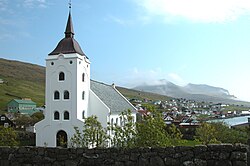
To the east lies Sandavágur, home to 958 residents (2020). This village held significant political importance as the residence of the law speaker of the Faroe Islands until the office was abolished in 1816, transitioning the islands into a Danish administrative district. It is also the birthplace of V. U. Hammershaimb (born 1819), the son of the final law speaker and the creator of the Faroese written language. A notable archaeological find, the Sandavágur stone—a runic inscription from approximately 1200—is preserved in the local church.
Sørvágur
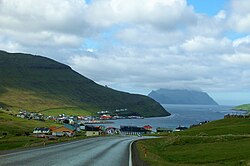
Situated on the western side of the island near the airport, Sørvágur is the largest village with 1,136 inhabitants (2020). The village has a strong connection to World War II; between 1942 and 1944, 5,000 British soldiers were stationed here during the construction of the airfield, though few remnants of their camp remain today. Sørvágur is renowned for its stunning vistas, including the islands of Tindhólmur and Gáshólmur, as well as two drangar (freestanding sea cliffs).
Small Villages and Remote Settlements
Beyond the major hubs, Vágar hosts several smaller communities. Bøur, located 4 kilometers west of Sørvágur, maintains a population of 74 (2020). Further west, along the Mykinesfjørður strait, is Gásadalur. Once highly isolated, Gásadalur now has a population of 16 (2020) and has seen improved accessibility thanks to the Gásadalstunnilin, a tunnel carved through the mountain to encourage regrowth.
Vatnsoyrar is a more recent addition, founded in 1921 by three men who established farms in the upland pastures of the Miðvágur District. With 44 inhabitants (2020), it served as the British headquarters during the occupation of the Faroe Islands, during which time the local residents were temporarily evacuated.
Abandoned Settlements
The landscape of Vágar also contains ghosts of the past. Slættanes, founded in 1835 at the island's northernmost point, once housed roughly 70 people and featured its own school before the last residents departed in 1964. Similarly, Víkar was established in 1833 in the upland pastures of Gásadalur. Despite the fertile farming land, extreme isolation made life difficult, leading to its total abandonment by 1910.
Village Overview Summary
| Village | Status | Population | Notable Feature |
|---|---|---|---|
| Sørvágur | Large | 1,136 | Proximity to airport and drangar cliffs |
| Miðvágur | Large | 1,130 | Kálvalíð museum and central services |
| Sandavágur | Large | 958 | Runic stone and linguistic history |
| Bøur | Small | 74 | Official grind beach |
| Vatnsoyrar | Small | 44 | Former British WWII headquarters |
| Gásadalur | Small | 16 | Mountain tunnel access |
| Slættanes | Abandoned | 0 | Abandoned in 1965 |
| Víkar | Abandoned | 0 | Abandoned in 1910 |
Frequently Asked Questions
Which is the largest village on Vágar?
Sørvágur is the largest village, with a population of 1,136 as of 2020.
What is the significance of the Gásadalstunnilin?
The Gásadalstunnilin is a road tunnel through the mountain that provides a vital link to the remote village of Gásadalur, helping to prevent further population decline.
What are grind beaches?
Grind beaches are official sites used for the traditional Faroese pilot whale hunt. In Vágar, Bøur, Miðvágur, and Sandavágur are recognized as such.
Who was V. U. Hammershaimb?
Born in Sandavágur in 1819, V. U. Hammershaimb is known as the father of the Faroese written language.
Which villages on Vágar are no longer inhabited?
The villages of Slættanes (abandoned in 1965) and Víkar (abandoned in 1910) are no longer inhabited.