
VOTEC: The Evolution of a Brazilian Regional Airline
The landscape of Brazilian aviation underwent a massive transformation in the mid-1970s. To better connect the vast interior of the country, the Brazilian Federal Government established the Brazilian Integrated System of Regional Air Transportation on November 11, 1975. This initiative divided Brazil into five distinct regions, granting concessions to five new regional airlines to ensure essential air connectivity.
Among these pioneers was VOTEC Serviços Aéreos Regionais S/A, the fifth airline to become operational under this system. Beginning its services on October 11, 1976, VOTEC played a critical role in linking the Central-West, North, Southeast, and Northeast regions.

From Air Taxi to Regional Powerhouse
VOTEC (an acronym for Voos Técnicos e Executivos) did not start as a scheduled carrier. It was originally founded in 1966 by Klaus Richard Hoelck as an air taxi company. On February 17, 1976, the company transitioned from VOTEC Táxi Aéreo to VOTEC Serviços Aéreos Regionais S/A, receiving authorization to operate scheduled flights.
The airline experienced rapid growth during its early years. By 1978, VOTEC was serving dozens of cities and had diversified its operations to include specialized contracts, such as off-shore air services for Petrobras and mail delivery for the Brazilian Post.
Operational Reach
VOTEC's network was extensive, covering the states of Goiás, Tocantins, and the Federal District, as well as portions of Pará, Maranhão, and Minas Gerais. Additionally, it provided vital connecting services to the major hubs of Rio de Janeiro and São Paulo.
Decline and the TAM Acquisition
The airline's momentum slowed in 1983 due to administration problems. This decline led to a significant reduction in capacity, leaving the fleet with only three Fokker F27 aircraft—a twin-engine turboprop airliner—by 1985. By January 1986, VOTEC was forced to cease its regular scheduled services.
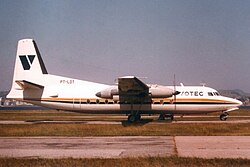
Recognizing an opportunity in the highly regulated market, TAM – Transportes Aéreos Regionais (IATA code KK) acquired VOTEC in June 1986. Following the acquisition, VOTEC was renamed Brasil Central Linhas Aéreas.
The Consortium Era
Although TAM and Brasil Central operated in different designated areas, they functioned as a consortium with integrated fleets and networks. The primary distinctions between the two were their aircraft liveries and their IATA codes: TAM used KK, while Brasil Central retained the code JJ inherited from VOTEC.
The Path to TAM Transportes Aéreos
A pivotal shift occurred on May 15, 1990, when the Brazilian Government removed operational area restrictions for regional airlines, allowing them to fly anywhere within the country. Consequently, Brasil Central was renamed TAM – Transportes Aéreos Meridionais. While it adopted the same color scheme as TAM (KK), it continued to use the IATA code JJ.
The final consolidation took place in 2000, when TAM (KK) merged into TAM (JJ). The resulting entity was named TAM Transportes Aéreos. During this merger, the KK code was released back to the International Air Transport Association (IATA), and the JJ code was maintained.
| Period/Year | Entity Name | IATA Code | Key Event |
|---|---|---|---|
| 1966–1976 | VOTEC Táxi Aéreo | N/A | Founded as air taxi service |
| 1976–1986 | VOTEC Serviços Aéreos Regionais | JJ | Scheduled regional operations |
| 1986–1990 | Brasil Central Linhas Aéreas | JJ | Acquired by TAM Regionais |
| 1990–2000 | TAM Transportes Aéreos Meridionais | JJ | Deregulation of flight areas |
| 2000+ | TAM Transportes Aéreos | JJ | Final merger of KK and JJ entities |
Key Facts
- Origin: Started as an air taxi company in 1966 by Klaus Richard Hoelck.
- Regional Role: One of five airlines created under the 1975 Brazilian Integrated System of Regional Air Transportation.
- Fleet: Operated Fokker F27 aircraft during its final years of independent service.
- Diversification: Provided essential services for Petrobras (off-shore) and the Brazilian Post.
- Legacy: The IATA code JJ, used by the modern TAM entity, is the sole remaining asset of the original VOTEC airline.
Frequently Asked Questions
What was the original purpose of VOTEC?
VOTEC began as an air taxi company in 1966 before transitioning into a scheduled regional airline in 1976 to support the Brazilian government's regional transportation system.
Which aircraft did VOTEC operate during its decline?
By 1985, the airline's fleet had been reduced to three Fokker F27 aircraft.
How did Brasil Central relate to TAM?
Brasil Central was the renamed version of VOTEC after it was acquired by TAM – Transportes Aéreos Regionais in 1986. They initially operated as a consortium with integrated networks.
What happened to the IATA codes KK and JJ?
TAM Regionais used KK and VOTEC/Brasil Central used JJ. After the 2000 merger, the KK code was released, and the JJ code was retained for TAM Transportes Aéreos.
Why is the merger history considered counter-intuitive?
Technically, TAM Regionais (KK) merged into the VOTEC/Brasil Central line (JJ). However, because TAM Regionais provided the cultural identity of the final company, it is historically viewed as the dominant entity.