
Vredefort Dome: Earth's Oldest and Largest Impact Structure
Deep in the heart of South Africa lies the Vredefort Dome, a geological marvel that serves as a silent witness to one of the most violent events in Earth's history. Once thought to be the result of a volcanic explosion, this massive structure is now recognized as the remains of a colossal asteroid impact that occurred billions of years ago. Today, it stands as one of the oldest and largest universally accepted impact structures on the planet.
The origin of the site was first proposed in 1937 by Claude C. Albritton and John D. Boon, but it wasn't until 1961 that American geologists Robert S. Dietz and Robert B. Hargraves confirmed the impact theory. Their discovery of shatter cones—distinctive cone-shaped fractures formed by high-pressure shock waves—provided the definitive evidence needed to rewrite the history of the region.
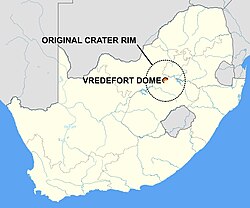
Key Facts
- Age: Approximately 2.023 billion years old (Orosirian Period).
- Asteroid Size: Estimated between 20 and 25 kilometers in diameter.
- Original Crater Diameter: Estimated between 170 and 300 kilometers.
- Impact Velocity: 15 to 25 kilometers per second.
- Current State: A 70-kilometer-wide ring of hills representing the central uplift.
The Mechanics of a Colossal Collision
The asteroid that struck Vredefort was one of the largest to hit Earth since the Hadean Eon. While early estimates suggested a diameter of 10–15 km, 2022 data indicates a much larger body of 20 to 25 kilometers. This asteroid struck the surface at a vertical velocity of 15–25 kilometers per second, releasing a staggering amount of kinetic energy.
The force of the impact created a complex structure. The original crater likely spanned at least 170 km, though evidence from planar deformation features (microscopic lines in quartz crystals caused by shock) and shatter cones suggests the affected region was as wide as 300 km. The impact was so powerful that it caused the rock below the site to rebound, creating a central uplift—a process where liquefied rock splashes upward in the wake of the penetrating meteor.

Erosion and the Modern Landscape
Over the eons, the original crater has been obliterated by geological processes. Erosion has stripped away approximately 7 to 11 km of the surface. What remains today is the "Vredefort Dome," a partial ring of hills 70 km in diameter that represents the core of that ancient central rebound.
Geological Distortion and the Gold Connection
The impact occurred during the Paleoproterozoic Era, distorting several existing geological layers. The Witwatersrand Basin, formed 950 to 700 million years before the strike, as well as the Ventersdorp lavas and the Transvaal Supergroup, were all warped into concentric rings.
These rocks now appear in a specific sequence moving away from the center:
- The Core: A 40-km diameter granite dome exposing the Kaapvaal craton, a microcontinent formed 3.9 billion years ago.
- Inner Ring: Witwatersrand rocks forming a semicircle 25 km from the center.
- Middle Ring: Ventersdorp lavas at roughly 35 km from the center.
- Outer Ring: The Transvaal Supergroup (Ghaap Dolomite and Pretoria Subgroup).
Interestingly, the order of these rocks reverses further out. The Witwatersrand rocks re-emerge between 80 and 120 km from the center. The Johannesburg group of these outcrops is particularly significant; it is where gold was discovered in 1886. Without the Vredefort impact pushing these deep-seated, erosion-resistant sediments toward the surface, this gold might never have been found.
Comparative Planetary Geology
The Vredefort Dome is a rare example of a multiple-ringed impact structure on Earth. While common in the Solar System—such as the Valhalla crater on Jupiter's moon Callisto or various craters on Earth's Moon—most such structures on Earth have been erased by plate tectonics and erosion.
| Structure | Estimated Age | Status/Notes |
|---|---|---|
| Vredefort Dome | ~2.023 Billion Years | Universally accepted; one of the oldest. |
| Sudbury Basin | ~1.849 Billion Years | Approx. 10% younger than Vredefort. |
| Yarrabubba | > 2.023 Billion Years | Approx. 10% older than Vredefort. |
| Maniitsoq | ~3.023 Billion Years | Controversial/Unsettled evidence. |
Frequently Asked Questions
How do scientists know it was an asteroid and not a volcano?
The discovery of shatter cones and planar deformation features in quartz provided the proof. These specific geological markers only form under the extreme pressure and shock waves associated with hypervelocity impacts, not volcanic activity.
What is the Kaapvaal craton?
The Kaapvaal craton is one of Earth's oldest microcontinents, formed approximately 3.9 billion years ago. It is exposed at the center of the Vredefort Dome due to the central uplift caused by the impact.
Did the impact create the gold in Johannesburg?
No, the gold was already present in the Witwatersrand Basin sediments. However, the impact distorted the geology and pushed these layers toward the surface, making the gold accessible for discovery in 1886.
Why is the original crater no longer visible?
Over 2 billion years, natural erosion has removed between 7 and 11 kilometers of rock from the site, effectively erasing the crater's rim and leaving only the central rebound structure.