
WABC-TV News: The Evolution of Eyewitness News in New York City
WABC-TV stands as a titan of broadcast journalism in the New York City market, currently producing 49 hours and 55 minutes of local news every week. From its early struggles in the 1960s to becoming the most-watched broadcast television station in the United States, the station's journey is a study in innovation and adaptation. Today, the operation is characterized by a massive weekday presence of 7 hours and 35 minutes, supplemented by extensive weekend coverage.
The station maintains a strategic partnership with its Philadelphia sister station, WPVI-TV. This collaboration is particularly evident in New Jersey, where the two stations pool reporters, helicopters, and live trucks to cover overlapping markets. They also join forces to produce statewide political debates for offices such as the Governor or U.S. Senate, sharing anchors and resources to ensure comprehensive coverage.
Key Facts
- Weekly Output: 49 hours and 55 minutes of locally produced news.
- Market Position: The most-watched broadcast television station in the U.S.
- Innovation: Pioneered the "happy talk" conversational style in news.
- Historic Partnership: Collaborates with WPVI-TV for New Jersey statewide coverage.
- New Headquarters: Moved to a Disney campus in Hudson Square on February 22, 2025.
The Early Years: From Report to New York to The Big News
WABC-TV's formal news journey began on October 26, 1959, with the launch of Report to New York. The original team featured Scott Vincent, sports anchor Howard Cosell, and weather presenter Lynn Dollar. While the program initially aired at 11 p.m., it expanded by January 1961 to include a 15-minute early edition at 6:15 p.m. on weeknights and weekends.
In October 1962, the station attempted to scale up by introducing The Big News, a 45-minute weeknight broadcast anchored by Bill Beutel and Jim Burnes. Despite the expansion, the program struggled to compete with the ratings dominance of WCBS-TV and WNBC-TV.
The Eyewitness News Revolution
The trajectory of the station changed forever in 1968. After a brief, unsuccessful experiment called Roger Grimsby and the Noisemakers—which saw ratings plunge to an all-time low—newly hired news director Al Primo introduced the Eyewitness News format. This revolutionary approach required reporters to present stories directly to the viewers rather than relying solely on an anchor.
Primo added a unique element known as "happy talk," which encouraged conversational chatter among the anchors to make the broadcast feel more natural. To complement this, the station adopted the "Tar Sequence" from the film Cool Hand Luke, composed by Lalo Schifrin, as its theme music. The telegraphic melody became an iconic part of the brand.
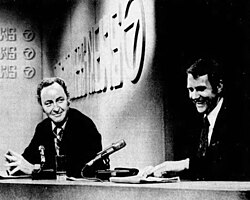
The impact was immediate. Within a year, WABC-TV shot to first place in the ratings, displacing WCBS-TV. The format was so successful that it was adopted by other ABC owned-and-operated stations in Los Angeles, Chicago, and Detroit. The legendary pairing of Roger Grimsby and Bill Beutel became the face of the station for 16 years, defining an era of New York television.
Growth and Ratings Dominance
Throughout the 1970s and 80s, the station continued to evolve. In 1981, it added a 5 p.m. newscast, and later experimented with feature-driven news via Eyewitness Extra. While the station faced a dip in the 1980s, the hiring of news director Bill Applegate in 1985 sparked a resurgence. By 1987, WABC-TV reclaimed the top spot in the ratings, a position it has largely maintained ever since.
The station's dominance was further bolstered by strong lead-in programming. For over 24 years, The Oprah Winfrey Show aired at 4 p.m., funneling a massive audience directly into the 5 p.m. Eyewitness News broadcast.
News Production Summary
| Day Type | Daily Duration | Weekly Total (Approx.) |
|---|---|---|
| Weekdays | 7 hours, 35 minutes | 37 hours, 55 minutes |
| Saturdays | 5 hours, 30 minutes | 5 hours, 30 minutes |
| Sundays | 6 hours, 30 minutes | 6 hours, 30 minutes |
| Total | - | 49 hours, 55 minutes |
Modern Era and Digital Expansion
In the 21st century, WABC-TV has embraced high-definition broadcasting (starting in 2006) and expanded its time slots. The morning news now begins at 4:30 a.m., and the station added a 4 p.m. hour of news in 2011 to fill the void left by Oprah Winfrey. In 2011, the station also moved its broadcasts to a street-level window studio on 66th Street and Columbus Avenue to increase visibility.
Digital innovation has also played a key role. The station launched the "ABC 7 New York 24/7 Stream" on January 31, 2022, which includes a dedicated 6:30 p.m. newscast available exclusively via streaming. Most recently, on September 11, 2023, a new 10 a.m. hour-long newscast was launched to provide deeper discussion on topics from Good Morning America and Live with Kelly and Mark.
Frequently Asked Questions
What is the "happy talk" format?
Introduced by Al Primo, "happy talk" is a style of news broadcasting that incorporates conversational, informal chatter between anchors to create a more personable and engaging atmosphere for the viewer.
How does WABC-TV collaborate with WPVI-TV?
The two stations pool their resources—including reporters, live trucks, and helicopters—to cover news in New Jersey where their markets overlap and to produce statewide political debates.
Who were the most iconic anchors in WABC-TV history?
Roger Grimsby and Bill Beutel were the most prominent faces of Eyewitness News for 16 years, though Bill Beutel held the record for the longest tenure as a main anchor in NYC television at the time of his retirement in 2001.
Where is WABC-TV located now?
As of February 22, 2025, WABC-TV has moved from its longtime home in Lincoln Square to a new Disney campus located at Hudson Square in Lower Manhattan.
What is the current weekly volume of news produced by WABC-TV?
The station currently broadcasts 49 hours and 55 minutes of locally produced newscasts each week.