
Wallace M. Greene: A Distinguished Career in the United States Marine Corps
The trajectory of Wallace M. Greene's military career serves as a comprehensive study of leadership and strategic evolution within the United States Marine Corps. From his early commissioning in the 1930s to his eventual appointment as the 23rd Commandant of the Marine Corps, Greene's service spanned some of the most pivotal conflicts and organizational shifts in American military history.
Early Commissioning and Foundational Years
Greene's journey began on June 5, 1930, when he graduated from the Naval Academy and was commissioned as a second lieutenant. His initial training took place at the Marine Officers' Basic School at the Philadelphia Navy Yard, followed by a year of service at the Marine Barracks in Kittery, Maine. By July 1932, he had completed Sea School in San Diego and joined the Marine Detachment aboard the USS Tennessee.
Throughout the mid-1930s, Greene rotated through various assignments, including posts in Pensacola, Florida, and Quantico, Virginia. In November 1934, while reporting to the Marine Barracks at Naval Air Station Lakehurst, New Jersey, he was promoted to first lieutenant. During this period, he also expanded his technical expertise by completing a course at the Chemical Warfare School at Edgewood Arsenal, Maryland.
Global Assignments and the Path to Command
In October 1936, Greene was stationed in Guam, later moving to Shanghai, China, in June 1937 to join the 4th Marine Regiment. It was here, as part of the 2nd Marine Brigade, that he was promoted to captain. Greene and his unit received commendations for their duty while attached to the defense forces of the International Settlement during the Sino-Japanese hostilities of 1937 and 1938.
Following his return to the U.S. in 1939, Greene pursued further education at the Marine Corps Schools in Quantico. By October 1940, he took command of the 1st Chemical Company, 1st Marine Brigade, deploying to Guantanamo Bay, Cuba, where the unit was redesignated as the 1st Marine Division.
World War II and Strategic Leadership
As the United States entered World War II, Greene's role shifted toward high-level operations. In November 1941, he served as a Special Naval Observer in London, England, where he attended the British Amphibious Warfare School in Scotland and the Royal Engineer Demolitions School in York. He was promoted to major in January 1942.
Greene's leadership during the Pacific campaign was marked by significant strategic contributions. Serving as the Assistant Chief of Staff, G-3 (the officer responsible for operations and training), he played a key role in the planning and execution of the Marshall Islands invasion, earning his first Legion of Merit with Combat "V". He later served as G-3 for the 2nd Marine Division during combat operations on Saipan and Tinian, earning a second Legion of Merit.
Post-War Advancement and General Officer Ranks
Following the war, Greene held various critical roles at Headquarters Marine Corps (HQMC) and the Amphibious Training Command in Virginia, where he attained the rank of colonel in February 1948. His expertise in operations continued as G-3 for the Fleet Marine Force (FMF), Pacific, based in Pearl Harbor.
Greene's ascent to general officer rank began in September 1955 when he was promoted to brigadier general. He subsequently commanded the Recruit Training Command and the Recruit Depot at Parris Island, South Carolina, and later the Marine Corps Base at Camp Lejeune.
By 1958, Greene returned to HQMC as assistant chief of staff, G-3, and was promoted to major general. His exceptional service as deputy chief of staff (plans) earned him his first Navy Distinguished Service Medal, and by January 1, 1960, he reached the rank of lieutenant general as chief of staff.
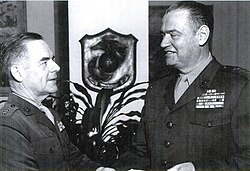
Commandant of the Marine Corps
On September 24, 1963, President John F. Kennedy nominated Greene to become the 23rd Commandant of the Marine Corps. Upon assuming the office on January 1, 1964, he was promoted to the four-star rank of general.
Greene's tenure as Commandant was defined by the rapid escalation of the conflict in Southeast Asia. He managed a massive proliferation of forces; while fewer than 1,000 Marines were in Vietnam in 1964, the III Marine Amphibious Force grew to over 100,000 Marines and sailors by 1968. For his leadership during this period, he was awarded a second Navy Distinguished Service Medal in December 1967.
Key Facts
- Highest Rank: General (four-star).
- Key Appointment: 23rd Commandant of the Marine Corps (1964–1968).
- Major Decorations: Two Navy Distinguished Service Medals and two Legions of Merit.
- War Experience: Served in the Sino-Japanese hostilities, World War II (Marshall Islands, Saipan, Tinian), and oversaw the expansion of forces in the Vietnam War.
- Education: Graduate of the Naval Academy (1930) and the National War College (1953).
| Year | Rank/Position | Key Location/Assignment |
|---|---|---|
| 1930 | Second Lieutenant | Naval Academy Graduation |
| 1937 | Captain | 4th Marine Regiment, China |
| 1942 | Major / Lt. Colonel | Special Naval Observer (UK) / Western Samoa |
| 1944 | G-3, 2nd Marine Division | Saipan and Tinian |
| 1955 | Brigadier General | Assistant Commander, 2nd Marine Division |
| 1960 | Lieutenant General | Chief of Staff, HQMC |
| 1964 | General | 23rd Commandant of the Marine Corps |
Frequently Asked Questions
When did Wallace M. Greene become the Commandant of the Marine Corps?
He assumed the post of the 23rd Commandant of the Marine Corps on January 1, 1964, following a nomination by President John F. Kennedy.
What was Greene's role during the Vietnam War?
As Commandant, he oversaw the massive increase of Marine forces in Vietnam, growing the presence from fewer than 1,000 personnel in 1964 to over 100,000 Marines and sailors in the III Marine Amphibious Force by 1968.
Which combat operations in World War II was Greene involved in?
Greene was instrumental in the planning and execution of the Marshall Islands invasion and served as G-3 for the 2nd Marine Division during the combat operations on Saipan and Tinian.
What military schools did Greene attend during his career?
Greene attended the Marine Officers' Basic School, Sea School, the Chemical Warfare School, the British Amphibious Warfare School, the Royal Engineer Demolitions School, and the National War College.
What were some of Greene's highest military honors?
He was awarded two Navy Distinguished Service Medals and two Legions of Merit, including one with a Combat "V" for his service during the Marshall Islands invasion.