
Watchung Mountains: Geography and Geological Structure
The Watchung Mountains are a series of prominent ridges in northern New Jersey, stretching over forty miles (64 km) from Somerville in Somerset County in the southwest to Mahwah in Bergen County in the northeast. These ridges traverse several counties, including Morris, Union, Essex, and Passaic, creating a distinct topographic landscape that separates the interior highlands from the coastal plains.
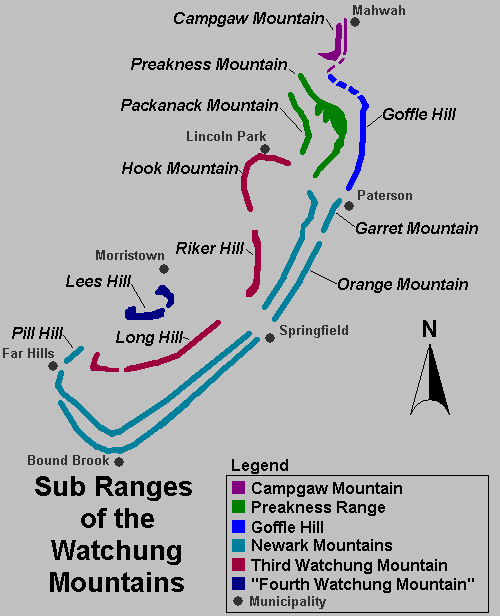
The system is primarily defined by two major ridges: First Watchung Mountain to the southeast and Second Watchung Mountain to the northwest. A third, less continuous ridge—comprising Long Hill, Riker Hill, Hook Mountain, and Packanack Mountain—is often referred to as Third Watchung Mountain. Additionally, a smaller fourth ridge exists south of Morristown; while it reaches elevations over 400 ft (120 m), it only rises about 100 ft (30 m) above the surrounding land, with its southern section known as Lees Hill.
Key Facts
- Extent: Over 40 miles (64 km) from Somerville to Mahwah.
- Composition: First Watchung consists of Orange Mountain basalt; Second Watchung consists of Preakness Mountain basalt.
- Highest Peaks: Located within the Preakness Range, including High Mountain (879 ft).
- Glacial History: The ridges helped pen in the prehistoric Glacial Lake Passaic.
- Key Waterways: The Passaic River cuts through these ridges at various gaps.
Geological Composition and Common Misconceptions
There is frequent confusion regarding the naming of these ridges. Often, the entire lengths of First and Second Watchung Mountains are incorrectly called Orange Mountain and Preakness Mountain. In reality, these names refer to specific sections of the ridges.
The confusion stems from geologic type localities—specific sites where a particular rock type is first identified. The basalt found throughout the entirety of First Watchung Mountain is classified as Orange Mountain basalt, while the rock throughout Second Watchung Mountain is Preakness Mountain basalt. Similarly, the entire Third Watchung Mountain is sometimes erroneously called Hook Mountain, which is actually just one of its type localities.
Regional Geography and Glacial Impact
The Watchungs lie to the east of the New York-New Jersey Highlands (part of the larger Appalachian Mountains). Together, these formations created a basin for the prehistoric Glacial Lake Passaic. A remnant of this ancient lake is the Great Swamp, much of which is now the Great Swamp National Wildlife Refuge, currently retained by the Third Watchung Mountain.
| Ridge | Relative Position | Basalt Type | Notable Components/Sections |
|---|---|---|---|
| First Watchung | Southeastern | Orange Mountain Basalt | Garret Mountain, Orange Mountain, Goffle Hill |
| Second Watchung | Northwestern | Preakness Mountain Basalt | Preakness Mountain, Caldwell Mountain, Pill Hill |
| Third Watchung | Far Northwestern | N/A | Packanack, Hook, Riker Hill, Long Hill |
Detailed Breakdown of Ranges and Ridges
The Northern Ranges
Campgaw Mountain is the northernmost ridge, formed by a combination of the First and Second Watchung Mountains, terminating near the Ramapo Mountains at the New York border. To its south lies Preakness Mountain (part of Second Watchung) and Goffle Hill (part of First Watchung). Preakness Mountain, along with Packanack Mountain, forms the Preakness Range, which contains the three highest peaks in the entire Watchung system.
The Third Watchung System
This ridge begins with Packanack Mountain and continues through Towakhow (or Hook) Mountain, which curves around the Great Piece Meadows. The range is interrupted by gaps where the Rockaway, Whippany, and Passaic Rivers flow east. It resumes as Riker Hill and later as Long Hill, which stretches toward Millington before ending at Liberty Corner, with a spur known as Cedar Hill.
The Newark Mountains
Historically, the ridges south of the Passaic River are known as the Newark Mountains. In this area, First Watchung Mountain includes Garret Mountain and Orange Mountain, separated by the Great Notch. The Hobart Gap (or Millburn Gap) further divides the ridge before it terminates near Far Hills. Second Watchung Mountain in this region begins as Caldwell Mountain, parallels the first ridge, and eventually turns north at Moggy Hollow to become Pill Hill.
Notable Summits
Several peaks stand out for their elevation. In Wayne, High Mountain reaches 879 ft (268 m), followed by Beech Mountain at 869 ft (265 m) and Mount Cecchino at 755 ft (230 m). Additionally, The Hilltop in Verona, Cedar Grove, and North Caldwell reaches a peak of 675 ft (206 m).
Frequently Asked Questions
What is the difference between First and Second Watchung Mountains?
The primary differences are their geographic position (First is southeastern, Second is northwestern) and their geological composition (Orange Mountain basalt versus Preakness Mountain basalt).
Why are the mountains sometimes called Orange and Preakness Mountains?
This is a common error. Orange and Preakness are actually specific sections of the ridges and the names of the basalt type localities found throughout the respective First and Second Watchung Mountains.
How did Glacial Lake Passaic relate to the Watchungs?
The Watchung ridges and the Appalachian Mountains to the west acted as a basin that penned in the prehistoric Glacial Lake Passaic. The Great Swamp is a modern remnant of this lake.
Where are the highest points of the Watchungs located?
The three highest peaks are located within the Preakness Range, with High Mountain in Wayne being the most prominent at 879 ft (268 m).
What are the Newark Mountains?
The Newark Mountains is a historical term for the sections of the First and Second Watchung Mountains located south of the Passaic River.