
Water Cycle: The Global Engine of Hydrologic Movement
The water cycle, also known as the hydrologic cycle, is a continuous process that circulates water between the Earth's surface and the atmosphere. Powered primarily by solar energy, this system ensures the redistribution of water across the globe, supporting all known forms of life and regulating the planet's climate.
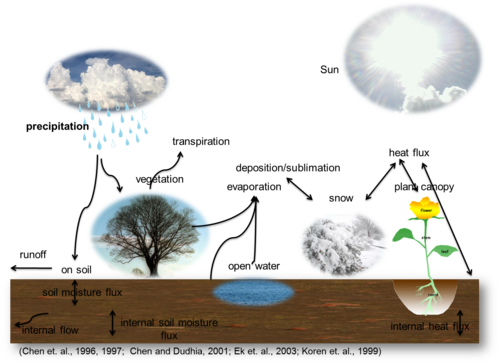
At its most basic level, the cycle is driven by the sun heating water in oceans, lakes, and rivers. This energy triggers evaporation, where liquid water undergoes a phase change into water vapor, a gas that rises into the atmosphere. Water also enters the air through sublimation (where snow and ice turn directly into gas) and evapotranspiration, which combines evaporation from the soil with transpiration—the release of water vapor from plants.
How Clouds Form and Precipitation Occurs
The movement of water into the atmosphere is influenced by molecular mass. Water molecules are lighter than the primary atmospheric gases, oxygen (O2) and nitrogen (N2). This lower density creates buoyancy, driving water molecules higher into the sky. As altitude increases, air pressure drops, leading to a decrease in temperature.
This cooling forces water vapor to undergo another phase change, condensing into liquid droplets. When these droplets are supported by an updraft over a large area, they form clouds. If this condensation occurs closer to the ground, it is known as fog. Once these particles collide and grow sufficiently heavy, they fall as precipitation, which can take the form of rain, snow, hail, sleet, or graupel.
The Journey of Water on Land and Sea
Once water reaches the surface, it follows several distinct paths. Much of it falls directly back into the ocean, but water landing on land may become surface runoff, flowing into rivers and streams that eventually lead back to the sea. Some water undergoes infiltration, soaking into the ground to become soil moisture or deeper groundwater.
Water that moves vertically through soil and rock under the influence of gravity is undergoing percolation. This process replenishes aquifers—underground layers of water-bearing rock that can store freshwater for millennia. Some of this groundwater may emerge as freshwater springs or interact with surface water in the hyporheic zone, the region of sediment and porous space beneath a riverbed.
![Water cycle showing human influences and major pools (storages) and fluxes[27]](/images/d3/06/d306372ed8f1c01fbfae6beb382c5ac411e29721fbc5831a689f989b7c01f901.jpg)
Key Facts
- Ocean Dominance: The ocean holds 97% of Earth's total water and is the source of 86% of global evaporation.
- Precipitation Distribution: Approximately 78% of all global precipitation falls over the ocean.
- Freshwater Storage: While ice caps and glaciers make up only 1.7% of total water volume, they contain 68.7% of the world's fresh water.
- Atmospheric Speed: Water has a very short average residence time in the atmosphere, lasting only about 9 days.
- Deep Storage: Water in deep aquifers or the Antarctic ice sheet can remain stored for 10,000 to 20,000 years.
Physical Processes of the Hydrologic Cycle
To understand the complexity of the water cycle, it is helpful to define the specific physical mechanisms that move water through different states and locations:
- Advection: The horizontal movement of water through the atmosphere, such as atmospheric rivers, which allows water evaporated over oceans to reach land.
- Condensation: The process of water vapor turning back into liquid droplets, forming clouds and fog.
- Evaporation: The transition of liquid water to gas, powered by solar radiation.
- Infiltration: The downward entry of water from the surface into the soil.
- Runoff: The movement of water across the land surface or through channels.
- Subsurface Flow: The movement of water underground through the vadose zone and aquifers.
Water Storage and Residence Times
Not all water moves through the cycle at the same speed. The residence time is the average amount of time a water molecule spends in a specific reservoir. This is calculated either by dividing the reservoir's volume by its flow rate (conservation of mass) or through isotopic techniques in isotope hydrology.
| Reservoir | Average Residence Time |
|---|---|
| Atmosphere | 9 days |
| Soil Moisture | 1 to 2 months |
| Rivers | 2 to 6 months |
| Seasonal Snow Cover | 2 to 6 months |
| Lakes | 50 to 100 years |
| Glaciers | 20 to 100 years |
| Shallow Groundwater | 100 to 200 years |
| Oceans | 3,200 years |
| Deep Groundwater | 10,000 years |
| Antarctica | 20,000 years |
Frequently Asked Questions
What is the difference between infiltration and percolation?
Infiltration is the initial process of water entering the soil from the surface, whereas percolation is the subsequent vertical movement of that water deeper through soil and rock layers due to gravity.
What is fossil water?
Fossil water refers to particularly old groundwater that has remained trapped in deep aquifers for thousands of years, far exceeding the average residence time of shallow groundwater.
How does advection affect land-based water supplies?
Advection is the atmospheric movement of water vapor. Without it, water that evaporates over the oceans would simply fall back into the ocean; advection transports this moisture over land, where it can fall as precipitation.
Why is the ocean so critical to the water cycle?
The ocean is the primary reservoir and engine of the cycle, holding 97% of Earth's water and providing 86% of the global evaporation that fuels atmospheric moisture.
What is the hyporheic zone?
The hyporheic zone is the region of saturated sediment beneath and alongside a stream or riverbed where there is a continuous exchange of water between surface water and groundwater.