
Watermelon: From Ancient Sudan to Global Favorite
The watermelon (Citrullus lanatus) is more than just a refreshing summer treat; it is a botanical marvel with a history spanning millennia. Belonging to the family Cucurbitaceae, this fruit has evolved from bitter wild ancestors in Africa to the sweet, juicy varieties enjoyed worldwide today.
Modern watermelons originated in Sudan, where they were first cultivated. Research indicates that Kordofan melons from Sudan are the closest relatives and likely progenitors of the domesticated fruit. Evidence of early use dates back to approximately 3500 BC, with wild seeds discovered at the prehistoric site of Uan Muhuggiag in Libya. A 2022 study further traced 6,000-year-old seeds from the Libyan desert to Egusi seeds in Nigeria, West Africa.
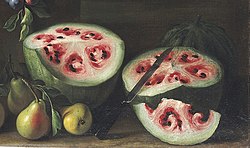
By 2000 BC, watermelons were cultivated in Egypt, as evidenced by tomb paintings dating back 4,000 years. While these early versions were not as sweet as modern cultivars, Hebrew texts from the early Christian era and records from Roman antiquity show that dessert watermelons eventually spread across the Mediterranean.
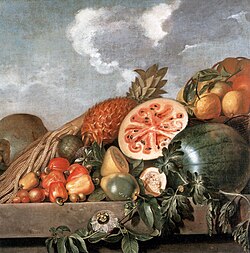
Key Facts
- Origin: Domesticated in Sudan; closely related to the Kordofan melon.
- Composition: Consists of approximately 91% water.
- Nutrients: Rich in lycopene and various B vitamins.
- Diversity: Over 1,200 cultivars exist, with flesh colors including red, pink, orange, yellow, and white.
- Global Leader: China is the world's largest producer of watermelon.
Taxonomy and Botanical Classification
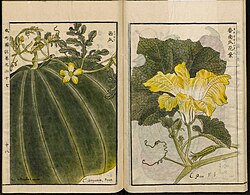
The classification of the watermelon has evolved with scientific advancement. Originally described by Carl Peter Thunberg in 1794 as Momordica lanata, it was reassigned to the genus Citrullus in 1916 by Japanese botanists Jinzō Matsumura and Takenoshin Nakai.
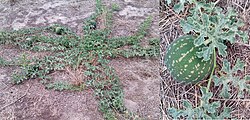
For years, scientists believed the closest wild relative was the tendril-less melon (Citrullus ecirrhosus) from South Africa. However, recent phylogenetic analysis—the study of evolutionary relationships—reveals that Citrullus mucosospermus from West Africa (ranging from Senegal to Nigeria) is the closest relative and is sometimes classified as a subspecies of C. lanatus.
Global Expansion and Modern Development
European colonists introduced watermelons to the Americas. Spanish settlers grew them in Florida by 1576, and by 1629, they were cultivated in Massachusetts. By 1650, the fruit had reached Peru, Brazil, and Panama. Simultaneously, Native Americans cultivated the crop in Florida and the Mississippi valley. Explorers like Captain James Cook later introduced the fruit to Hawaii and other Pacific islands.
A major innovation occurred in 1939 when Japanese scientists developed seedless triploid hybrids. Although early versions lacked disease resistance, seedless varieties surged in popularity during the 21st century, accounting for nearly 85% of U.S. watermelon sales by 2014.
Cultivation and Production
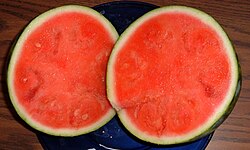
Watermelon production is a massive global industry, with China dominating the market. In the United States, commercial growth occurs in approximately 44 states, generating over $500 million annually. Florida is the leading U.S. producer, followed by Georgia, Texas, California, and Arizona.
| Region | Production (Million Tonnes) |
|---|---|
| China | 63.8 |
| India | 3.6 |
| Turkey | 3.1 |
| Algeria | 2.5 |
| Brazil | 1.8 |
| World Total | 104.9 |
Notable Varieties
With over 1,200 cultivars, watermelons vary wildly in size and appearance. Some "icebox melons" are small and spherical, while others reach massive proportions.
- Carolina Cross: Holds the world record for the heaviest watermelon at 159 kg (351 lb).
- Densuke: A premium Japanese variety from Hokkaido with a black rind. One specimen sold at auction in 2008 for 650,000 yen (approx. $6,300).
- Moon and Stars: An heirloom variety created in 1926, featuring a purple/black rind with yellow spots.
- Orangeglo: Known for its sweet orange flesh and jagged dark green stripes.
- Melitopolski: An early-ripening variety from the Astrakhan region of Russia.
Nutritional Value
Watermelon is highly hydrating and low in calories. A 100-gram serving provides approximately 30 kcal. It is particularly noted for containing lycopene, a powerful carotenoid antioxidant.
| Nutrient | Amount | % Daily Value (DV) |
|---|---|---|
| Water | 91.45 g | - |
| Sugars | 6.2 g | - |
| Vitamin C | - | 9% |
| Potassium | - | 4% |
| Pantothenic acid (B5) | - | 4% |
| Lycopene | 4532 μg | - |
Frequently Asked Questions
Where did the watermelon originally come from?
The modern watermelon was first cultivated in Sudan, with the Kordofan melon being its closest wild relative.
What makes the Densuke watermelon so expensive?
The Densuke is a rare variety grown exclusively on Hokkaido island in Japan. Due to its limited production and prestige, some have sold for as much as $6,300 at auction.
How are seedless watermelons created?
Seedless watermelons are triploid hybrids, a technique first developed by Japanese scientists in 1939.
What is the nutritional benefit of watermelon?
Watermelon is 91% water, making it excellent for hydration. It also contains lycopene, an antioxidant, and provides small amounts of Vitamin C and B vitamins.
What is the largest watermelon ever recorded?
The 'Carolina Cross' variety produced the world record fruit, weighing 159 kilograms (351 pounds), grown in Tennessee in 2013.