
Western and Atlantic Railroad Zero Mile Post
In the heart of Atlanta, a modest stone marker once served as the definitive starting point for one of the region's most influential transit lines. The Zero Mile Post of the Western and Atlantic Railroad (W&A RR) is more than just a piece of masonry; it is a physical record of the city's growth and its historical reliance on rail infrastructure to connect the interior of Georgia to the coast.
Key Facts
- Established: 1842
- Original Location: Central Ave. between Wall St. and Railroad Ave., Atlanta, Georgia
- Current Location: Atlanta History Center
- Dimensions: 7 feet 5 inches tall (fully exposed) and approximately 800 pounds
- NRHP Status: Listed in 1977; removed in 2019
- Engravings: "W&A RR 0.0" and "W&A RR 138"
The Purpose of the Zero Mile Post
Railroad mile markers are essential navigational tools placed along rail lines at every mile to inform train crews of their exact position on a specific route. The Zero Mile Post specifically designated the terminus—the final stop or starting point—of the Western and Atlantic Railroad in Atlanta.
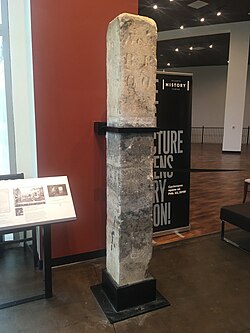
The marker is a rectangular stone with a pyramidal crown. The above-ground portion measures approximately 1 foot wide on each side and 42 inches tall. One side is engraved with "W&A RR 0.0," where the double-zero signifies the beginning of the line. The opposite side is engraved with "W&A RR 138," marking the distance to the other end of the line.
A History of Relocation and Preservation
For over a century, the post remained at its original site in Downtown Atlanta, located under the Central Ave. viaduct within the Underground Atlanta Historic District. Its historical importance was formally recognized in 1958 by the Georgia Historical Commission and later in 1977 when it was added to the U.S. National Register of Historic Places (NRHP).
During the 1980s, the post was moved indoors to protect it when a passenger depot was constructed around the site for the New Georgia Railroad tourist operation. Following the cessation of those operations in 1994, the depot became a restricted area, accessible only by appointment through the Georgia Building Authority.
In October 2018, the original stone was moved to the Atlanta History Center to allow for the demolition of the depot and the reconstruction of the Courtland Street and Central Avenue bridges. To maintain the historical integrity of the original site, a replica post and an interpretive marker from The Georgia Historical Society were installed at the original location.
Controversy and Current Display
The decision to move the post sparked debate among historians and preservationists. Some argued that removing the marker from its original geographic context stripped it of its historical significance. Conversely, representatives from the Atlanta History Center maintained that the original stone is better preserved in a controlled indoor environment, while the outdoor replica serves the public's need for a site-specific landmark.
Today, the Zero Mile Post is a centerpiece of the exhibition Locomotion: Railroads and the Making of Atlanta. It is displayed alongside the restored Texas locomotive, one of only two remaining Western & Atlantic locomotives that would have frequently passed the post during its active service.
| Feature | Detail |
|---|---|
| Construction Year | 1842 |
| Total Height | 7 feet 5 inches |
| Weight | Approx. 800 lbs |
| NRHP Reference No. | 77000435 |
| Current Exhibition | Locomotion: Railroads and the Making of Atlanta |
Frequently Asked Questions
What does "W&A RR 0.0" mean?
The "W&A RR" stands for the Western and Atlantic Railroad, and the "0.0" indicates that this marker was the zero-mile point, or the official beginning of the rail line.
Why was the Zero Mile Post removed from the National Register of Historic Places?
The Historic Preservation Division of the Georgia Department of Natural Resources requested its delisting in February 2019, and it was officially removed on April 26, 2019, following its relocation from its original site.
Where can the original Zero Mile Post be seen today?
The original stone marker is currently on display at the Atlanta History Center as part of the Locomotion: Railroads and the Making of Atlanta exhibition.
Is there still a marker at the original downtown location?
Yes, a replica post was placed at the exact original location, accompanied by an interpretive marker provided by The Georgia Historical Society.
What is the significance of the Texas locomotive in the exhibition?
The Texas locomotive is one of only two surviving Western & Atlantic locomotives, providing a tangible link to the trains that actually utilized the line starting from the Zero Mile Post.