
Westover Educational Buildings: The History of Reed and Swanson Schools
The Westover neighborhood is defined by its commitment to education and community service, anchored by historic structures that have evolved alongside the population. From the adaptive reuse of the Walter Reed School to the enduring legacy of Swanson Middle School, these buildings reflect the shifting demographic and social landscape of Arlington.
The Evolution of the Reed School
The Walter Reed School began its journey in 1938, constructed by contractor T. Calvin Owens on what was then farmland. For nearly five decades, it served as a cornerstone of local education, operating as an elementary school from 1938 until 1984.
As the student population grew, the facility underwent several expansions. In 1950, a new mechanical room and an eight-classroom wing were added to the rear, while lower-level spaces were repurposed into a clinic, conference room, teachers' room, and library. By 1966, the school further expanded with the addition of a unique octagonal classroom building.

Decline and Transformation
By the 1980s, the facility no longer met modern educational standards. The building suffered from severe humidity and mold issues, was difficult to climate control, and contained hazardous materials including lead paint and asbestos (a mineral fiber used in insulation and fireproofing). Additionally, the site lacked wheelchair accessibility. These physical failings, combined with declining enrollment and the direction of then-superintendent Charles M. Nunley, led to the school's closure as a traditional educational facility in 1984.
Despite the closure, a county-funded study predicted that the area would again require a school within 20 years. This foresight paved the way for a massive revitalization project. On May 9, 2008, a groundbreaking ceremony marked the start of the $21.6 million Reed School/Westover Library project. The renovation preserved the original 1938 shell but demolished the rest of the structure to create a 61,000-square-foot facility.
On October 31, 2009, the building reopened as the Westover Branch Library and a hub for public pre-school programs, relocating the library from its previous site one block northeast.
The Return of Elementary Education: Cardinal Elementary
The need for local primary education resurfaced by 2010, as nearby McKinley and Tuckahoe elementary schools became the most overcrowded in the county. After several proposals—including a rejected plan in 2014 to house the H-B Woodlawn Secondary Program—the Arlington School Board approved the construction of a new neighborhood elementary school at the Reed site in 2017.
This resulted in the opening of Cardinal Elementary School in the fall of 2021. The school currently enrolls 683 students. To ease the burden on overcrowded facilities, Cardinal absorbed most students from McKinley Elementary (which now hosts the Arlington Traditional School) and some students from Tuckahoe. The name "Cardinal" was specifically chosen to maintain a sense of continuity for former McKinley students, who shared the cardinal mascot.
Swanson Middle School
Located at the intersection of Washington Boulevard and Patrick Henry Drive, Swanson Middle School is a landmark of the Arlington Historic District. Built in 1939 by contractor E. A. Pessagnolo for $200,941, it stands as the oldest operating junior high in Arlington.
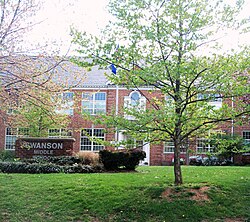
Originally serving grades 7 through 9, the school now serves students in grades 6 through 8. The building has expanded significantly since its inception on the former A. Duke Torreyson family farm. A large addition was added to the north side in 1955, and between 1963 and 1968, the original central courtyard was filled in to accommodate a library, gymnasium, mechanical rooms, and additional classrooms.
A History of Desegregation
Swanson Middle School was at the center of a significant racial desegregation struggle in 1958. Under a court order, the school was required to admit an African American student, who was one of seven plaintiffs seeking entry into white schools. The move was met with fierce resistance; state officials even threatened to shut the school down to prevent integration. Ultimately, integration did not occur at Swanson in 1958; instead, several African American students were admitted to Stratford Junior High School in 1959.
Key Facts
- Cardinal Elementary opened in 2021 with an enrollment of 683 students.
- The Reed School project in 2008 cost $21.6 million and preserved the 1938 building shell.
- Swanson Middle School is the oldest operating junior high in Arlington and part of the Arlington Historic District.
- The original cost to build Swanson Middle School in 1939 was $200,941.
- The Reed site transitioned from an elementary school (1938-1984) to a library/pre-school (2009) and back to an elementary school (2021).
| Feature | Reed / Cardinal Building | Swanson Middle School |
|---|---|---|
| Year Built | 1938 | 1939 |
| Current Primary Use | Elementary School & Library | Middle School (Grades 6-8) |
| Original Contractor | T. Calvin Owens | E. A. Pessagnolo |
| Notable Status | Adaptive Reuse Project | Arlington Historic District |
Frequently Asked Questions
Why was the original Reed School closed in 1984?
The school was closed due to declining enrollment and severe building deterioration, including the presence of asbestos and lead paint, mold, humidity issues, and a lack of wheelchair accessibility.
How did Cardinal Elementary School get its name?
The school was named "Cardinal" to make students transferring from McKinley Elementary feel more welcome, as the cardinal was the mascot for McKinley.
What is the current role of the Reed building?
The 61,000-square-foot facility now houses Cardinal Elementary School and the Westover Branch Library.
What is the historical significance of Swanson Middle School?
Beyond being the oldest operating junior high in Arlington and a member of the Arlington Historic District, it was a focal point of racial desegregation controversies in the late 1950s.
Which schools provided students for Cardinal Elementary?
Cardinal Elementary absorbed most of the students from McKinley Elementary and some students from the overcrowded Tuckahoe Elementary.