
William Ballard Preston: A Legacy of Law and Naval Leadership
William Ballard Preston was a pivotal figure in 19th-century American law and politics, serving in capacities that spanned from the local courts of Virginia to the highest levels of the United States federal government. His career reflects the turbulent transition of a nation expanding its global reach while grappling with deep internal divisions.
Early Life and Legal Foundations
Born in 1805 at Smithfield Plantation in Blacksburg, Virginia, Preston demonstrated an early aptitude for intellectual and forensic pursuits. He entered Hampden–Sydney College in 1821, where he became active in literary and forensic activities before graduating in 1824. To further his professional training, he studied law at the University of Virginia and was admitted to the bar in 1826.
Preston's early professional life was rooted in public service. In 1831, he served as the Commonwealth's Attorney for Floyd County, Virginia. During this period, he also married Lucinda Redd of Henry County, Virginia.
Political Ascent and the Whig Party
Preston entered the political arena as a member of the Whig Party, a political coalition known for opposing the policies of Andrew Jackson. He was elected to the Virginia House of Delegates in 1830, where he notably participated in campaigns to abolish slavery during the 1831–1832 session.
Following an eight-year hiatus dedicated to his private law practice, Preston returned to public office. He served in the State Senate from 1840 to 1844 and later returned to the House of Delegates. His political trajectory culminated in 1846 when he was elected to the United States House of Representatives.
Secretary of the Navy and Global Expansion
In March 1849, President Zachary Taylor appointed Preston as the Secretary of the Navy. His tenure coincided with a period of rapid American westward expansion and the acquisition of California, which necessitated new duties for the U.S. Navy.
Under Preston's leadership, the Navy expanded its presence in the Pacific Ocean, sailing into Chinese waters and eyeing the commercial possibilities of Japan, which was then closed to Western influence. Beyond diplomacy, Preston oversaw a critical technological transition as the Navy moved from traditional sail power to steam propulsion and implemented improvements in naval ordnance and gunnery.
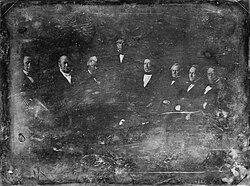
Preston's time in the Cabinet ended following the death of President Taylor. The succeeding president, Millard Fillmore, reorganized the Cabinet and appointed William Alexander Graham as the new Secretary of the Navy, leading Preston to withdraw from public life.
Diplomacy and the Path to Secession
Returning to his law practice, Preston earned a reputation as a skilled defense attorney. In 1858, he was dispatched to France to negotiate the establishment of a commercial steamer line between Le Havre and Norfolk. While the mission showed promise, the project was ultimately derailed by the onset of the American Civil War.
As tensions rose in the lower South, Preston initially aligned with moderate sentiments. However, by early 1861, he became a delegate to the secession convention in Richmond. On April 12, 1861, Preston was part of a special delegation that met with President Abraham Lincoln in Washington, D.C. When Lincoln remained firm on holding Federal forts in the South, Preston and his colleagues returned to Richmond.
Following the firing on Fort Sumter, the influence of moderates waned. On April 16, 1861, Preston submitted the Preston Resolution in a secret session. The ordinance of secession passed with a vote of 88 to 55, officially removing Virginia from the Union.
Final Years and Legacy
Preston was elected as a Senator from Virginia to the Confederate States Congress. He served in this legislative body until his death in 1862 at Smithfield Plantation. He is buried at the Preston Cemetery in Blacksburg, Virginia.
Key Facts
- Birth: 1805, Smithfield Plantation, Blacksburg, Virginia.
- Education: Hampden–Sydney College (1824) and University of Virginia (Law).
- Cabinet Role: Secretary of the Navy under President Zachary Taylor (1849).
- Naval Legacy: Managed the transition from sail to steam propulsion and expanded Pacific trade.
- Civil War Role: Authored the Preston Resolution, which led to Virginia's secession.
- Final Office: Senator in the Confederate States Congress.
| Period | Role/Position | Key Contribution/Event |
|---|---|---|
| 1830–1832 | Virginia House of Delegates | Campaign to abolish slavery |
| 1840–1844 | Virginia State Senate | State-level legislative service |
| 1846 | U.S. House of Representatives | Federal legislative service |
| 1849 | Secretary of the Navy | Steam propulsion transition and Pacific expansion |
| 1858 | Diplomatic Envoy to France | Negotiated Le Havre-Norfolk steamer line |
| 1861–1862 | C.S. Senator from Virginia | Authored the ordinance of secession |
Frequently Asked Questions
What was the Preston Resolution?
The Preston Resolution was an ordinance of secession submitted by William B. Preston during a secret session of the Virginia secession convention on April 16, 1861. It passed 88 to 55, resulting in Virginia leaving the Union.
How did Preston influence the U.S. Navy?
As Secretary of the Navy, Preston guided the fleet through a technological shift from sail to steam propulsion and improved naval ordnance. He also expanded U.S. naval presence in Chinese and Japanese waters to facilitate trade.
Did William Ballard Preston always support secession?
No. Preston was initially associated with moderate sentiments through 1860. He only moved toward secession after a failed diplomatic attempt to resolve tensions with President Abraham Lincoln in April 1861.
Where was William Ballard Preston educated?
Preston attended Hampden–Sydney College, graduating in 1824, and subsequently studied law at the University of Virginia, where he was admitted to the bar in 1826.
What was Preston's role in international diplomacy?
In 1858, Preston was sent to France to negotiate the establishment of a commercial steamer line between Le Havre and Norfolk, though the American Civil War eventually stopped the project.