
William Hendricks: The Political Architect of Early Indiana
William Hendricks was a pivotal figure in the early governance of Indiana, transitioning from a territorial clerk to the state's governor and eventually a United States Senator. His career was defined by a commitment to anti-slavery principles, the establishment of critical infrastructure, and the formalization of the state's legal and educational foundations.
Key Facts
- Unanimous Election: The only Indiana governor to win 100% of the vote (18,340 votes in 1822).
- Legal Milestone: Oversaw the first execution of a white man for killing a Native American in U.S. history.
- Legislative Legacy: Codified the state's laws for the first time, creating the Indiana Code in 1822.
- Educational Pioneer: Helped establish the first state-funded school system in the nation.
- Capital Transition: Signed the measure to move the state capital from Corydon to Indianapolis.
Rise Through the Territorial Legislature
Hendricks began his public service in February 1813 as the clerk of the territorial legislature in Vincennes. Following the outbreak of the War of 1812, the capital shifted to Corydon. During this reorganization, the legislature—dominated by a pro-statehood and anti-slavery faction—appointed Hendricks as the official printer responsible for publishing assembly records.
By 1814, Hendricks had transitioned into a representative for Jefferson County (with Madison as the county seat). His alignment with Speaker Dennis Pennington and the anti-slavery movement propelled him to become the speaker of the legislative assembly that same year. While expanding his influence, he opened a law practice and served as a prosecutor for several eastern counties, as well as the U.S. Attorney for the entire territory, an appointment made by President James Madison.
In 1816, Hendricks served as the secretary of the state Constitutional Convention in Corydon. Working alongside Jonathan Jennings and Dennis Pennington, he advocated for a constitutional ban on slavery, a move that solidified his reputation for political skill and business aptitude.
Congressional Service and Infrastructure
When Jonathan Jennings was elected governor in 1816, Hendricks stepped into the vacant congressional seat for Indiana's at-large district. Despite a brief debate regarding the legality of his seating due to the timing of Indiana's statehood approval, he served in the U.S. House of Representatives from December 11, 1816, until July 25, 1822.
During his tenure, Hendricks focused heavily on internal improvements—the development of transportation infrastructure. As a member of the Select Committee on Roads and Canals, he championed the funding of the National Road to link Indiana with eastern states. He also advocated for the rapid granting of statehood to Missouri and Illinois.
The Governorship of William Hendricks
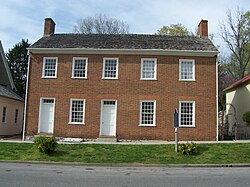
In 1822, Hendricks ran unopposed for Governor, securing every single one of the 18,340 votes cast. He assumed office on December 5, 1822, and became the final governor to serve while the capital was located in Corydon.
Economic Recovery and Education
Hendricks inherited a state in financial distress following the Panic of 1819, which had caused bank failures and depreciated state bonds. To resolve the deficit, he sold public lands to pay off debts and moved government accounts to the Second Bank of the United States.
His administration laid the groundwork for the nation's first state-funded school system by granting land to each township for public schools, an investment exceeding $1.25 million. He also oversaw the start of construction for the State Seminary, which later became Indiana University, and personally contributed to Hanover College.
Law, Order, and the Capital Move
In 1822, Hendricks created the Indiana Code, the first codification of the state's laws. He also demonstrated a firm commitment to justice in 1824 following the murder of a Seneca family. By ensuring the execution of the perpetrators, Hendricks marked the first time in U.S. history that a white man was executed for killing a Native American, a move intended to maintain peace and show goodwill to indigenous tribes.
One of his most consequential final acts was signing the 1824 measure to move the capital to Indianapolis. This was a controversial decision, as Indianapolis was then a frontier settlement 60 miles north of the nearest town, far from the majority of the state's population in the south.
Later Career in the U.S. Senate
Hendricks resigned as governor on February 14, 1825, to enter the U.S. Senate. As an Anti-Jacksonian, he continued his push for federal funding for western improvements, specifically the Wabash and Erie Canal. He chaired the committee on roads and canals from 1831 to 1837.
Notably, in 1834, Hendricks was one of only two Anti-Jacksonian senators to vote against the censure of President Andrew Jackson. He served in the Senate until March 3, 1837, and remained a trustee on the Indiana University Board until 1840.
| Role | Period | Key Achievement/Focus |
|---|---|---|
| Territorial Legislator/Speaker | 1813–1816 | Anti-slavery advocacy; Territorial Printer |
| U.S. Representative | 1816–1822 | National Road funding; Statehood for MO and IL |
| Governor of Indiana | 1822–1825 | Indiana Code; First state-funded school system |
| U.S. Senator | 1825–1837 | Wabash and Erie Canal funding |
Frequently Asked Questions
How did William Hendricks achieve a 100% vote margin as governor?
Hendricks ran unopposed in the 1822 election, resulting in him receiving all 18,340 votes cast, a unique feat in Indiana's gubernatorial history.
What was the significance of the Indiana Code of 1822?
The Indiana Code represented the first time the state's laws were formally codified, providing a structured and written legal framework for the young state.
How did Hendricks handle the financial crisis of the early 1820s?
He addressed the deficit caused by the Panic of 1819 by selling public lands to pay off outstanding debts and utilizing the Second Bank of the United States for government accounts.
Why was the move to Indianapolis controversial?
The move was contested because most of Indiana's population lived in the south, whereas Indianapolis was located on the frontier, roughly 60 miles from the nearest settlement.
What was Hendricks' role in early Indiana education?
He established the first state-funded school system in the U.S. by granting land to townships for schools and initiated the construction of the State Seminary (now Indiana University).