
Willibald Pirckheimer: The Humanist Scholar and Patron of Dürer
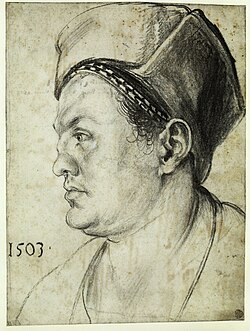
Willibald Pirckheimer was a central figure of the German Renaissance, embodying the ideal of the humanist—an intellectual movement focused on the study of classical Greek and Roman literature, ethics, and art. Born in Eichstätt to Dr. Johannes Pirckheimer, a lawyer, Willibald spent seven years in Italy studying law at the universities of Padua and Pavia. This rigorous education provided him with the linguistic and philosophical foundation that would later influence some of the most important art and science of his era.
Key Facts
- Education: Studied law for seven years in Padua and Pavia, Italy.
- Intellectual Circle: Member of the Nuremberg humanists alongside Conrad Celtis and Hartmann Schedel.
- Artistic Influence: Close friend and intellectual mentor to the artist Albrecht Dürer.
- Military Service: Commanded Nuremberg troops during the Swabian War in 1499.
- Scientific Patronage: Supported the astronomer and meteorologist Johannes Werner.
- Legacy: His portrait appeared on the 100 Billion Mark note of the Weimar Republic.
Intellectual Contributions and Humanism
Pirckheimer was a prominent member of a circle of Nuremberg humanists, which included Sebald Schreyer and Hartmann Schedel, the author of the Nuremberg Chronicle. His expertise was so highly regarded that he served as a literary consultant to the Holy Roman Emperor Maximilian I.
A prolific translator, Pirckheimer worked on bringing classical texts into German and Greek texts into Latin. He championed a translation philosophy known as translating "by the sense," which prioritized the overall meaning and spirit of a text over a strict, word-for-word literal translation. In 1525, he edited and published an edition of Ptolemy's Geographia, a foundational work of geography.
The Partnership with Albrecht Dürer
One of the most significant relationships in Pirckheimer's life began around 1495 when he met the artist Albrecht Dürer. Because Dürer lacked a formal classical education, Pirckheimer served as an intellectual guide. It is widely believed that the classical and humanist themes found in Dürer's prints, most notably in Melencolia I, were the result of their deep discussions.
Their bond was one of genuine friendship and mutual support. Pirckheimer provided the financial means for Dürer's second trip to Italy in 1506/07. The closeness of their relationship is preserved in ten letters sent by Dürer from Italy, which are characterized by a tone of affectionate teasing.
Military Service and Public Life
Beyond his scholarly pursuits, Pirckheimer was active in the civic and military affairs of Nuremberg. In 1499, the City Council appointed him to command the city's contingent of troops within the Imperial army during the Swabian War against the Swiss. Upon his successful return, the city honored him with a gold cup, an object that may be referenced in Dürer's 1502 engraving, Nemesis.
Patronage of Science
Pirckheimer's influence extended into the early sciences through his patronage of Johannes Werner, an astronomer and meteorologist. Together with Sebald Schreyer, Pirckheimer provided the necessary support for Werner to develop scientific instruments and conduct systematic experiments. These efforts focused on measuring distances and locations, as well as studying meteorology and the earth's magnetism.
The Legacy of the Pirckheimer Library
Pirckheimer's personal library was legendary during his lifetime. Following the death of Dürer's last immediate family member in 1560, Pirckheimer's grandson, Willibald Imhoff, acquired Dürer's remaining papers and collections. However, the Pirckheimer library itself was eventually sold by another Imhoff descendant to the Earl of Arundel in 1636.
In 1678, much of the Arundel library was gifted to the Royal Society. While 85 of Pirckheimer's books have been identified as remaining there, many others were sold off in 1873 to Bernard Quaritch and later through Sotheby's in 1925.
| Category | Details |
|---|---|
| Education | Law studies in Padua and Pavia, Italy |
| Key Collaborator | Albrecht Dürer (Artist) |
| Key Protégé | Johannes Werner (Astronomer) |
| Major Publication | Ptolemy's Geographia (1525) |
| Military Role | Commander in the Swabian War (1499) |
| Final Resting Place | Johannisfriedhof cemetery, Nuremberg |
Frequently Asked Questions
How did Willibald Pirckheimer influence Albrecht Dürer?
Pirckheimer provided the classical and humanist knowledge that Dürer lacked due to his education. This intellectual partnership is evident in the complex themes of Dürer's prints, such as Melencolia I, and was supported by a close friendship and financial assistance for Dürer's travels.
What was Pirckheimer's approach to translation?
He believed in translating "by the sense," meaning he focused on conveying the intended meaning and essence of the original text rather than adhering to a strict, literal word-for-word translation.
What was Pirckheimer's role in the Swabian War?
In 1499, he was chosen by the Nuremberg City Council to command the city's troops within the Imperial army during the conflict against the Swiss.
What happened to Pirckheimer's famous library?
The library was sold to the Earl of Arundel in 1636, and a large portion was given to the Royal Society in 1678. Over time, many volumes were sold to private collectors and auction houses, though some remain at the Royal Society.
Who was Johannes Werner and why was Pirckheimer's support important?
Johannes Werner was an astronomer and meteorologist. Pirckheimer, along with Sebald Schreyer, provided the financial and social support Werner needed to build instruments and conduct systematic research on magnetism, meteorology, and geographic measurement.