
Wilmès II Government: Belgium's Historic Caretaker Administration
The Wilmès II Government represents a unique chapter in Belgian political history. Serving as the 97th Cabinet of Belgium since the nation's founding in 1830, this administration was characterized by its role as a caretaker minority coalition tasked with steering the country through an unprecedented global crisis.
Led by Sophie Wilmès, the administration marked a significant milestone as she became the first female prime minister in the history of Belgium. The government operated during a period of intense political transition following the 2019 Belgian federal election, bridging the gap between previous administrations and the eventual formation of a stable government.
Key Facts
- Prime Minister: Sophie Wilmès (First female PM of Belgium).
- Duration: 17 March 2020 to 1 October 2020.
- Status: Caretaker minority coalition with emergency plenary powers.
- Composition: 12 ministers from MR, CD&V, and Open Vld.
- Primary Mandate: Managing the coronavirus outbreak and overseeing government formation.
From Wilmès I to Wilmès II
To understand the Wilmès II Government, one must look at its predecessor. Following the 2019 federal elections, Sophie Wilmès was selected as a caretaker prime minister, heading the Wilmès I Government starting on 27 October 2019. This initial administration maintained the same party composition as the preceding Michel II Government.
The transition to the Wilmès II Government occurred on 17 March 2020. This shift was not a standard change in leadership but a strategic adjustment to grant the executive branch the authority necessary to handle the escalating health crisis.
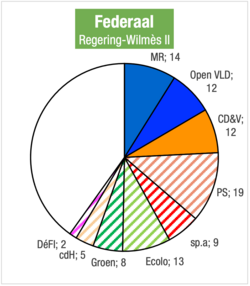
Emergency Plenary Powers and the Pandemic
The defining feature of the Wilmès II Government was the granting of plenary powers—special emergency authorities that allow the government to take decisive action without the standard lengthy legislative process. These powers were essential for coordinating the national response to the coronavirus outbreak.
In a rare show of cross-party cooperation, several opposition parties—including sp.a, PS, Groen, Ecolo, cdH, and DéFI—agreed to grant these powers to Wilmès. Initially granted for a three-month period, the mandate was extended twice: first until mid-September 2020, and finally until 1 October 2020.
Government Composition and Support
The government consisted of 12 ministers representing three primary parties: the Francophone MR, and the Flemish parties CD&V and Open Vld. While it remained a minority coalition, the support from opposition parties regarding emergency powers allowed the administration to function effectively during the crisis.
| Category | Details |
|---|---|
| Head of State | Philippe of Belgium |
| Head of Government | Sophie Wilmès |
| Member Parties | MR, CD&V, Open Vld |
| Opposition Parties | Groen, sp.a, N-VA, VB, cdH, DéFI, Ecolo, PS, PVDA-PTB |
| Predecessor | Wilmès I |
| Successor | De Croo |
Conclusion and Transition
The Wilmès II Government served its purpose as a stabilizing force during a time of national emergency. Its tenure concluded on 1 October 2020, coinciding with the completion of the 2019–20 Belgian government formation process. At this point, the administration was officially replaced by the De Croo Government, returning the country to a standard legislative structure.
Frequently Asked Questions
Who was the leader of the Wilmès II Government?
The government was led by Sophie Wilmès, who made history as the first woman to serve as the Prime Minister of Belgium.
What were plenary powers in the context of this government?
Plenary powers were emergency authorities granted to Prime Minister Wilmès by opposition parties, allowing the government to act quickly and decisively to manage the coronavirus outbreak.
Which parties were part of the Wilmès II coalition?
The coalition included the MR (Francophone), as well as the CD&V and Open Vld (Flemish) parties.
How long did the Wilmès II Government last?
The government was formed on 17 March 2020 and was dissolved on 1 October 2020.
What government succeeded the Wilmès II administration?
The Wilmès II Government was succeeded by the De Croo Government following the conclusion of the government formation process.