
Wire Forms: Comparing Solid, Stranded, and Braided Conductors
Selecting the right type of electrical wire is critical for the performance and longevity of any electronic system. While all wires serve the primary purpose of conducting electricity, the physical structure of the conductor—whether it is a single solid piece or a bundle of smaller strands—drastically changes its mechanical properties and electrical behavior. Choosing between solid, stranded, and braided forms depends on the specific needs for flexibility, durability, and environmental resistance.
Solid Wire
Solid wire, also known as solid-core or single-strand wire, consists of one continuous piece of metal. Because of its simple construction, it is generally cheaper to manufacture than its stranded counterparts.
This form is ideal for applications where flexibility is not required, such as wiring breadboards. Beyond cost, solid wire offers superior mechanical ruggedness and better protection against the environment; because it has less surface area exposed to the air, it is less susceptible to attack by corrosives.
Stranded Wire
Stranded wire is composed of multiple small wires bundled or wrapped together to form a single larger conductor. The primary advantage of this design is flexibility. When compared to a solid wire of the same total cross-sectional area, stranded wire is far more resistant to metal fatigue—the weakening of metal caused by repeated bending.
This makes stranded wire essential for components that move or undergo stress during assembly and servicing, including:
- A.C. line cords for household appliances
- Computer mouse and musical instrument cables
- Control cables for moving machine parts
- Welding electrode and mining machine cables
- Connections between circuit boards in multi-PCB devices
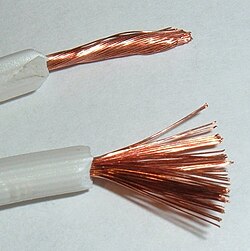
Electrical Considerations and the Skin Effect
At high frequencies, electricity experiences the skin effect, where current tends to travel near the surface of the conductor, increasing power loss. While stranded wire has a larger total surface area, ordinary stranded wire does not reduce this effect because the strands are short-circuited together and act as a single conductor.
Furthermore, stranded wire has higher electrical resistance than a solid wire of the same diameter. This is due to the "circle packing problem," where unavoidable gaps between the circular strands mean the total cross-section is not entirely copper. To achieve the same equivalent gauge (the same amount of conductor material) as a solid wire, a stranded wire must have a larger overall diameter.
In some high-frequency cases, simple stranded wire can reduce the proximity effect (the interaction of magnetic fields between nearby conductors), which can be more severe than the skin effect. For maximum performance at high frequencies, litz wire is used, featuring individually insulated strands twisted in specialized patterns.
Strand Counts and Flexibility
The flexibility, strength, and resistance to kinking increase as the number of strands increases. However, higher strand counts also increase manufacturing costs. Common strand configurations include:
- 7 strands: One center strand surrounded by six. Suitable only for stationary applications.
- 19 strands: A second layer of 12 strands added to the base 7. The minimum recommended for wires that move.
- 37 to 49 strands: Common mid-range counts; 49 is significantly better for movement.
- 70 to 100 strands: Mandatory for constant repeated movement, such as headphone wires or assembly robots.
Extreme flexibility is achieved in specialized cables, such as welding cables. For example, a 2/0 wire may consist of 5,292 strands of No. 36 gauge wire. These are organized into bundles of 7, then "super bundles" of 7, and finally 108 super bundles. Each group is wound in a helix, allowing stretched parts of the bundle to move into compressed areas during flexing, thereby reducing stress.
Prefused Wire
Prefused wire is a hybrid option. It consists of stranded wire where the strands are heavily tinned and then fused together. This provides many of the mechanical benefits of solid wire while remaining less likely to break.
Braided Wire
Braided wire consists of small strands woven together. This structure ensures the wire does not break easily when flexed. Due to its construction, braided wire is frequently used as an electromagnetic shield in noise-reduction cables to protect signals from interference.
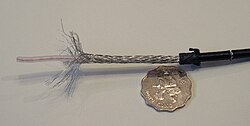
Key Facts
- Solid wire is cheaper, more rugged, and more corrosion-resistant but lacks flexibility.
- Stranded wire prevents metal fatigue and is essential for cables subject to movement.
- Equivalent gauge means a stranded wire must be physically thicker than a solid wire to provide the same amount of conductive metal.
- Litz wire uses insulated strands to combat high-frequency power loss.
- Braided wire is ideal for flexibility and electromagnetic shielding.
- Strand count directly correlates to flexibility: 7 for stationary, 19+ for movement, and 70-100 for constant motion.
Comparison Summary
| Feature | Solid Wire | Stranded Wire | Braided Wire |
|---|---|---|---|
| Flexibility | Low | High | Very High |
| Cost | Lowest | Higher | Variable |
| Durability (Bending) | Poor (Prone to fatigue) | Excellent | Excellent |
| Corrosion Resistance | High (Less surface area) | Lower | Lower |
| Primary Use Case | Breadboards, fixed wiring | Power cords, robotics | Shielding, flexible links |
Frequently Asked Questions
Why is stranded wire thicker than solid wire of the same gauge?
Stranded wire is thicker because of the gaps between the individual circular strands. Since the wire is not a solid block of metal, a larger overall diameter is required to match the total cross-sectional area of copper found in a solid wire.
Does stranded wire reduce the skin effect?
Generally, no. Because the strands in ordinary stranded wire are short-circuited together, they behave as a single conductor. To actually reduce the skin effect at high frequencies, litz wire—which uses insulated strands—is required.
How many strands are needed for a wire that moves constantly?
For applications involving constant repeated movement, such as assembly robots or headphone cables, a strand count between 70 and 100 is mandatory to prevent breakage and fatigue.
What is the difference between stranded and braided wire?
While both use multiple strands, braided wire is woven together. This makes it particularly resistant to breaking when flexed and highly effective as an electromagnetic shield for noise reduction.
What is prefused wire?
Prefused wire is stranded wire that has been heavily tinned and then fused together. It combines the stability of solid wire with the increased break-resistance of stranded wire.