
Wislicenus Crater Layers and the Search for Water on Mars
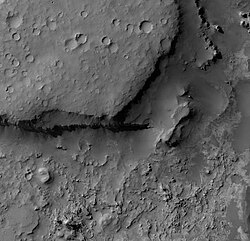
The Martian landscape is a vast archive of the planet's geological history, and few features are as telling as the strata—or layers—found within its craters. In the Wislicenus crater, these visible layers provide critical clues about the environmental conditions that existed millions of years ago, offering a window into the planet's volatile past.
These layers are not uniform; they vary in color, composition, and durability. By analyzing these differences, scientists can reconstruct the processes that shaped the Martian surface, from volcanic eruptions to the flow of ancient liquids.
The Composition of Martian Strata
Observations from orbiting spacecraft and surface rovers, such as Opportunity, reveal that the layers in Wislicenus and similar regions are composed of diverse materials. Some layers consist of fine particles that easily break down into dust, while others are composed of hard, durable rock that fractures into large boulders.
Volcanic and Mineral Components
Many of the harder layers are believed to be basalt, a common volcanic rock found across Mars. In contrast, light-toned rocks often indicate the presence of hydrated minerals—minerals that contain water within their molecular structure.
- Sulfates: Often associated with light-toned rock layers.
- Phyllosilicates: Also known as clays, these have been detected in various layers by orbiting instruments.
The Significance of Hydrated Minerals
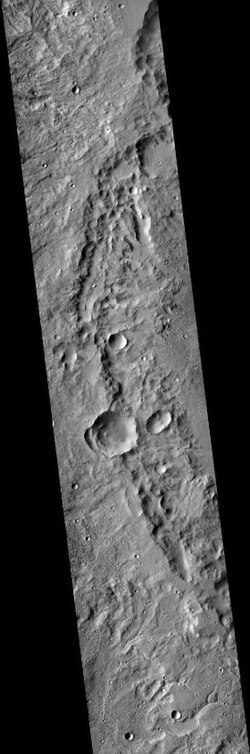
The discovery of sulfates and phyllosilicates is particularly significant because these minerals typically form in the presence of water. While layers can be created by wind or volcanic activity, the specific mineralogy found in Wislicenus crater strongly suggests that water played a primary role in its formation.
Scientists hypothesize that Wislicenus, like many other Martian craters, may have once hosted a lake. Because hydrated minerals are key indicators of past aqueous environments, these areas are prioritized as prime locations to search for evidence of ancient life.
Key Facts
- Wislicenus crater contains distinct geological layers known as strata.
- Harder layers that form boulders are likely composed of basalt, a volcanic rock.
- Light-toned layers are often linked to hydrated minerals like sulfates.
- Orbiting spacecraft have identified phyllosilicates (clays) within the layers.
- The presence of these minerals suggests the crater may have once contained a lake.
| Layer Type | Physical Property | Likely Composition | Formation Driver |
|---|---|---|---|
| Hard/Bouldery | Durable | Basalt | Volcanic Activity |
| Light-Toned | Variable | Sulfates | Water |
| Fine-Grained | Dusty | Clays (Phyllosilicates) | Water/Sedimentation |
Frequently Asked Questions
What are strata in the context of Mars?
Strata are layers of rock or sediment that have accumulated over time. In craters like Wislicenus, these layers reveal the history of the materials deposited there.
Why is basalt important to Martian geology?
Basalt is a volcanic rock that has been identified in many locations on Mars, indicating a history of volcanic activity that contributed to the planet's crust and crater layers.
What are phyllosilicates?
Phyllosilicates are a group of minerals commonly referred to as clays. Their presence is a strong indicator that water was once present in the environment.
How do scientists know water was in Wislicenus crater?
The detection of hydrated minerals, specifically sulfates and clays, provides strong evidence for water, as these minerals generally require water to form.
Why do these layers make Wislicenus a good place to look for life?
Since hydrated minerals suggest the past existence of water—perhaps in the form of a lake—these areas are the most likely candidates for preserving evidence of ancient biological activity.