
Women's Voluntary Service (WVS) in World War II
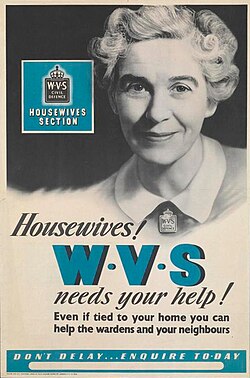
During the turmoil of World War II, the Women's Voluntary Service (WVS) emerged as a cornerstone of British civilian resilience. From the chaotic early days of evacuation to the terrifying nights of the Blitz, these women provided the essential logistics, nourishment, and emotional support required to keep the home front functioning. Their contributions spanned from local community kitchens to international support missions, proving that organized voluntary action was as vital as military strategy.
Key Facts
- Mass Evacuation: Helped move 1.5 million people, primarily children, out of cities in September 1939.
- Blitz Support: Assisted over 10,000 people every single night during the bombing of British cities.
- Scale of Operation: Membership grew to one million women by 1941.
- Sacrifice: 241 WVS members were killed and 25 offices were destroyed during the Blitz.
- Global Reach: Established sister organizations in India, the US, Canada, and Australia.
Civilian Evacuation and Essential Supplies
Under the leadership of National Administrator Kathleen Halpin, the WVS was tasked with the monumental challenge of civilian evacuation. Their primary role was to identify safe areas and arrange billeting (the provision of temporary lodging) for children fleeing urban centers. While moving children out of cities was straightforward, the logistics of arrival were often chaotic, with trains arriving at unexpected destinations or reception points without warning.
Beyond housing, the WVS managed the distribution of critical resources. In October 1939, a broadcast by Lady Reading to the United States sparked a massive donation drive known as "Bundles for Britain." These clothing donations, sent via the American Red Cross, were managed and distributed through WVS Emergency Clothing Stores to help those most in need.
The organization also provided immediate relief to soldiers. Following the evacuation at Dunkirk, WVS members greeted returning troops at ports with food, drink, and warm clothing. In Headcorn, Kent, the WVS railway station base became a hub for feeding soldiers, even installing a spit to roast meat on-site.
The WVS During the Blitz
As the Luftwaffe began the Blitz, the WVS transitioned into a high-risk emergency service. While Air Raid Precautions (ARP) wardens and firemen battled blazes, WVS members operated mobile canteens, delivering food and drink to first responders. This work was perilous, as they operated amidst collapsing buildings and active bombing raids.
The aftermath of each raid required immense coordination. The WVS managed rest centers that provided shelter, sanitation, and food for the displaced. In Barnes, the scale of the crisis was highlighted when a single WVS member used her own kitchen to feed 1,200 bomb victims in one day. During the 57 nights of the London Blitz, the WVS routinely helped over 10,000 people nightly.
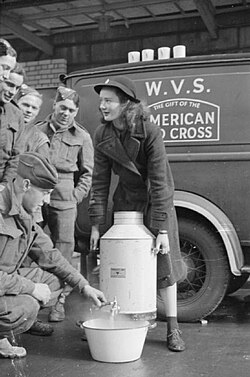
This bravery came at a high cost. The proximity to bombing targets led to the deaths of 241 members and the destruction of 25 WVS offices.
Expanding Roles and National Effort
To streamline emergency responses, the WVS established Incident Inquiry Points (IIPs). These were dedicated locations where civilians could seek information about loved ones in bombed areas, which freed ARP wardens to focus on firefighting efforts. They also supported the Queen's Messenger Food Convoys; for example, following the bombing of Coventry, these convoys served 14,000 meals.
As the war progressed, the WVS shifted focus toward the Battle of the Atlantic. To combat shortages caused by U-boat attacks on merchant ships, the WVS educated the public on waste reduction and material collection. Each center appointed a Salvage Officer and a Food Leader to assist the government with the complexities of food rationing through lectures and pamphlets. They also spearheaded patriotic campaigns such as Warship Week, Wings for Victory Week, and Salute the Soldier Week.
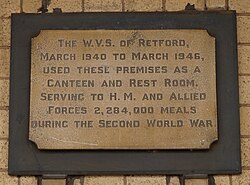
The impact of these local efforts is still remembered today. In Retford, Nottinghamshire, a plaque commemorates the WVS's work at the local railway junction, where they served approximately 2.3 million meals to British and Allied forces between 1940 and 1946—averaging over 1,000 meals per day.
D-Day and International Expansion
The catering and logistical expertise honed during the Blitz proved invaluable during the buildup to D-Day and the subsequent V-1 and V-2 rocket attacks on London. Following the success of the Normandy landings, the WVS expanded its operations into Europe to support troops, having already established a presence in Italy.
The WVS model was adopted globally. With British assistance, similar organizations were formed in Canada and Australia. In the US, Alice Throckmorton McLean—who had observed the WVS in Northampton, England—founded the American Women's Voluntary Services. The most significant overseas expansion occurred in India in 1942, particularly in Bengal, where membership exceeded 10,000 and continued into the 1950s.
In recognition of their bravery and service, WVS members were eligible for the Defence Medal, the campaign medal for home defence, placing them on the same status as professional emergency services.
| Area of Service | Key Achievement/Statistic | Impact |
|---|---|---|
| Evacuation | 1.5 million people moved | Cleared urban areas of civilians/children |
| The Blitz | 10,000+ people helped nightly | Provided food, shelter, and sanitation |
| Logistics | "Bundles for Britain" | Distributed US clothing to the needy |
| Military Support | 2.3 million meals (Retford) | Sustained British and Allied forces |
| Global Reach | 10,000+ members in India | Exported the voluntary service model |
Frequently Asked Questions
What was the primary role of the WVS during the early stages of the war?
The WVS was primarily responsible for the evacuation of civilians from cities, specifically identifying safe areas and arranging billeting for children, as well as managing the distribution of clothing from the "Bundles for Britain" campaign.
How did the WVS support first responders during the Blitz?
They operated mobile canteens to provide food and drink to ARP wardens and firemen, often working in dangerous areas where buildings were at risk of collapsing.
What were Incident Inquiry Points (IIPs)?
IIPs were centers established by the WVS where people could find information about loved ones in bombed areas, which allowed the ARP to focus exclusively on firefighting and emergency rescue.
Did the WVS operate outside of the United Kingdom?
Yes. The WVS supported troops in Italy and Europe. Furthermore, the WVS model inspired the creation of similar organizations in the United States, Canada, Australia, and India.
Were WVS members officially recognized for their service?
Yes, WVS members were eligible for the Defence Medal, the same campaign medal awarded to members of the emergency services for their role in home defence.